Beginner’s guide · Write & create
Write what the audience can see.
Build one scene around a change.
Start with a three-to-five-page scene: one character wants something, another force resists, and the situation is different by the end. Free screenplay software handles layout; reading produced scripts teaches more than decorating an idea with jargon.
Quick answer
Give the scene an objective, pressure and a turn
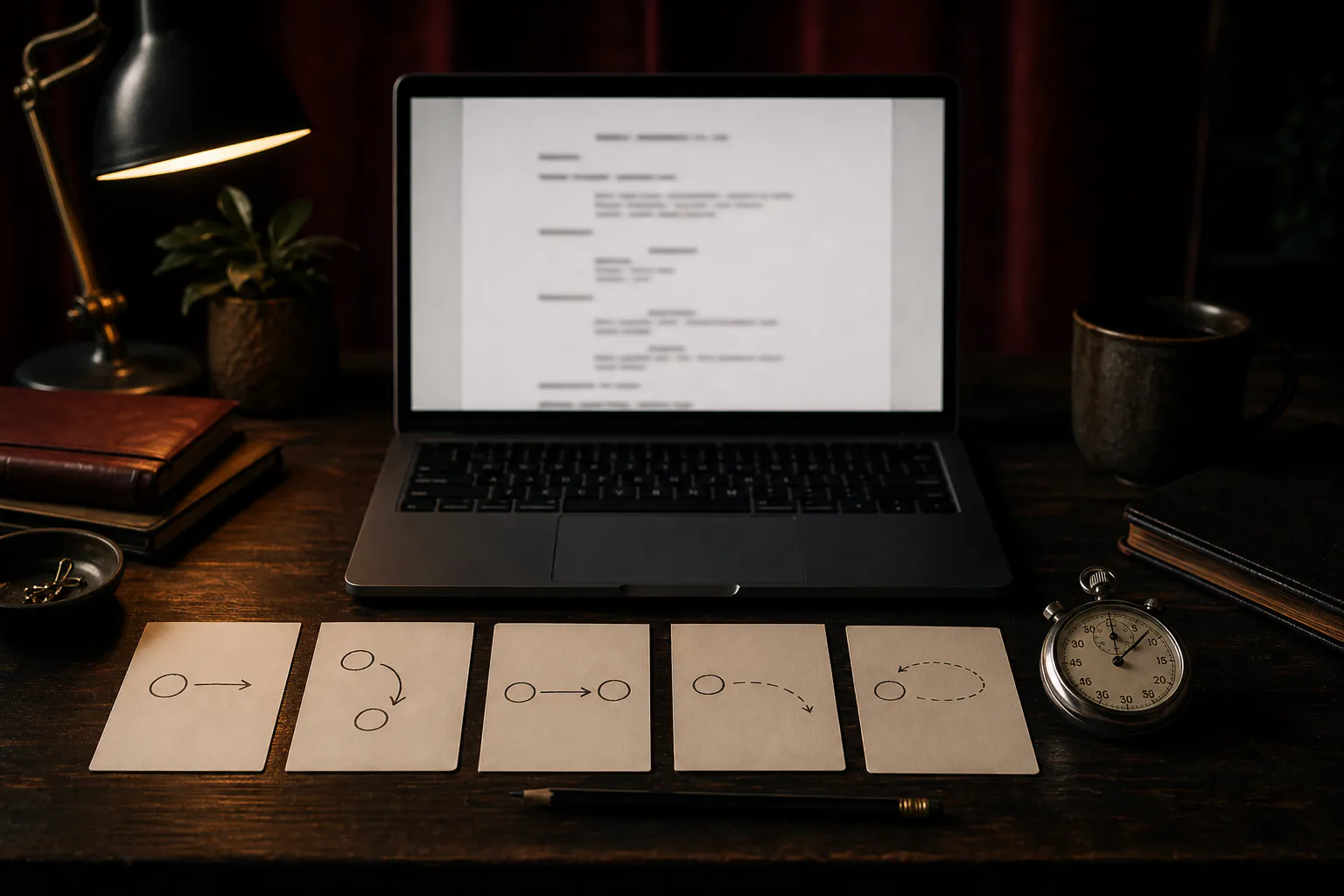
Choose two characters, one location and a situation that can be filmed. Give the viewpoint character an immediate objective, make the other character or circumstance resist it and end on a decision, discovery or reversal. Use screenplay software for scene headings, action and dialogue so attention stays on behaviour rather than manual margins.
- 01
Write present-tense action the audience can see or hear. Internal history belongs only where behaviour, dialogue or image reveals it.
- 02
A scene heading establishes interior or exterior, location and broad time. It is a production signpost, not atmospheric prose.
- 03
Dialogue earns its place when characters pursue something, conceal something or alter the relationship—not when they explain the writer’s notes.
- 04
Read the draft aloud and time it. A page guideline is useful, but density, action and performance affect actual duration.
What to expect
Format is learnable; dramatic choice takes revision
Software can place names and margins correctly, but it cannot decide whose scene this is, what matters now or why the ending is different.
Action
Short visual paragraphs are easier to read and imagine than novelistic explanation. Each paragraph should represent a meaningful beat.
Dialogue
Naturalistic does not mean copied conversation. Screen dialogue is compressed around intention, interruption, rhythm and subtext.
Structure
Beat sheets can expose missing cause and effect, but copying a formula mechanically produces tidy pages without necessary choices.
Length
A complete short scene teaches more than twenty opening pages that never turn or resolve.
Feedback
Readers often identify where attention drops more reliably than they prescribe the correct rewrite. Diagnose before accepting a fix.
Industry
A strong sample, professional conduct and persistence matter; no book, contest or course guarantees representation or production.
Scene craft
Put only filmable information on the page
Define the change before writing dialogue
Write one sentence for the opening state and one for the closing state. For example: a tenant enters intending to complain; the landlord leaves believing the tenant knows a secret. The scene must create that change through action, speech and discovery. If nothing changes, combine it with another scene or sharpen the objective.
Use format as shared reading grammar
A standard scene heading names INT. or EXT., the location and DAY or NIGHT. Action is in present tense. A character cue introduces dialogue consistently. Parentheticals should be rare and brief. Free screenwriting software can handle indentation, page breaks and element changes; learn what each element communicates rather than spacing a script by hand.
Write playable behaviour
Replace “she remembers being ignored” with an action an actor can perform or an image the audience can interpret. Keep action paragraphs short and specific. Let props, pauses and interrupted tasks carry information. Avoid directing every expression, camera angle and performance unless the shot or action is essential to understanding the story.
Revise from the scene’s purpose outward
First check objective, resistance and turn. Then remove repeated information, greetings, throat-clearing and dialogue that states what the image already shows. Read roles aloud, mark where intention becomes unclear and produce a clean PDF. Keep old versions so a brave change remains reversible.
Useful products
Two craft lenses and a practical scene-planning tool
Syd Field explains the conventional screenplay framework; Save the Cat offers a widely used beat vocabulary that is best treated as a diagnostic option, not law. The Oxford cards support physical scene ordering for writers who think spatially. Free formatting software and produced scripts should still come first.
Syd Field Screenplay: The Foundations of Screenwriting
It connects scenes and sequences to a complete dramatic movement in plain, established terms.
Blake Snyder Save the Cat! The Last Book on Screenwriting You’ll Ever Need
The named beats make it easy to ask whether pressure and consequence are changing across an outline.
Oxford A6 Ruled Flash Cards, Pack of 80
Physical cards make order, omission and repetition visible without buying specialist planning software.
First scene
Write and revise a three-to-five-page scene
Limit the variables: two speaking characters, one accessible location and one immediate objective with a clear turn.
- 01
State the opening and ending
Write the relationship, knowledge or power state before and after the scene in two plain sentences.
- 02
Choose the objective
Give one character something specific they want before leaving the location.
- 03
Create resistance
Give the other character a competing intention or make the situation obstruct the easy route.
- 04
List five beats
Map approach, resistance, tactic change, decisive information and the final turn.
- 05
Draft visually
Use short present-tense action and let dialogue perform a tactic instead of explaining background.
- 06
Read it aloud
Assign voices if possible and mark lines that are difficult, repetitive or impossible to perform naturally.
- 07
Cut the runway
Remove the earliest exchanges until the scene begins close to the pressure point.
- 08
Export a clean PDF
Check page breaks, element formatting and filename, then ask a reader what changed and where attention slipped.
What can wait
What can wait until one finished scene works
Ambitious formats become easier to judge after the smallest dramatic unit has survived a rewrite.
- 01
A feature screenplay
Ninety pages multiply structural problems. Complete several scenes or a short film before carrying one idea that far.
- 02
Paid software
Formatting is available free. Pay for collaboration, production features or a workflow you have already tested.
- 03
Camera directions
Use a shot only when the audience must receive information in that exact way. Constant direction makes a spec script harder to read.
- 04
A rigid beat count
Beat frameworks can reveal pacing questions; they cannot prove that a character choice is necessary or emotionally credible.
- 05
Contests and coverage
Finish and revise a strong sample first, then research the current reputation, rights terms and reader feedback of any paid service.
Upgrade path
Increase scope after the dramatic unit is stable
Each stage adds another layer of cause, character and practical production thinking.
Single scene
FreeFree editor + produced script
Learn format, objective, resistance and a turn.Short film
Free to about £305–12 pages + table read
Connect scenes and test a complete beginning, middle and end.Series or feature outline
About £7–£30Cards, beat sheet and character arcs
Track cause and effect across a longer structure.Workshop or script reading
About £40–£300+Experienced readers or actors
Hear pacing, performance and clarity problems the page can hide.Professional basics
Keep the sample readable and the claims realistic
Screenwriting advice often turns preferences into rules and career hopes into sales promises. Treat both carefully.
- Read current scripts in the intended medium; film, continuing television, sitcom and audio drama use different conventions.
- Do not submit another writer’s story, protected characters or close imitation as original work; research permissions and underlying rights.
- Back up drafts, keep version dates and strip personal comments or revision marks from a submission PDF.
- Represent cultures, trauma, disability and professional procedures with appropriate research rather than using a screenwriting device as authority.
- Check current submission windows and terms on the organisation’s own site; never pay someone who guarantees access, representation or production.
Outside help
When actors and readers add value
A table read or focused workshop becomes useful once the writer has a complete scene and specific questions about clarity, pace or character intention.
Read produced scripts beside the finished programme and compare what the page includes or leaves out.
Look for written work, feedback and tutor credits rather than promises of industry entry.
Free UK script resources and representative short-course pricing checked 2 August 2026; submission access and tutor involvement vary.
Sources
Where the guidance came from
BBC format material and produced scripts establish readable conventions; craft books and working-writer resources provide contrasting structure lenses.
-
01
BBC Writersroom · Screenplay format
Scene headings, action, character cues, dialogue and page-format examples.
Open source -
02
BBC Writersroom · TV screenplay format
Television-specific formatting examples and guidance for spec scripts.
Open source -
03
BBC Writers · Script library
Produced film, television, radio and stage scripts for page-to-screen comparison.
Open source -
04
ScreenSkills · Screenwriter profile
UK industry context, responsibilities and career realities.
Open source -
05
Amazon UK · Syd Field Screenplay
Exact product page, model or ISBN, observed price and availability checked for this guide.
Open source -
06
Amazon UK · Blake Snyder Save the Cat
Exact product page, model or ISBN, observed price and availability checked for this guide.
Open source -
07
Amazon UK · Oxford A6 ruled flash cards
Exact product page, model or ISBN, observed price and availability checked for this guide.
Open source
Guide information and links checked 2 August 2026.