Beginner’s guide · Play & perform
Choose the five-string route,
then make open G and the pulse feel ordinary.
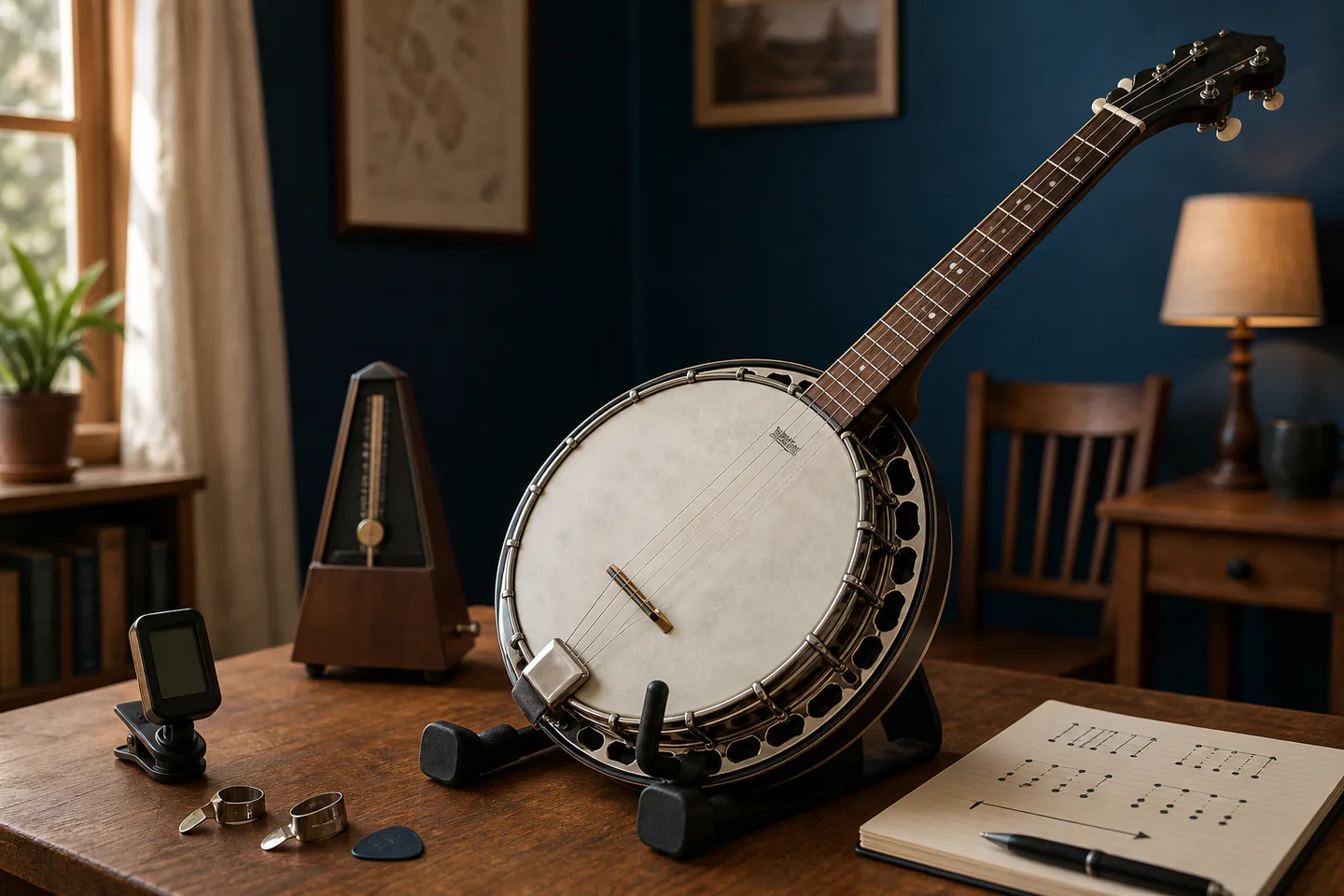
A setup-checked five-string banjo, open-G tuning and slow strums can lead to G and D7 chords before bluegrass rolls or clawhammer style split the path.
Quick answer
Complete one two-chord banjo song before expanding the setup
Choose a standard five-string banjo and have a reputable shop or teacher check bridge position, head, neck, action and fifth-string condition. Tune slowly to open G from fifth to first string as g-D-G-B-D, stabilise the instrument with a strap even when seated, strum open G on a counted pulse, learn D7 and return cleanly to G, then choose either one simple three-finger roll or a basic clawhammer stroke and apply it to the same two-chord song at a slow steady tempo.
- 01
The short fifth string starts partway up the neck and gives five-string banjo its re-entrant tuning and right-hand logic. Record what happened during banjo so the next attempt changes one known variable instead of several guesses.
- 02
Open-G tuning already forms a G chord, so rhythm and clean D7 changes can produce music quickly. Record what happened during banjo so the next attempt changes one known variable instead of several guesses.
- 03
Bridge position, head tension, nut and action are setup variables rather than finger-strength tests. Record what happened during banjo so the next attempt changes one known variable instead of several guesses.
- 04
Bluegrass three-finger and clawhammer techniques are distinct paths; one clear stroke should be established before mixing them. Record what happened during banjo so the next attempt changes one known variable instead of several guesses.
What to expect
What banjo is really like at the start
The useful beginner controls are preparation, one bounded task and a record of the result; specialist equipment matters only when it solves a repeated limitation.
Fifth string
Its high pitch and starting point surprise guitarists and must be tracked separately in picking patterns. Record what happened during banjo so the next attempt changes one known variable instead of several guesses.
Volume
A resonator banjo can be very loud at close range even without amplification. Record what happened during banjo so the next attempt changes one known variable instead of several guesses.
Roll
A repeating finger order is not yet musical time until accents and chord changes remain steady. Record what happened during banjo so the next attempt changes one known variable instead of several guesses.
Setup
The bridge is held by string tension and can move, affecting intonation and action. Record what happened during banjo so the next attempt changes one known variable instead of several guesses.
Core method
The core banjo method
Choose and stabilise the instrument
Confirm five-string construction and setup, use a strap and position the pot without twisting the wrist. Record what happened during banjo so the next attempt changes one known variable instead of several guesses.
Tune open G deliberately
Tune g-D-G-B-D gradually, recheck after each pass and learn which peg controls the short fifth string. Record what happened during banjo so the next attempt changes one known variable instead of several guesses.
Build the chord pulse
Count open G strums, form D7 with minimum pressure and practise the exact change in both directions. Record what happened during banjo so the next attempt changes one known variable instead of several guesses.
Add one right-hand pattern
Use a basic roll or clawhammer stroke slowly while the left hand keeps the same two-chord form. Record what happened during banjo so the next attempt changes one known variable instead of several guesses.
Useful products
Products with a clear job in the route
The five-string pack provides a conventional open-G route and basic accessories, while the compact tuner offers a consistent daily pitch reference even if the bundled tuner changes.
Gear4music 5 String Banjo Pack
The standard string count supports common chord, roll and clawhammer beginner material.
D’Addario NS Micro Headstock Tuner PW-CT-12
Accurate tuning makes paired mandolin strings and open-G banjo practice easier to diagnose.
First project
Play a G-and-D7 song with one steady pattern
Choose either a simple roll or a basic clawhammer stroke and keep the pulse slower than the fastest clean chord change.
- 01
Have the banjo checked
Confirm bridge position, head, neck, nut, fifth-string hardware and comfortable action. Record what happened during banjo so the next attempt changes one known variable instead of several guesses.
- 02
Tune to open G
Work gradually through g-D-G-B-D, recheck the whole set and stop at a stuck or slipping tuner. Record what happened during banjo so the next attempt changes one known variable instead of several guesses.
- 03
Strum the open chord
Count four-beat measures and control volume with a relaxed small motion. Record what happened during banjo so the next attempt changes one known variable instead of several guesses.
- 04
Add D7 and return
Practise only the change, keeping unused fingers and thumb relaxed. Record what happened during banjo so the next attempt changes one known variable instead of several guesses.
- 05
Apply one picking pattern
Use a slow roll or clawhammer stroke through the two chords and record one complete verse. Record what happened during banjo so the next attempt changes one known variable instead of several guesses.
What can wait
What can wait until the first result
Delay anything that adds cost, risk or another variable before the basic workflow has produced something you can review.
- 01
Fast Scruggs rolls
Finger order, accents and chord changes need a stable slow pulse first. Record what happened during banjo so the next attempt changes one known variable instead of several guesses.
- 02
Multiple tunings
Open G gives one dependable map before double C or modal systems. Record what happened during banjo so the next attempt changes one known variable instead of several guesses.
- 03
Head and coordinator-rod adjustment
Mechanical changes interact and should follow measurement and instruction. Record what happened during banjo so the next attempt changes one known variable instead of several guesses.
- 04
Loud jam sessions
A slow beginner group makes timing and hearing safer and clearer. Record what happened during banjo so the next attempt changes one known variable instead of several guesses.
Upgrade path
Add the capability you can now name
Each stage should remove a demonstrated constraint rather than make the setup look more advanced.
Use what you own
£0–£20Existing equipment and one written plan
Rent or buy a setup-checked five-string banjo.Repeat the first route
About £150–£600 including setupA complete repeatable starter setup
Complete several open-G two- and three-chord songs.Add one capability
Often £50–£250One selected tool, service or learning resource
Choose bluegrass three-finger or clawhammer instruction.Build specialist depth
Club, course or specialist dependentA documented specialist workflow
Join slow jams and add capo, alternate tunings and ensemble backup.Safety & care
Control volume, string tension and setup force
The instrument should feel stable and playable without aggressive tuning or fretting pressure.
- Use a strap or stable seated support and keep wrists, shoulders and thumb relaxed.
- Tune gradually with the face away from the string path and replace damaged or corroded strings.
- Keep acoustic and amplified volume conservative, especially in small rooms or close to other players.
- Do not force the truss rod, bridge, head hooks or coordinator rods without the instrument’s setup procedure.
- Stop at pain, numbness or persistent tension and have technique and setup assessed.
Outside help
When outside help earns its place
A teacher helps the beginner choose bluegrass or clawhammer technique, stabilise the fifth string and turn a repeated pattern into musical time.
Choose a teacher or slow jam that explicitly welcomes complete beginners and open-G two-chord songs.
Use outside help after the first banjo attempt can reveal the exact technique, access or safety problem that needs live correction.
Representative UK learning and access routes checked 1 September 2026; local prices, permissions, equipment and tutor support vary.
Sources
Where the guidance came from
Authoritative and specialist guidance supports the method and safety boundaries; community discussion contributes recurring beginner problems rather than unsupported claims.
-
01
Deering · How to tune a banjo
Five-string open-G and alternate tuning reference.
Open source -
02
Deering · Five-string banjo for beginners
Parts, tuning, G and D7 lesson sequence.
Open source -
03
Deering · How to get started playing banjo
Banjo types, tuners, pot and beginner selection.
Open source -
04
Peghead Nation · Beginning musician resources
Beginner banjo chords, strums, rolls and clawhammer route.
Open source -
05
Gear4music · Five-string banjo
UK model specification, open-G tuning and setup context.
Open source -
06
Reddit · r/banjo
Community evidence on setup, first instruments, rolls, clawhammer, volume and slow jams.
Open source -
07
Amazon UK · 5 String Banjo Pack
Exact Amazon UK product page or ISBN used for this recommendation; current price, seller, specification and availability should be confirmed.
Open source -
08
Amazon UK · NS Micro Headstock Tuner PW-CT-12
Exact Amazon UK product page or ISBN used for this recommendation; current price, seller, specification and availability should be confirmed.
Open source
Guide information and links checked 1 September 2026.