Beginner’s guide · Move & explore
Ten controlled catches in a three-ball cascade
Practise one clean arc before adding the third ball.
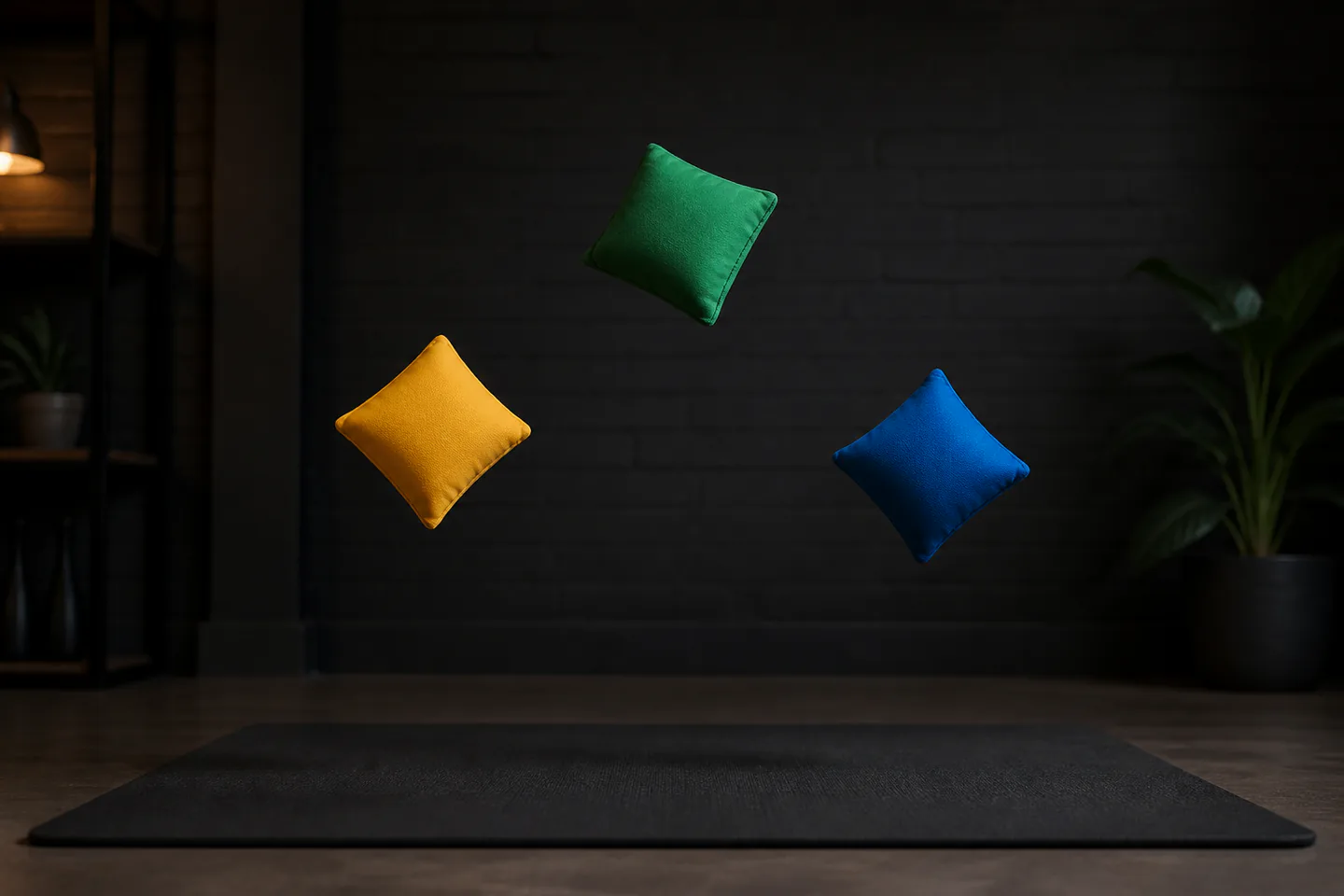
Start with three matched soft beanbags in a clear space. A single controlled toss, two-ball exchange and short three-ball cascade teach the pattern while drops stay quiet and do not roll away.
Quick answer
Build one toss, then two exchanges, then the cascade
Stand over a bed or soft clear floor with one beanbag in the dominant hand. Toss it to just above eye level so it crosses and lands near the other hand without reaching. Repeat until the arc is consistent. With one bag in each hand, throw the second only when the first reaches its peak—throw, throw, catch, catch. Add a third bag as two in one hand, keep the same alternating rhythm and stop after a few successful exchanges rather than running forward to save a bad throw.
- 01
Soft underfilled beanbags are easier to learn than bouncy balls because they stay where they drop.
- 02
The cascade is a sequence of crossing throws. Hands do not pass balls directly or circle them around each other.
- 03
Most failures begin with a throw too far forward, too low or too hurried; fix the throw before the catch.
- 04
Short sessions protect shoulders and preserve attention. Hundreds of tense repetitions can make the pattern worse.
What to expect
What the first juggling result really teaches
Juggling is controlled throwing with catching as the consequence. Looking near the arc peak helps both hands share peripheral information.
Height
Choose one peak slightly above eye level and make both hands send bags to the same invisible window.
Width
Throws cross toward the opposite shoulder rather than travelling vertically or far outside.
Timing
Release the next bag near the previous peak, not immediately and not after it is already falling.
Hands
Keep elbows low and hands near waist height; scooping upward and reaching forward create drift.
Drops
Let a bad toss fall in the safe area. Lunging teaches recovery rather than the cascade.
Count
Count throws or catches consistently and finish a successful short run deliberately.
Core method
Build one repeatable juggling workflow
Create a safe learning space
Clear fragile objects, pets and people from two arm spans around the practice point. Use soft beanbags over a bed or mat, check overhead fans and lights, tie hair back and wear shoes if the weights could hurt bare feet.
Own the single crossing toss
Throw one bag from hand to hand through the same eye-level window. Keep hands low, watch near the peak and make twenty catches without moving the feet. Practise the non-dominant hand until its arc looks the same.
Make the two-ball exchange
Hold one bag in each hand. Throw from the dominant hand, wait for the peak, throw the other underneath and catch both. Restart from the other hand. Say “throw, throw, catch, catch” and do not pass or swap bags at waist level.
Add the third without speeding up
Put two bags in the starting hand and one in the other. Make the same first two throws, then send the third when the second peaks. Aim for three, then five, then ten catches with feet planted. Record from the front to see which hand throws forward or low.
Useful products
Products with a clear job in the setup
Juggle Dream Pro Thuds are the practical matched beanbag route, the Klutz kit combines three bags with a strong illustrated method and the contact ball is a later separate discipline. Choose one first-ball route.
Juggle Dream Pro Thud Juggling Balls, Set of 3
The soft construction suits home learning and keeps attention on throw placement.
Klutz Juggling for the Complete Klutz
The book keeps the progression visible without pausing a screen and has introduced the cascade for decades.
Juggle Dream 75 mm Acrylic Contact Juggling Ball
It supports body rolls and visual isolation rather than thrown cascade practice.
First project
Reach ten cascade catches
A count of ten is long enough to establish alternation and short enough to preserve clean form.
- 01
Clear the practice zone
Check floor, ceiling, people, pets and fragile items.
- 02
Make twenty single tosses
Use one consistent peak without moving the feet.
- 03
Exchange two balls
Throw beneath the peak and restart from both hands.
- 04
Add the third ball
Keep the identical rhythm instead of rushing.
- 05
Stop at ten catches
Finish deliberately rather than saving a wild throw.
- 06
Review a front video
Correct the low, wide or forward hand on the next attempt.
What can wait
What can wait until the first result
Clubs, rings and contact juggling change collision, space and technique before the basic soft-ball pattern is comfortable.
- 01
Bouncy or hard balls
They roll, make noise and can damage objects during inevitable drops.
- 02
Juggling clubs
Rotation, handle catches and a larger collision zone create a different learning problem.
- 03
Four balls
The common four-ball fountain is not simply a faster three-ball cascade.
- 04
Tricks during unstable runs
Learn starts, ten catches and a controlled finish before under-the-leg or columns.
- 05
Long exhausting sessions
Frequent short practice protects posture and keeps the throw accurate.
Upgrade path
Upgrade the repeated limitation
Upgrade object type or pattern only when a consistent cascade makes the new discipline meaningful.
Soft-ball start
About £15–£30Three matched beanbags
Learn cascade timing.Durable outdoor set
About £20–£60Washable stage balls or firmer bags
Practise in more spaces.Clubs or rings
About £40–£120Three matched specialist props + tuition
Learn rotation or flat-plane catches.Performance set
About £100–£500+Multiple props, case and insurance/context
Develop routines and public-space awareness.Safety & care
Clear space and choose drop-friendly props
Soft props lower risk but do not remove collisions, repetitive strain or unsafe overhead practice.
- Clear people, pets, glass, screens, fans, lights and trip hazards from the full throw and retrieval area.
- Begin with soft matched beanbags, inspect seams before each session and stop using leaking or damaged props.
- Keep throws below dangerous overhead fixtures, never practise while driving or near roads and use permission in public spaces.
- Warm up gently, take breaks and stop for pain, dizziness or persistent shoulder, elbow or wrist discomfort.
- Learn clubs, knives, fire or heavy contact props only with specialist instruction, venue permission and the controls appropriate to that separate discipline.
Outside help
When outside help earns its place
A good video or book is enough for the cascade. A juggling club becomes valuable for immediate throw correction, shared space and progression to clubs or passing.
Use a toss-to-exchange-to-cascade sequence.
Ask about beginners, loan props and practice-space rules.
Representative UK product, workshop, lesson and club costs checked 13 August 2026; local prices, access, materials and tutor support vary.
Sources
Where the guidance came from
Established juggling organisations and teachers define skill progressions; community discussion supplies prop, space and practice evidence.
-
01
International Jugglers’ Association
Juggling education, safety and community resources.
Open source -
02
Juggling Edge
UK event, club and practitioner network.
Open source -
03
Library of Juggling · Cascade
Stepwise pattern and prerequisite reference.
Open source -
04
Juggle Dream · Guides
UK prop and beginner-learning context.
Open source -
05
Reddit · r/juggling
Community advice on first balls, cascade faults and progression.
Open source -
06
Amazon UK · Juggle Dream Pro Thud set
Exact product page, model or ISBN, observed price and availability checked for this guide.
Open source -
07
Amazon UK · Klutz complete juggling kit
Exact product page, model or ISBN, observed price and availability checked for this guide.
Open source -
08
Amazon UK · Juggle Dream 75 mm contact ball
Exact product page, model or ISBN, observed price and availability checked for this guide.
Open source
Guide information and links checked 13 August 2026.