Beginner’s guide · Grow & care
Save one variety with its name intact.
Dry seed is only half the record.
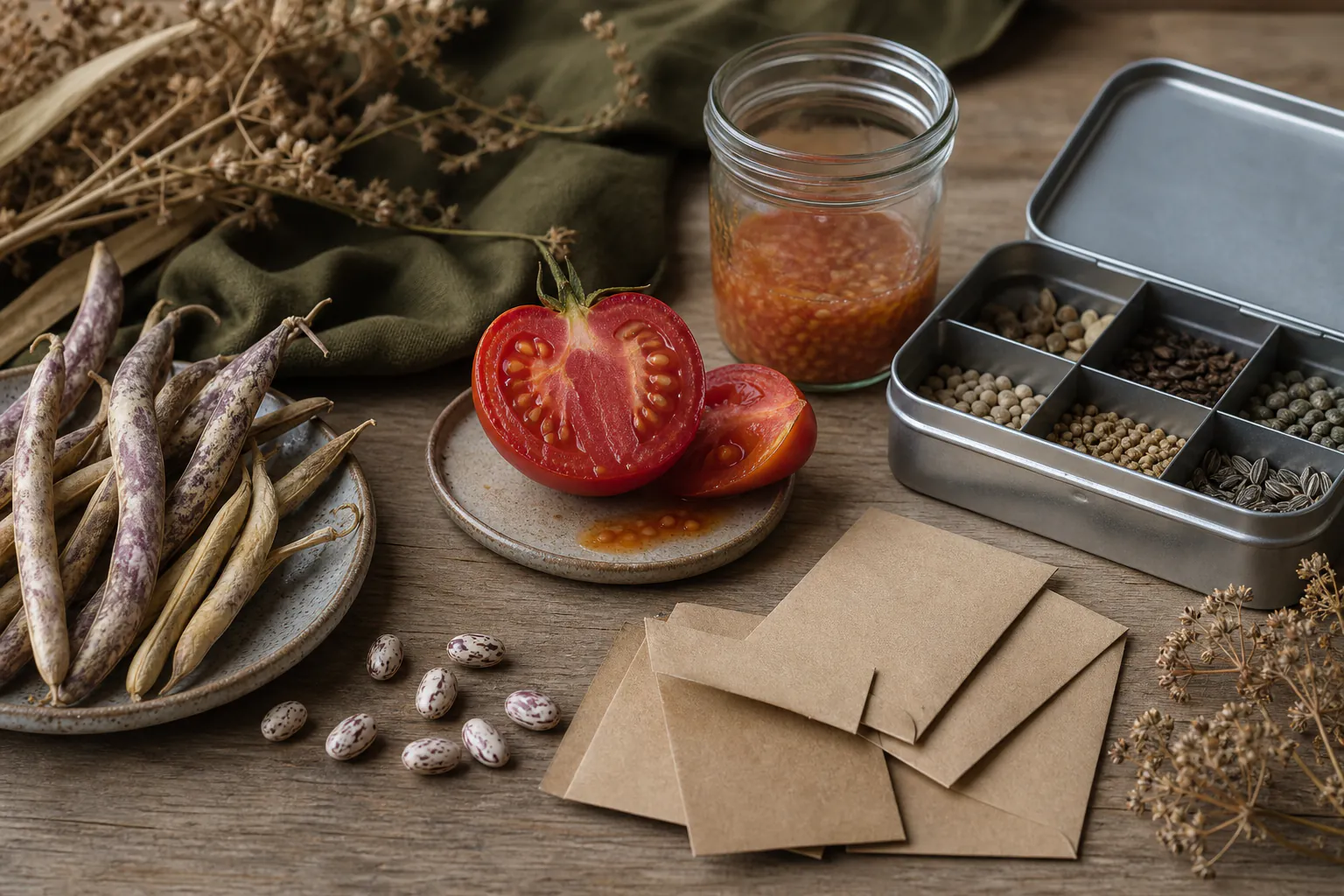
Start with one easy open-pollinated bean, pea, lettuce or tomato. Let seed mature fully, process it carefully, dry it thoroughly and store it with variety, year and source.
Quick answer
Choose one open-pollinated crop and keep its identity
Save from a healthy named open-pollinated bean, pea, lettuce or tomato grown from a trustworthy source. Mark the chosen plants before harvest, let seeds reach full botanical maturity, collect in dry weather and process one variety at a time. Dry seed thoroughly away from direct heat, label the envelope with crop, variety, source, year and notes, then store it cool, dark and dry.
- 01
Seed from an F1 hybrid may germinate but will not reliably reproduce the parent variety.
- 02
Cross-pollinating crops need distance, timing, barriers or controlled pollination to keep a variety true.
- 03
A fruit ready to eat is not always seed mature; cucumbers and courgettes for seed become far older than table produce.
- 04
Seed saving preserves a living population. Select several healthy typical plants rather than one exceptional accident where guidance recommends it.
What to expect
The hidden work happens before harvest
Pollination biology and variety identity determine what the seed represents. Drying and storage determine whether it remains alive.
Variety
Open-pollinated does not mean self-pollinating. Find the species and crossing behaviour before flowering.
Selection
Do not save from diseased or clearly off-type plants merely because their seed is easy to reach.
Maturity
Pods often dry brown and brittle; wet-seeded fruits may need over-ripening and fermentation.
Processing
Clean one lot at a time and remove chaff without mixing varieties or damaging embryos.
Drying
Apparently dry seed can retain damaging moisture. Use airflow and time, not a hot oven.
Storage
Cool, dark and dry conditions extend life, but longevity differs greatly among species.
Core method
Preserve identity from flower to envelope
Choose an easy crop and verify the seed source
Read the original packet or supplier record and avoid an F1-labelled variety for the first attempt. Peas, beans, lettuce and tomatoes are common beginner candidates, but each still has crop-specific isolation and disease considerations. Keep the packet and mark several healthy plants before harvesting begins.
Understand how the crop crosses
Use reputable crop-by-crop guidance to learn whether flowers mainly self-pollinate, attract insects or shed pollen on wind. Note neighbouring compatible varieties and flowering overlap. For a simple first year, save only one variety of the chosen species or use physical isolation and hand-pollination methods you fully understand.
Harvest at seed maturity
Leave dry-seeded pods or heads on the plant until brown and papery where weather allows, then finish drying under cover. For tomatoes, scoop fully ripe seed with gel, ferment briefly according to guidance, rinse and spread thinly. Never process two varieties on the same unclean surface.
Dry, test and label
Use breathable paper and gentle airflow until dry seed snaps, shatters or otherwise meets crop-specific tests. Pack small labelled lots inside a cool dry container. A duplicate label goes inside and outside. Sow a counted sample next season to estimate germination and keep notes about vigour and type.
Useful products
A reliable reference, breathable packets and an organised outer store
Sue Stickland’s UK book provides crop-specific depth. Small paper envelopes are the immediate storage surface. The divided tin protects and organises packets once seed is genuinely dry; it does not correct damp seed.
Sue Stickland Back Garden Seed Saving
It supports decisions before flowering and harvest, when varietal purity is actually won or lost.
Tatuo 100 Seed Envelopes with Pen and Record Book
Paper packets make moisture and mixing easier to notice than loose seed in jars.
Burgon & Ball Seed Storage Tin with Dividers and Envelopes
It supports a durable yearly archive without forcing seed into unlabelled plastic bags.
First project
Save one bean or tomato variety
Choose beans for the simplest dry-seed route or tomato for learning a controlled wet-seed process. Do not process both simultaneously on the same tools.
- 01
Verify open-pollinated seed
Keep the original packet and record the exact variety and supplier.
- 02
Mark healthy plants
Select several typical disease-free plants before the crop is eaten.
- 03
Check crossing risk
Identify compatible nearby varieties and the crop-specific isolation method.
- 04
Harvest mature seed
Wait for dry pods or fully ripe tomato fruit according to reliable guidance.
- 05
Process and dry
Work one variety at a time, remove debris and use airflow without high heat.
- 06
Label and test
Store cool and dry, then germinate a counted sample before relying on the lot.
What can wait
What can wait until the first result
A smaller accurately named seed lot is more valuable than drawers of uncertain envelopes.
- 01
Saving every crop
Brassicas, squashes and biennials add crossing, population and overwintering work.
- 02
F1 hybrid experiments
They are interesting genetics but not a reliable route to preserving the purchased variety.
- 03
A vacuum sealer
Paper envelopes in a dry outer container make inspection and labelling simple.
- 04
Hot artificial drying
Heat can reduce viability even when the seed looks intact.
- 05
Trading untested seed
Check germination, disease and current seed regulations before distribution.
Upgrade path
Upgrade the repeated limitation
Add harder crops only when records and storage have proved dependable.
One self-pollinating crop
FreeOriginal packet + paper envelope
Learn maturity, drying and labels.Germination record
MinimalCounted paper-towel or compost test
Measure viability instead of assuming it.Two managed varieties
Mostly timeIsolation or controlled pollination
Learn crossing prevention.Community seed work
VariablePopulation, provenance and legal guidance
Preserve diversity beyond one household.Safety & care
Keep disease, identity and legal claims under control
Seed can carry pathogens and variety names or distribution may have legal and contractual implications.
- Do not save from plants showing seed-borne disease symptoms; use crop-specific health guidance.
- Keep tools, surfaces and hands clean and process one variety at a time to prevent mixing.
- Label honestly and do not claim varietal purity when isolation or parentage is uncertain.
- Check current UK rules before selling or widely distributing seed and respect protected variety rights.
- Keep seeds away from children and pets where the species is toxic and never treat saved seed as edible food.
Outside help
When outside help earns its place
A seed-swap group can add local knowledge, but ask how varieties were isolated and whether germination was tested.
Use crop biology, purity and processing resources before flowering.
Choose hands-on pollination and processing rather than a packet exchange alone.
Representative UK prices and free learning routes checked 3 August 2026; local availability, materials and tutor support vary.
Sources
Where the guidance came from
Garden Organic supplies detailed UK seed-saving biology and crop guidance; responsible storage and distribution depend on clear records.
-
01
Garden Organic · Preserving varietal purity
Isolation, populations and maintaining variety identity.
Open source -
02
Garden Organic · Basic botany for seed savers
Flowers, pollination, seed development and terminology.
Open source -
03
Garden Organic · Saving seed crop by crop
Crop-specific harvest and processing guidance.
Open source -
04
DEFRA · Plant varieties and seeds
Current UK regulatory context for plant varieties and seed marketing.
Open source -
05
Amazon UK · Back Garden Seed Saving by Sue Stickland
Exact product page, model or ISBN, observed price and availability checked for this guide.
Open source -
06
Amazon UK · Seed envelope and record set
Exact product page, model or ISBN, observed price and availability checked for this guide.
Open source -
07
Amazon UK · Burgon & Ball seed storage tin
Exact product page, model or ISBN, observed price and availability checked for this guide.
Open source
Guide information and links checked 3 August 2026.