Beginner’s guide · Observe the sky
Build the mount around known optics,
then collimate before judging the view.
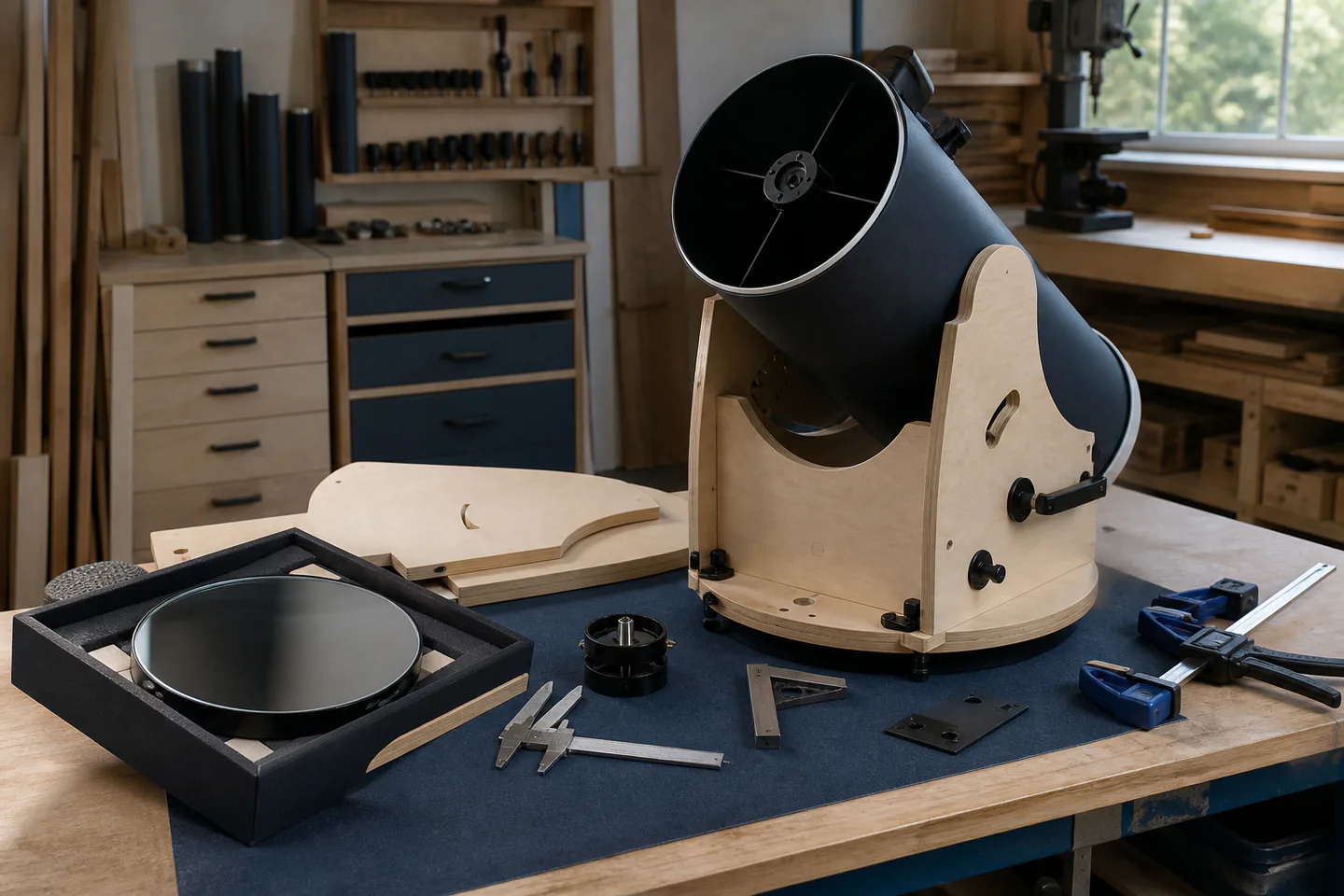
A small Dobsonian made around a purchased mirror set teaches optical alignment, balance and smooth movement without making mirror grinding the first hazardous unknown.
Quick answer
Complete one Dobsonian build before expanding the setup
Join an astronomy or telescope-making group and choose a documented small Newtonian or Dobsonian design around a matched purchased primary and secondary mirror set. Confirm focal length and tube geometry, make a scale drawing and parts list, build the stable rocker and altitude bearings with hand tools, fit capped optics only after dusty work is finished, collimate with a simple cap and test on a distant terrestrial target before supervised night first light.
- 01
Optical focal length and mirror diameter determine tube geometry; dimensions cannot be guessed from an exterior photograph. Record what happened during telescope making so the next attempt changes one known variable instead of several guesses.
- 02
A Dobsonian succeeds through low-friction smooth axes, balance and stiffness as much as optical quality. Record what happened during telescope making so the next attempt changes one known variable instead of several guesses.
- 03
Collimation aligns optical elements but cannot repair pinched mirrors, poor support or a shaking mount. Record what happened during telescope making so the next attempt changes one known variable instead of several guesses.
- 04
Mirror grinding adds abrasive, pitch, glass-edge and optical-testing work and is a later club-supported project. Record what happened during telescope making so the next attempt changes one known variable instead of several guesses.
What to expect
What telescope making is really like at the start
The useful beginner controls are preparation, one bounded task and a record of the result; specialist equipment matters only when it solves a repeated limitation.
Design
Small dimensional errors accumulate at focuser travel, secondary placement and balance. Record what happened during telescope making so the next attempt changes one known variable instead of several guesses.
Mount
Too much friction causes jerks; too little lets the telescope drift when eyepieces change. Record what happened during telescope making so the next attempt changes one known variable instead of several guesses.
Optics
Fingerprints, grit and over-tight clips can damage or distort mirrors. Record what happened during telescope making so the next attempt changes one known variable instead of several guesses.
Test
Poor seeing, thermal currents and an uncooled mirror can look like construction failure. Record what happened during telescope making so the next attempt changes one known variable instead of several guesses.
Core method
The core telescope making method
Freeze the optical geometry
Record mirror diameter, focal length, secondary size, focuser height and required focus range from actual parts. Record what happened during telescope making so the next attempt changes one known variable instead of several guesses.
Prototype movement
Build and test the ground board, rocker and bearings with equivalent tube weight before fitting optics. Record what happened during telescope making so the next attempt changes one known variable instead of several guesses.
Install cleanly
Complete sanding and finishing, clean the workspace and fit supports without stress or exposed edges. Record what happened during telescope making so the next attempt changes one known variable instead of several guesses.
Collimate and first-light
Align secondary and primary in sequence, check focus travel and begin with the Moon or a bright star under supervision. Record what happened during telescope making so the next attempt changes one known variable instead of several guesses.
Useful products
Products with a clear job in the route
Clamps stabilise glue-up, the backsaw supports controlled small timber cuts, the caliper verifies parts and safety glasses provide baseline eye protection; optics and focuser must be selected as one documented system.
IRWIN Quick-Grip 300 mm Clamps, Twin Pack
Stable work improves repeatability and keeps hands farther from a tool path.
Spear & Jackson Predator 10-Inch Tenon Saw
A backsaw supports a straightforward plywood or timber build before machinery is justified.
Kynup Digital Caliper, 150 mm
It makes small fit differences visible instead of relying on feel.
3M SecureFit 200 Safety Glasses
They are easy to keep at the bench for routine impact risks.
First project
Build a tabletop Dobsonian around a matched mirror set
Use a published plan and keep mirror making, motor drives and photography out of the first instrument.
- 01
Join a support route
Have a club or experienced builder review the optics, plan, budget and tools. Record what happened during telescope making so the next attempt changes one known variable instead of several guesses.
- 02
Make the full-scale drawing
Place primary, secondary, focuser and focal plane and confirm clearances. Record what happened during telescope making so the next attempt changes one known variable instead of several guesses.
- 03
Build and test the mount
Check square, stiffness, axis friction and balance with dummy weight. Record what happened during telescope making so the next attempt changes one known variable instead of several guesses.
- 04
Finish dusty work
Sand, seal and clean before opening optical packaging. Record what happened during telescope making so the next attempt changes one known variable instead of several guesses.
- 05
Fit, collimate and test
Install without stress, align in sequence and record focus and movement at first light. Record what happened during telescope making so the next attempt changes one known variable instead of several guesses.
What can wait
What can wait until the first result
Delay anything that adds cost, risk or another variable before the basic workflow has produced something you can review.
- 01
Grinding the first mirror alone
Abrasives, glass work and optical testing benefit from a club workshop and mentor. Record what happened during telescope making so the next attempt changes one known variable instead of several guesses.
- 02
A large fast mirror
Weight, collimation tolerance and coma make the build less forgiving. Record what happened during telescope making so the next attempt changes one known variable instead of several guesses.
- 03
Motor drives
Manual movement and balance must work before tracking is added. Record what happened during telescope making so the next attempt changes one known variable instead of several guesses.
- 04
Solar observing
It requires separate certified front-aperture equipment and procedure. Record what happened during telescope making so the next attempt changes one known variable instead of several guesses.
Upgrade path
Add the capability you can now name
Each stage should remove a demonstrated constraint rather than make the setup look more advanced.
Use what you own
£0–£20Existing equipment and one written plan
Visit a club and study a small working Dobsonian.Repeat the first route
About £180–£450 including opticsA complete repeatable starter setup
Build around known purchased optics and manual movement.Add one capability
Often £50–£250One selected tool, service or learning resource
Improve bearings, baffling, cooling or portability for a measured observing limitation.Build specialist depth
Club, course or specialist dependentA documented specialist workflow
Attempt mirror making or larger structures only with specialist testing and workshop controls.Safety & care
Treat optics, tools and the Sun as separate hazards
Sharp glass, dust, blades, unstable structures and unsafe solar viewing require explicit controls.
- Wear task-appropriate eye, hearing and respiratory protection and use extraction for cutting, sanding and finishing.
- Clamp work, guard blades, keep free hands out of tool paths and follow each tool manual.
- Store mirrors capped in padded trays, support edges correctly and never clean optics casually.
- Check the completed structure for stability, pinch points, protrusions and secure mirror retention before night use.
- Never point the telescope or finder at the Sun without a complete certified front-aperture solar system and expert training.
Outside help
When outside help earns its place
An amateur telescope-making group is the right first outside help because it can review geometry, demonstrate collimation and test optical and mount performance.
Ask whether the group supports purchased-optics builds, mirror testing, workshop safety and first-light troubleshooting.
Use outside help after the first telescope making attempt can reveal the exact technique, access or safety problem that needs live correction.
Representative UK learning and access routes checked 1 September 2026; local prices, permissions, equipment and tutor support vary.
Sources
Where the guidance came from
Authoritative and specialist guidance supports the method and safety boundaries; community discussion contributes recurring beginner problems rather than unsupported claims.
-
01
Royal Astronomical Society · Getting started in astronomy
UK beginner observing, equipment and club guidance.
Open source -
02
British Astronomical Association · Observing guide
Structured visual observation and record guidance.
Open source -
03
Stellafane · Telescope making
Established amateur telescope-making plans, optics and testing resources.
Open source -
04
Stellafane · Build a Dobsonian
Documented Dobsonian structure, bearings and construction sequence.
Open source -
05
HSE · Woodworking
UK machinery, dust, guarding and workshop safety guidance.
Open source -
06
Reddit · r/telescopes
Community evidence on observing, Dobsonian builds, collimation and beginner equipment.
Open source -
07
Amazon UK · Quick-Grip 300 mm Clamps, Twin Pack
Exact Amazon UK product page or ISBN used for this recommendation; current price, seller, specification and availability should be confirmed.
Open source -
08
Amazon UK · Predator 10-Inch Tenon Saw
Exact Amazon UK product page or ISBN used for this recommendation; current price, seller, specification and availability should be confirmed.
Open source -
09
Amazon UK · Digital Caliper, 150 mm
Exact Amazon UK product page or ISBN used for this recommendation; current price, seller, specification and availability should be confirmed.
Open source -
10
Amazon UK · SecureFit 200 Safety Glasses
Exact Amazon UK product page or ISBN used for this recommendation; current price, seller, specification and availability should be confirmed.
Open source
Guide information and links checked 1 September 2026.