Beginner’s guide · Make & create
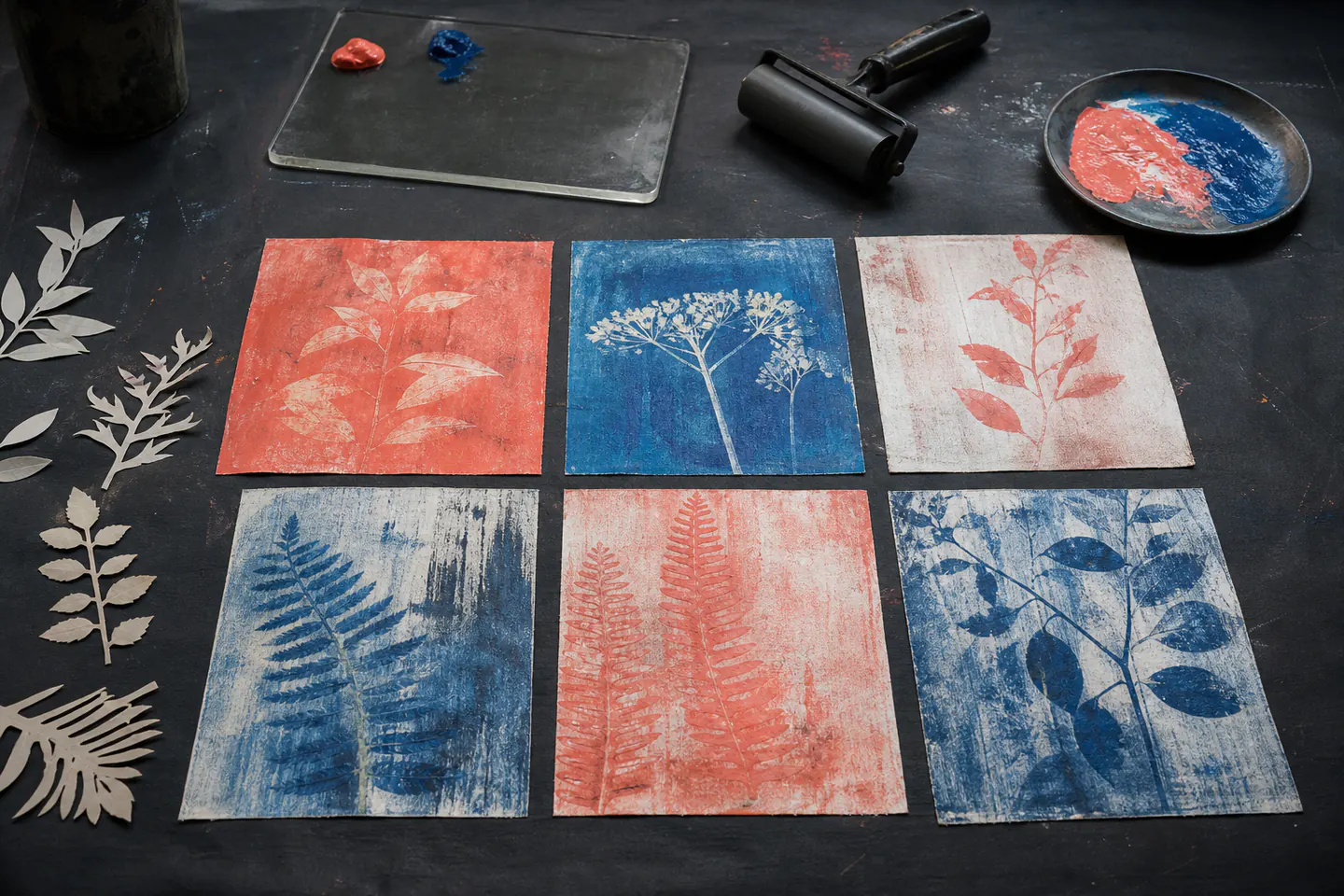
A small edition-like series of six layered monoprints
Repeat one plate and let every pull teach you.
Begin with low-pressure gel-plate monoprinting: acrylic paint, a small brayer and ordinary smooth paper. It teaches ink thickness, transfer, masking and layered registration without blades, a press or permanent equipment.
Quick answer
Roll one thin colour, mask a shape and pull six variations
Place a small gel plate on a stable protected surface, put a pea-sized amount of compatible acrylic paint on it and roll until the brayer makes a quiet tacky sound rather than sliding through puddles. Lay down torn-paper or leaf-shaped masks, place a smooth sheet over the plate and rub evenly by hand. Peel the paper in one motion, remove masks and pull the remaining ghost image. Repeat with one second colour only after the first layer is dry enough not to lift.
- 01
This guide uses gel-plate monoprinting as the accessible printmaking route. Linocut, screenprinting, etching and press printing are distinct processes.
- 02
Too much paint causes blurry edges and long drying; too little gives dry gaps. Small controlled changes teach the useful range.
- 03
Fresh leaves, glossy paper, solvents and sharp objects may stain, damage or permanently mark some gel plates; follow the exact maker’s care list.
- 04
A monoprint is usually unique. Repeated masks and placement can create a related series without pretending every pull is identical.
What to expect
The print appears backwards and the plate keeps a history
Transfer reverses the arrangement, and residue from one layer can become part of the next. Planning and surprise both belong in the method.
Film
Roll paint to a thin even layer; puddles squeeze outward and cover the marks that were meant to print.
Timing
Open acrylic time varies with room, paint and plate. Prepare paper and masks before rolling.
Pressure
Hand rubbing should reach corners and edges consistently without shifting the sheet.
Reverse
Text and directional images print mirrored. Avoid text at first and test orientation with simple shapes.
Ghost
A second pull often captures delicate residue and can become a background rather than waste.
Series
Change one variable per pull—colour, mask, texture or order—so the result teaches something comparable.
Core method
Learn paint film, transfer and a two-layer sequence
Protect and organise the table
Cover the work area, set the plate on a clean non-slip surface and arrange brayer, paint, masks, paper and waste sheets within reach. Keep one zone clean for finished prints. Check the plate maker’s current compatibility and cleaning instructions before introducing plants, textured objects or cleaners.
Roll a controlled film
Add less paint than seems necessary and spread it across the whole plate with overlapping passes. Roll the brayer on a clean waste sheet if ridges build at its edges. The plate should show a consistent colour without deep wet tracks.
Pull a mask and a ghost
Place two or three flat paper masks, cover with a sheet and rub from the middle outward. Lift without dragging. Remove the masks, place a second clean sheet and pull the remaining image. Label both with the paint amount and order.
Add a registered second layer
Let the first print dry, then use a corner guide or transparent planning sheet to place a second restrained colour. Rotate or offset one mask intentionally. Compare the main pull, ghost and second layer, and write the one change that produced the clearest result.
Useful products
Products with a clear job in the setup
The Gelli Arts plate is the reusable printing surface, the Daler-Rowney set provides compatible artist acrylic colours and the small brayer pair spreads a thin film. Paper can come from an existing smooth drawing pad for the first test.
Gelli Arts Gelli Arts Gel Printing Plate, 8 × 10 in
Its size supports masks, layers and ghost pulls without requiring a press.
Daler-Rowney System3 Acrylic Paint Introduction Set
The paint has enough body and colour strength for learning film thickness without a huge palette.
Falling in Art Soft Rubber Brayer Rollers, 10 cm and 6 cm
The 10 cm roller covers the plate efficiently while the smaller one can isolate a second layer.
First project
Make six variations from two masks
A short series turns accidental results into useful evidence about film, timing and layer order.
- 01
Prepare six sheets
Trim paper, make two flat masks and keep a clean drying zone.
- 02
Roll one colour
Use a small amount and remove thick edge ridges.
- 03
Pull the masked print
Rub evenly without shifting the paper.
- 04
Pull the ghost
Remove masks and capture the quieter residue.
- 05
Add one dry second layer
Use a simple corner guide and a restrained contrast colour.
- 06
Label and compare
Record order, paint amount and the best change.
What can wait
What can wait until the first result
Carving tools, a press and a wall of specialised inks belong to later processes, not this first transfer lesson.
- 01
A printing press
Hand pressure is sufficient for the selected gel-plate route.
- 02
Linocut blades
They introduce cutting direction and sharpening and are covered in the separate linocut guide.
- 03
Dozens of textures
Two masks and two colours reveal cause and effect more clearly than a crowded plate.
- 04
Solvent cleaners
Use only the cleaning method approved for the exact plate and paint; aggressive cleaners can damage it.
- 05
Selling an edition
Learn consistent transfer and document materials before making durability or edition claims.
Upgrade path
Upgrade the repeated limitation
Choose the next print process because its repeatability, mark or scale solves a creative need.
Gel-print start
About £40–£75Plate + brayer + acrylic + paper
Learn transfer, masks and layers.Paper and paint control
About £20–£80Purpose paper + open acrylic/retarder
Extend working time and improve surface quality.Relief route
About £45–£140Linocut tools, block ink and baren
Carve a repeatable image and edition.Press or studio process
About £150–£2,000+Course, membership or press access
Explore intaglio, screenprint or larger editions safely.Safety & care
Protect the plate, table and wastewater
The beginner route avoids blades and solvents, but acrylic paint and damaged plates still require deliberate handling and disposal.
- Follow the gel-plate maker’s compatibility and cleaning instructions; avoid sharp tools, incompatible solvents and materials known to stain or react.
- Protect clothing and furniture, clean wet acrylic before it cures and never wash large quantities of paint solids into household drains.
- Use only non-toxic labelled art materials appropriate to the user and keep paint, tools and printed paper away from food preparation.
- Dry prints flat where children and pets cannot step on or lick wet paint; wash hands after the session.
- Credit or license reference imagery and plant material appropriately; a transferred copyrighted image does not become free to sell.
Outside help
When outside help earns its place
Gel printing can be learned at home. A print studio earns the cost when a press, screen, specialist chemistry or supervised cutting is central to the process you want next.
Check current plate care as well as image techniques.
Ask which process, materials, press time and cleanup are included.
Representative UK product, workshop, lesson and club costs checked 13 August 2026; local prices, access, materials and tutor support vary.
Sources
Where the guidance came from
Plate and paint makers define compatibility; print studios and working printmakers provide transfer, edition and safe-cleanup practice.
-
01
Gelli Arts · Care and use
Manufacturer plate compatibility, storage and cleaning guidance.
Open source -
02
Daler-Rowney · System3 acrylic
Paint properties and product information.
Open source -
03
Printmakers Council
Established UK printmaking practice and artist context.
Open source -
04
Handprinted · Printmaking blog
Specialist tutorials across gel and relief processes.
Open source -
05
Reddit · r/printmaking
Community evidence on beginner processes, inks, paper and presses.
Open source -
06
Amazon UK · Gelli Arts 8 × 10 gel plate
Exact product page, model or ISBN, observed price and availability checked for this guide.
Open source -
07
Amazon UK · Daler-Rowney System3 acrylic set
Exact product page, model or ISBN, observed price and availability checked for this guide.
Open source -
08
Amazon UK · Falling in Art brayer set
Exact product page, model or ISBN, observed price and availability checked for this guide.
Open source
Guide information and links checked 13 August 2026.