Beginner’s guide · Make & create
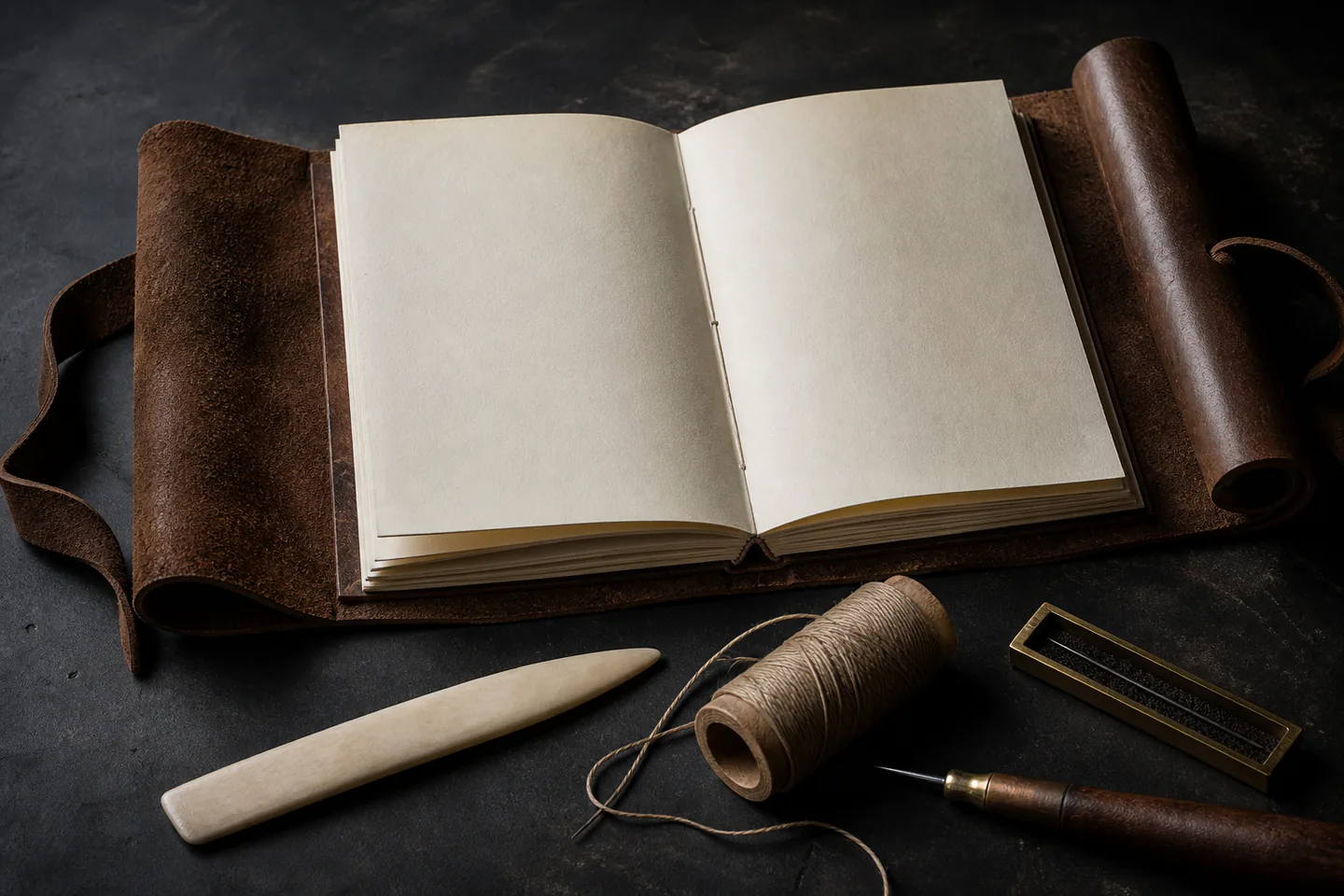
A refillable wraparound leather journal with one sewn section
Bind a sound text block before decorating the leather.
Start with a simple pamphlet-stitched paper section and a removable wraparound leather cover. That route teaches grain direction, folding, sewing and cover fit without skiving thick leather or buying a large tooling set.
Quick answer
Sew one folded paper section and fit a simple leather wrap
Fold eight to twelve grain-correct sheets into one section, press the fold and make a three-hole sewing template. Punch the paper in a cradle or supported fold with an awl travelling away from the hand, then sew a pamphlet stitch with waxed linen thread. Cut a thin vegetable-tanned or suitable garment-leather rectangle only after measuring the closed section, add a modest fore-edge wrap and punch matching cover holes. Sew the text block into the cover or use a removable cord structure.
- 01
Paper grain should run parallel to the spine so pages open and settle instead of fighting the fold.
- 02
Leather type and thickness affect cutting, folding, adhesive and finish. Scrap or pre-cut panels are more sensible than a whole hide.
- 03
A single section avoids heavy punching and specialised skiving while still producing a real bound object.
- 04
Awls, needles and knives need a cut-resistant surface and a hand position that never waits in front of the point.
What to expect
What the first leather journal making result really teaches
The leather is visually dominant, but page grain, accurate folds and sewing tension decide whether the journal opens well and lasts.
Paper
Fold with the grain, align edges and avoid overfilling one section with too many sheets.
Template
One reusable paper guide keeps every station aligned and prevents improvised extra holes.
Punch
Support the fold and push the awl into a clear safe space, never toward a palm or thigh.
Thread
Waxed linen should seat firmly without sawing through paper or puckering the spine.
Leather
Test dye transfer, edge finish and fold on a scrap before it touches the text block.
Fit
Allow enough cover movement for the journal to open; a tight decorative wrap can distort the spine.
Core method
Build one repeatable leather journal making workflow
Make the paper section first
Choose paper suitable for the intended pen and determine grain by flexing or damp-testing a spare corner. Fold eight to twelve sheets individually, nest them, tap the head and press under boards. Trim only if a proper knife, ruler and cutting method are available.
Create and use one template
Fold a narrow strip to the exact section height and mark three or five symmetrical sewing stations, keeping holes away from the ends. Place the section in a punching cradle or open support, keep the non-tool hand clear and make perpendicular holes with a sharp awl.
Sew a controlled pamphlet stitch
Use an appropriate bookbinding needle and waxed linen thread about three times the spine height. Sew from inside, travel through the stations and tie around the long centre thread without piercing it. Tension each pass so it lies flat but does not tear the fold.
Measure and fit the leather cover
Close the section and measure around it, adding the chosen wrap and a little working ease. Cut thin suitable leather on a mat with a steel ruler and multiple controlled passes. Punch cover holes over a sacrificial board and attach the section, then round or burnish edges only with products compatible with the leather.
Useful products
Products with a clear job in the setup
The traditional bookbinding kit covers folding, punching and sewing; the NAMOON set is a broader leather-tool upgrade; Lineco neutral-pH adhesive is only for a design that actually uses pasted components. A simple sewn wrap may need no glue.
Kikkerland / craft kit Traditional Bookbinding Starter Kit
The tools remain useful for paper refills and prevent leather decoration from hiding a weak text block.
NAMOON Leather Working Tool Kit
It can support repeated covers and small leather projects without buying every tool singly.
Lineco Neutral pH Adhesive, 8 oz
It is preferable to an unidentified household glue for documented paper and board work.
First project
Bind one refillable wrap journal
A single-section structure is strong enough to use and simple enough to diagnose.
- 01
Fold grain-correct sheets
Make one section and press it flat under boards.
- 02
Punch from one template
Keep stations centred and hands out of the awl path.
- 03
Sew the pamphlet
Seat thread without tearing or puckering paper.
- 04
Measure the closed section
Add cover ease and the intended fore-edge wrap.
- 05
Cut and punch the leather
Use a mat, steel ruler and sacrificial punching board.
- 06
Attach and test opening
Open fully, write on several pages and adjust the next cover.
What can wait
What can wait until the first result
Tooling, thick hides and elaborate multi-section structures add specialised leather and binding problems simultaneously.
- 01
A whole hide
Small pre-cut panels or offcuts make thickness, quality and cost easier to inspect.
- 02
Decorative stamping
Tooling needs suitable vegetable-tanned leather, moisture control, stamps and a striking surface.
- 03
A thick multi-signature book
It adds sewing supports, spine shaping and cover engineering beyond the first wrap.
- 04
Chemical dyes and finishes
Test natural leather first and introduce products only with their ventilation and transfer information.
- 05
Routine glue
A sewn removable cover is honest, repairable and avoids unnecessary adhesive choices.
Upgrade path
Upgrade the repeated limitation
Upgrade the limitation that repeats: paper capacity, leather edge quality, refillability or decorative surface.
Simple wrap journal
About £35–£80Binding tools + thin leather panel + paper
Learn folds, holes and stitch.Repeatable refills
About £20–£80Templates, punches and selected paper
Make interchangeable sections.Leather finishing
About £60–£250Skiving knife, edge tools and compatible finish
Refine folds, edges and closures.Case or multi-section binding
About £100–£600+Press, boards, sewing frame and training
Build larger durable books.Safety & care
Control blades, points, leather treatments and posture
Most injuries come from cutting or punching toward a hand. Unknown dyes, mouldy hides and unsuitable adhesives add avoidable exposure.
- Use a cut-resistant mat and steel ruler, make controlled passes away from the body and retract or sheath blades immediately.
- Punch into a proper board or cradle with the free hand outside the path; never hold work on the thigh or palm.
- Check leather provenance and treatment, isolate mouldy material and follow ventilation and glove guidance for every dye, adhesive and finish.
- Use archival or neutral-pH products only when long-term paper compatibility matters and never imply that “natural” leather is chemically untreated.
- Take hand and posture breaks, store awls and needles in rigid holders and keep loose thread away from children and pets.
Outside help
When outside help earns its place
A bookbinding kit can support the first pamphlet. A leathercraft or book arts class becomes useful for skiving, edge finishing, tooling or multi-section structures.
Use grain-direction, pamphlet-stitch and safe-cutting demonstrations.
Ask which leather, paper, binding structure and tools are included.
Representative UK product, workshop, lesson and club costs checked 13 August 2026; local prices, access, materials and tutor support vary.
Sources
Where the guidance came from
Bookbinding organisations establish paper and structure; leather suppliers and maker communities add thickness, edge and tool experience.
-
01
Society of Bookbinders
UK binding education and conservation-minded practice.
Open source -
02
iBookBinding · Tutorials
Specialist folding, sewing and cover methods.
Open source -
03
J. Hewit & Sons
UK bookbinding leather, tool and material information.
Open source -
04
Leather Working Group
Leather supply-chain and material context.
Open source -
05
Reddit · r/bookbinding
Community experience with journal structures, kits and paper grain.
Open source -
06
Amazon UK · Traditional bookbinding kit
Exact product page, model or ISBN, observed price and availability checked for this guide.
Open source -
07
Amazon UK · NAMOON leather tool kit
Exact product page, model or ISBN, observed price and availability checked for this guide.
Open source -
08
Amazon UK · Lineco neutral-pH adhesive
Exact product page, model or ISBN, observed price and availability checked for this guide.
Open source
Guide information and links checked 13 August 2026.