Beginner’s guide · Reflect & explore
Follow one story back through its variants.
Keep place, teller and source attached.
Choose one local legend, custom or saying and trace where it was recorded, who repeated it and how the details changed. Folklore is living vernacular culture—not a list of supernatural claims to repeat without evidence or attribution.
Quick answer
Make a source trail, not a truth verdict
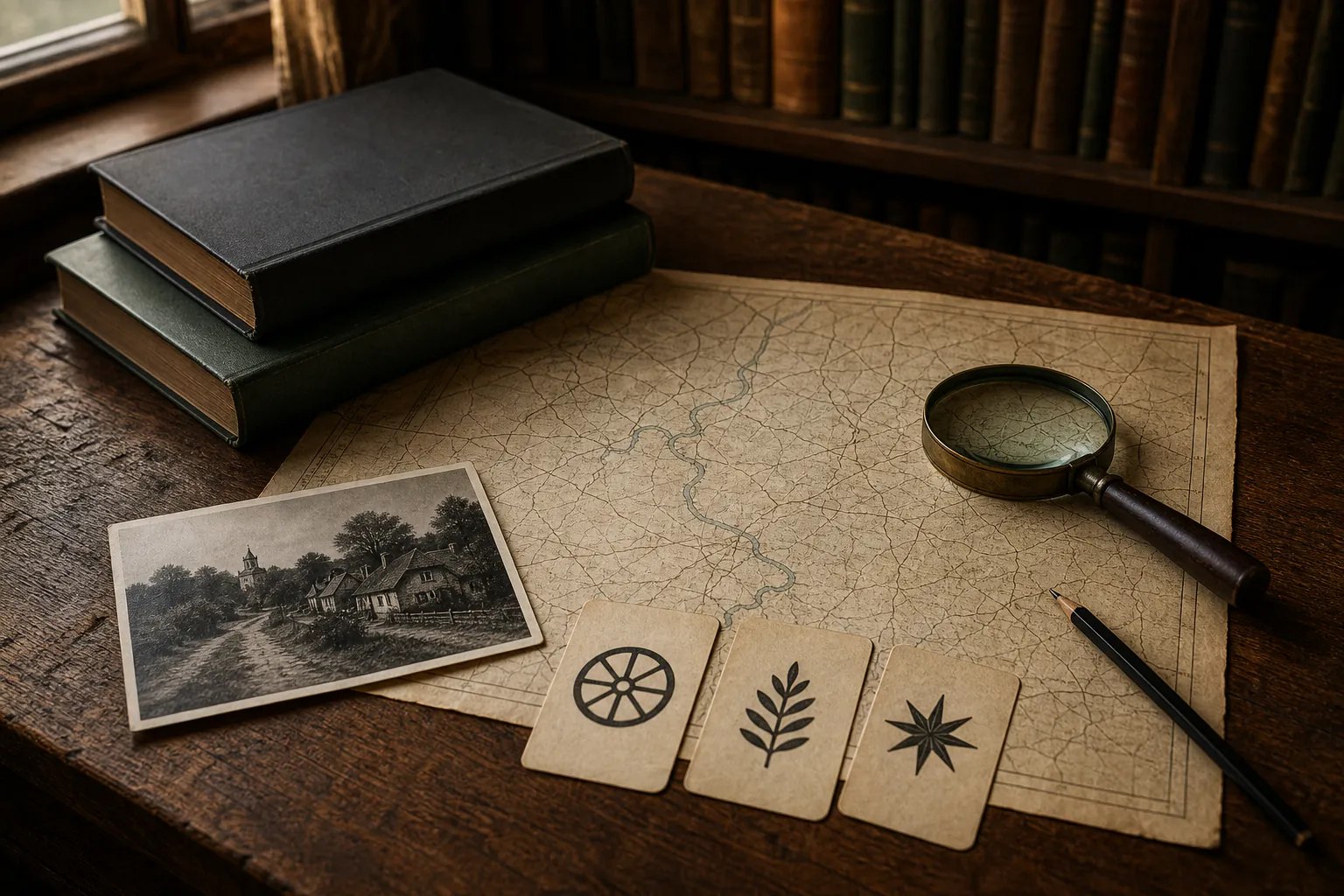
Choose one tightly bounded item: a named bridge legend, seasonal custom, children’s rhyme or weather saying. Record the version you encountered and its source. Search a local history catalogue, newspaper archive and folklore index for earlier or different versions. Build a table of date, place, teller or collector, wording and what changed, then visit the public location only if access and safety allow.
- 01
A legend can be culturally important without being a factual account. State clearly what a source records and what evidence does not establish.
- 02
“Ancient” is a claim that needs a dated trail. Many familiar customs are recent, revived or transformed, which is interesting rather than disappointing.
- 03
Different versions are the material of folklore, not errors to be merged into one perfect tale.
- 04
Collecting from living people needs consent, agreed use, accurate attribution and care around private, sacred or community-owned knowledge.
What to expect
The source chain is often part of the story
A tourist sign may quote a Victorian collector who paraphrased an unnamed teller, while a modern family version preserves different detail. Exploration means keeping those layers visible.
Definition
Folklore includes narrative, belief, custom, games, food, material culture, sayings and more—not only ghosts and fairy tales.
Variant
Oral and informal transmission changes wording, emphasis and setting. Difference can reveal audience and purpose.
Archive
Catalogues describe holdings imperfectly. Try place names, former spellings, motif terms and neighbouring parishes.
Collector
Every record reflects who asked, selected, translated and published. An archive is evidence, not a transparent window.
Place
A landscape visit can clarify route and material detail, but private land, hazards and wildlife remain firm boundaries.
Sharing
Retelling for entertainment should not erase source, living community or uncertainty merely to make the claim sound older or stranger.
Research method
Keep the context attached to every version
Define the item narrowly
Write the exact version first encountered and where it appeared. Give the project a boundary: “the black-dog story associated with one lane” is researchable; “black dogs in Britain” is a field. Separate the narrative from the accompanying claim that it is true, ancient, unique or typical. Each part may have a different evidential trail.
Search from local to comparative
Begin with the local library, museum, historic-environment record and digitised newspaper catalogue. Search variant spellings and nearby settlements. Then use a specialist collection such as the Vaughan Williams Memorial Library or Folklore Society indexes to find motif, custom or song connections. Record catalogue references even when the item is not digitised.
Build a variant table
For every source, note publication or collection date, claimed event date, place, teller or informant when known, collector, exact scope and significant differences. Mark quotation, paraphrase and your inference separately. A late source may preserve a real tradition, but it cannot by itself prove the tradition existed at the date it describes.
Collect and share ethically
Before interviewing, explain the project, recording method, storage, intended audience and whether anonymity is possible. Obtain meaningful consent and allow withdrawal under the agreed process. Do not publish precise locations for vulnerable sites or material a community regards as restricted. Credit archives, tellers and previous researchers in the final account.
Useful products
A broad sampler, a place-led study and a serious reference
The Treasury of Folklore offers themed entries that can suggest a first subject. The Fabled Coast demonstrates how stories attach to specific shorelines. The Oxford Dictionary is a substantial reference upgrade for checking terms and English traditions. It is expensive and not necessary before free catalogues and a local enquiry.
Dee Dee Chainey A Treasury of Folklore
The themed entries help identify a bounded story or motif worth tracing through catalogues.
Sophia Kingshill and Jennifer Westwood The Fabled Coast
The collection demonstrates comparison across named coastal locations rather than floating tales without provenance.
Jacqueline Simpson and Steve Roud A Dictionary of English Folklore
Repeated English folklore research benefits from a dependable reference with scholarly cross-references.
First enquiry
Trace three versions of one local item
Choose something small enough that three sources can be compared rather than merely collected.
- 01
Record the encountered version
Copy the wording, creator, platform, date and any claim about age or truth.
- 02
Define the boundary
Limit the item by place, name and type so search results remain comparable.
- 03
Search locally
Try the library catalogue, museum, historic record and newspaper archive with spelling variants.
- 04
Search a specialist index
Use VWML or Folklore Society resources for connected motifs, customs or collections.
- 05
Create a variant table
Record date, place, teller, collector, source type and changed details.
- 06
Visit only if appropriate
Use public access, daylight and safe conditions; do not trespass for atmosphere.
- 07
Write with uncertainty
Separate documented record, later claim, pattern and your own inference.
- 08
Credit the trail
List every archive, catalogue, teller and publication used, including unconfirmed leads.
What can wait
What can wait until one source trail is complete
A huge theme encourages decontextualised collecting. Depth in one case teaches the methods needed for breadth.
- 01
A national survey
Work through one place and item before comparing regions with different archives, terms and historical conditions.
- 02
Buying the Oxford reference
Use library access and free catalogues first. Its price is easier to justify when references recur across several projects.
- 03
Recording interviews
Learn consent, storage, transcription and withdrawal planning before collecting material from another person.
- 04
Night-time legend trips
Darkness adds risk and no evidential value. Visit lawful public locations in conditions suited to terrain and transport.
- 05
Declaring an origin
The earliest source found is the earliest source found—not automatically the moment a story began.
Upgrade path
Add comparative scope and original collection carefully
The next stage adds sources and responsibility, not certainty for its own sake.
Three-source local enquiry
FreeLibrary, catalogues and variant table
Learn provenance, dates and uncertainty.Comparative theme
Free to about £20Several local cases + specialist reading
Compare function and transmission without erasing place.Archive visit
Travel and copying costsCatalogue references + appointment
Inspect unpublished or undigitised material.Ethical field collection
VariableConsent, recorder, storage and deposit plan
Document living tradition with obligations to contributors.Ethics & access
Stories belong to contexts and people
Responsible folklore work protects contributors, communities, sites and the distinction between narrative and fact.
- Obtain informed consent before recording or publishing a living person and agree attribution, anonymity, storage, access and future use.
- Respect cultural, religious and community restrictions; public availability does not automatically make commercial reuse appropriate.
- Do not disclose vulnerable archaeological, ecological or private locations or trespass to reproduce a legend journey.
- Distinguish a documented belief or story from medical, historical or supernatural proof and do not promote unsafe folk remedies.
- Check copyright and archive reproduction terms for images, recordings and transcripts even when the underlying story is old.
Outside help
When an archive or society helps
A formal class is optional. Local librarians, museum staff, record offices and folklore events can reveal catalogues and terminology that general search misses.
Begin with catalogues, ethics guidance, indexes and local collections.
Choose source-led events that identify collections and research methods rather than presenting legend as fact.
Free catalogue access and representative UK event or short-course pricing checked 2 August 2026; travel and archive copying may add cost.
Sources
Where the guidance came from
The Folklore Society defines the field and ethical collection; specialist archives provide catalogues for source-led local and comparative work.
-
01
The Folklore Society · About folklore
Scope of folklore as traditional and vernacular culture and the society’s research remit.
Open source -
02
The Folklore Society · Ethics guidelines
Consent, intellectual property, contributors, archiving and sharing primary folklore material.
Open source -
03
Vaughan Williams Memorial Library · Explore
Specialist catalogues and digitised collections for folk song, dance, narrative and custom.
Open source -
04
British Library · Folklore collections
Collection context and routes into archival folklore material.
Open source -
05
Amazon UK · A Treasury of Folklore Waterlands Wooded Worlds and Starry Skies
Exact product page, model or ISBN, observed price and availability checked for this guide.
Open source -
06
Amazon UK · The Fabled Coast
Exact product page, model or ISBN, observed price and availability checked for this guide.
Open source -
07
Amazon UK · Oxford Dictionary of English Folklore
Exact product page, model or ISBN, observed price and availability checked for this guide.
Open source
Guide information and links checked 2 August 2026.