Beginner’s guide · Write & create
Start with what you own.
Keep only what helps.
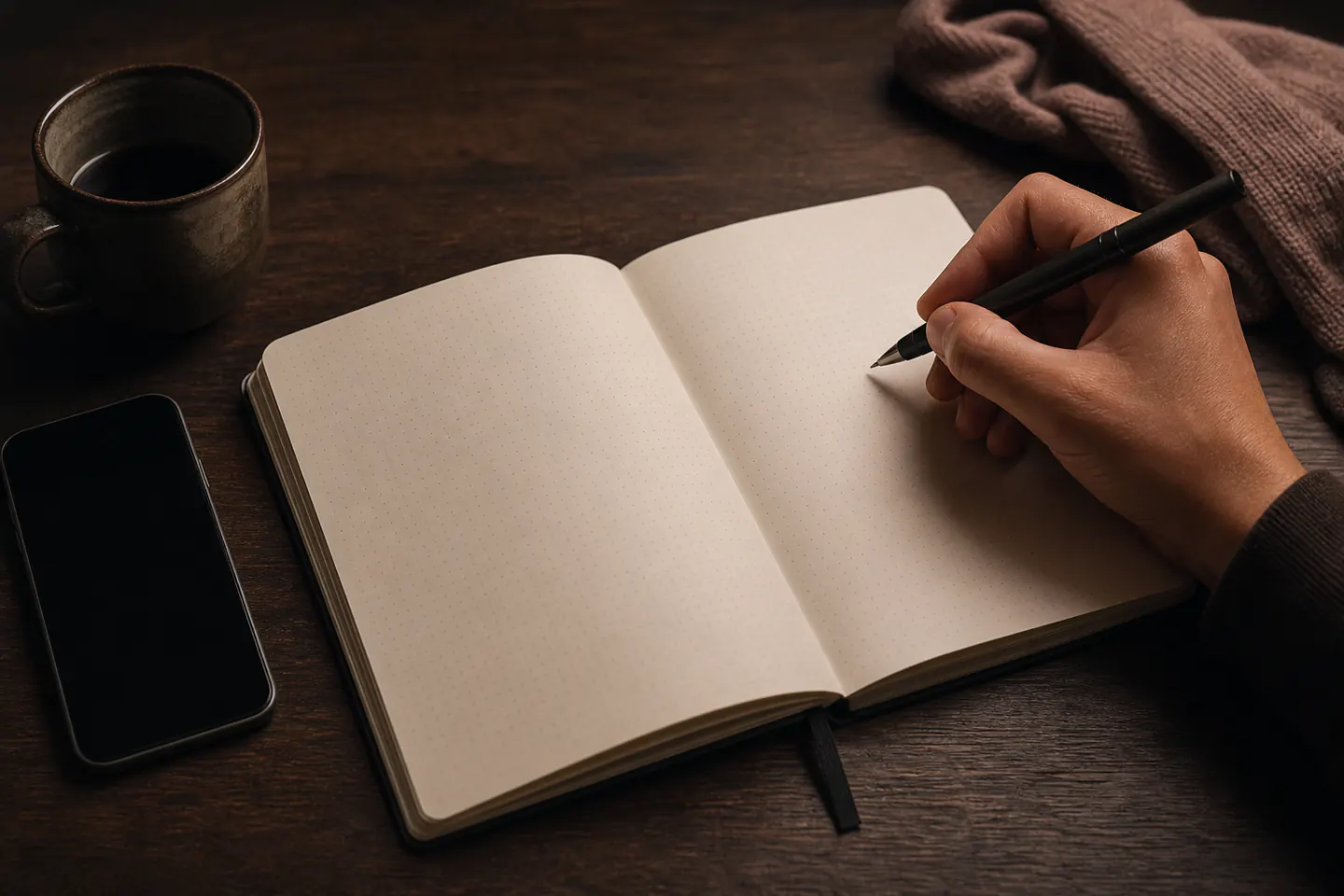
Begin on paper with any notebook and comfortable pen, or use a properly locked digital journal on a device you already own. Try a five-minute entry, then choose reflective writing, prompts or simple bullet logging without turning the page into a performance.
Quick answer
Write one useful entry today
Choose the route you will actually open. Paper is tactile, distraction-free and easy to begin with any spare notebook. Digital writing is searchable and easier to back up, but only when the device, app and account are properly protected. Neither route needs a daily streak or a polished page.
- 01
Put the date at the top, set a five-minute timer and answer: what happened, what mattered, and what do I want to remember or do next?
- 02
When full sentences feel unnecessary, use three rapid-log bullets: a task, an event and a note.
- 03
Missed days do not create a debt. Continue on the next blank page or next entry without rebuilding the gap.
- 04
Treat claims about wellbeing cautiously. Journalling can support reflection or mood tracking, but it is not a replacement for professional care.
What to expect
The useful pages are often ordinary
Most journalling is quieter and less decorative than the pages shown online. Its value comes from recording, noticing and returning, not from handwriting quality or a perfect routine.
The page is private work
Spelling, handwriting and crossed-out thoughts do not need fixing unless you plan to share the entry.
Frequency can change
Daily writing suits some people, while others write after an event, once a week or only when a project needs a record.
Early entries may feel flat
A first week often reads like a list of events. Patterns and useful questions become clearer after several entries.
The method should earn its place
A layout, tracker or prompt is useful only when it helps you notice, decide or remember something.
Storage matters
Paper accumulates and digital services change. Decide whether entries are temporary, private working notes or a long-term archive.
Choose a route
Choose paper, digital or a light hybrid
Paper journalling
Start with any unused notebook, exercise book or a few sheets of paper and a pen that does not make your hand work hard. Lined pages make continuous writing easy, dot grid helps with lists and simple layouts, and blank paper leaves room for sketches or pasted items. None is more authentic than another.
Paper removes notifications and makes each entry a physical object. It also takes space, cannot be searched automatically and can be read by anyone who finds it. A decorative lock on a notebook is usually less useful than sensible storage or a genuinely lockable container.
Digital journalling
A locked notes app can test the habit before you install anything. A dedicated journal app becomes useful when you need dated entries, prompts, search, media, reminders or export. Check device access, app passcode or biometrics, end-to-end encryption, backup, export formats and what happens if the subscription ends.
Typing is faster for long entries and digital search makes old notes easier to retrieve. The trade-off is dependence on a device, an account and software that may change. Start on one device and export a sample before trusting years of writing to it.
A light hybrid
You can capture short notes on a phone and write a weekly paper reflection, or keep a paper daily log with occasional digital scans. Do not copy every entry twice. The hybrid route works when each format has a clear job.
Starter options
Use what you own, then remove one irritation
Any spare notebook and comfortable pen can test the habit. The Silvine notebook and Jetstream pens are sensible replacements only when paper or pen is the friction; the heavier LEUCHTTURM1917 notebook is a later option for an archive you already know you will use.
Silvine A5 Executive Dotted Hardback Notebook
It gives prose and lists one compact home without turning the first entry into a stationery purchase.
Uni Jetstream SXN-150 0.5 mm Pens, Pack of 3
The fine quick-drying ink and retractable body suit everyday entries and left-handed writers who struggle with smearing.
LEUCHTTURM1917 Edition 120 Dotted A5 Notebook, Black
Numbered pages, stronger paper and hardback binding become useful when indexing and long-term storage are real needs.
What to skip
What can wait
Buying an identity around journalling is easier than learning what you will use. Delay anything that adds setup, pressure or storage before it solves a repeated problem.
- 01
A premium archival notebook
Paper weight, binding and page count matter after you know whether you prefer long writing, lists, wet ink, collage or portability.
- 02
A large pen and stationery set
One reliable pen is enough. Extra colours, stickers, stamps and tape are creative options, not requirements for reflection or bullet logging.
- 03
Complicated trackers and monthly spreads
A tracker that takes longer to maintain than the activity it records is unlikely to survive. Add one only when you know what decision the data will support.
- 04
Several separate journals
A journal for every topic creates more places to check and more unfinished books. Split subjects only when finding or protecting them has become difficult.
- 05
A paid app or automated analysis
Free text entries are enough to test digital journalling. Pay for sync, richer media or another specific capability, not because a higher tier promises deeper thoughts.
First entry
Make a five-minute first entry
The first result is not a beautiful page. It is a dated record that tells your future self what happened, what mattered and what should happen next.
- 01
Choose the privacy level
Decide whether this is a paper page that must be stored away, a temporary sheet you may destroy, or a locked digital entry. Do this before writing sensitive detail.
- 02
Date it and name the moment
Write the date, then one factual sentence about where you are or what has just happened. This gives the reflection an anchor.
- 03
Write what mattered
Continue with one of these: “The part I keep thinking about is…”, “I noticed…”, or “This took more energy than I expected because…”. Stop after a few honest lines if that is enough.
- 04
Leave one useful marker
Finish with one next action, question, reminder or thing you want to notice tomorrow. A bullet point is fine.
- 05
Close it without editing
Do not improve the handwriting or rewrite the entry. Return after several days and note which format helped: sentences, prompts, lists or a mixture.
Useful methods
Use a method for a reason
A simple daily record
Record what happened, one detail you would otherwise forget and one decision or next step. This works well for memory keeping without requiring a long emotional entry.
Reflective or free writing
Write continuously about a question, event or feeling for a limited time. A timer of five to fifteen minutes gives the session an end point. Reflective writing can feel intense, so it is reasonable to switch to neutral facts, stop early or choose a lighter prompt.
Prompt-based entries
A prompt removes the blank-page decision. Useful prompts are specific enough to answer but open enough to reveal something: “What made today easier?”, “What am I avoiding deciding?”, “What do I want to remember about this week?” or “What would make tomorrow less complicated?”
Gratitude or positive-event notes
Record a small event, person or detail you appreciated and explain why it mattered. Research on gratitude interventions reports average benefits across studies, but effects vary and a forced positive list can feel hollow. Specificity is more useful than pretending a difficult day was good.
Bullet journalling
The original Bullet Journal method uses rapid logging for tasks, events and notes, supported by an index and future or monthly logs. It does not require illustration. Begin with plain bullets and add collections or trackers only when they help you retrieve or act on information.
Project and interest journals
A reading log, garden record, travel diary, creative notebook or build log can be easier to maintain than a general diary because it has a clear subject. Record enough context to make the entry useful later, including dates, versions, conditions or results where relevant.
Upgrade path
Upgrade only when a limit repeats
The best upgrade removes friction, protects the archive or makes entries easier to retrieve. It does not make the writing more honest.
After 10–20 entries
£0–£10Choose the ruling, size or reusable digital template that matched the entries you actually made.
You spend less time deciding how to begin and more time writing.When paper fills quickly
Roughly £7–£27Move to a durable notebook with the page count, binding and paper weight your pen or collage needs. Number pages or use an index if retrieval matters.
Better binding and paper can improve durability, lay-flat use and show-through, but they do not improve the content.When one device is the limit
Paid app planPay for multi-device access or richer media only after the free tier has become a repeated limit.
You can write across devices and attach more material. The trade-off is a recurring subscription and continued dependence on the service.When the archive matters
£0 onwardLabel paper volumes and store them dry, or schedule digital exports and protect both the files and any encryption key.
Preservation becomes intentional, and changing app or device is less likely to strand the journal.Privacy & limits
Protect the writing and the person writing it
Journalling is physically low risk, but private writing can expose personal information, strain a hand during long sessions or make difficult material feel more immediate.
- For paper, choose storage based on the people who can access the space. Keeping a journal out of sight may be enough in a respectful home; otherwise use a genuinely lockable container or choose digital writing.
- For digital entries, use a strong device PIN or password, biometrics where suitable and two-step verification on the account. Make a backup or export, then protect that copy too.
- End-to-end encryption is only as recoverable as its key. Day One warns that losing the key can make synced encrypted entries unreadable, while exported files may not keep the app’s encryption.
- Writing about upsetting events can increase distress in the moment, and research does not support presenting journalling as a cure. Stop, switch to factual logging or seek qualified support when writing is making things worse.
- Avoid unnecessary identifying detail about other people, especially in files you may share, sync or leave unlocked. Decide deliberately whether an entry is private, shareable or temporary.
- Use shorter sessions and a relaxed grip if handwriting becomes tiring. Cut down the activity and seek appropriate health advice for persistent pain, tingling, numbness or weakness.
Sources
Sources and checked information
Checked 27 July 2026
The guide combines official method and software documentation, peer-reviewed reviews, UK health and cyber-security guidance, a current UK product page and recurring beginner experience from journalling communities.
-
01
Bullet Journal · What is the Bullet Journal Method?
Official definition of rapid logging and the task, event and note bullets used by the method
Open source -
02
Bullet Journal · How to start for beginners
Official beginner setup, notebook flexibility, index, future log and monthly log without decorative requirements
Open source -
03
Day One · plans
Current Basic, Silver and Gold plan features, one-device Basic access, privacy features, export and 2026 list prices
Open source -
04
Day One · pricing and features guide
Official details for the free Basic plan and Silver annual subscription, including sync, media and platform availability
Open source -
05
Day One · end-to-end encryption FAQ
Encryption scope, default status for new journals, key recovery limits and warning that some backups or exports are not encrypted
Open source -
06
Day One · keeping an encryption key safe
Official explanation that Day One does not retain a copy of a user-held end-to-end encryption key
Open source -
07
Day One · exporting entries
Current export formats and platform-specific limitations for PDF, JSON, plain text, Markdown and CSV
Open source -
08
Mind · depression self-care
UK charity guidance that a mood diary can help someone notice mood changes and patterns
Open source -
09
Sohal et al. · journalling systematic review
Systematic review and meta-analysis reporting promising adjunct effects alongside high heterogeneity and methodological limits
Open source -
10
Diniz et al. · gratitude interventions review
Systematic review and meta-analysis of gratitude interventions, supporting cautious wording about average benefits rather than guaranteed outcomes
Open source -
11
American Psychological Association · expressive writing
Specialist discussion of expressive writing, its possible benefits and a practical way to try it
Open source -
12
NCSC · protecting your devices
UK government guidance on device PINs, passwords and biometric access controls
Open source -
13
NCSC · back up important data
UK government advice to back up important information and protect accounts with strong passwords and two-step verification
Open source -
14
NHS · pain in the palm of the hand
Current NHS advice to reduce activities such as writing when they cause hand pain and to seek help for concerning symptoms
Open source -
15
r/Journaling · beginner discussion
Community examples showing that journals can cover days, projects, thoughts or interests without one correct frequency or format
Open source -
16
r/Journaling · handling missed days
Recurring advice that gaps can be left alone and pressure to backfill can make the practice harder to sustain
Open source -
17
r/bulletjournal · starting without artwork
Repeated practitioner advice that a functional bullet journal does not require artistic spreads or special handwriting
Open source -
18
r/Journaling · privacy concerns
Real-world privacy concerns and recurring use of app locks or digital alternatives when paper cannot be stored privately
Open source -
19
Amazon UK · Silvine A5 dotted hardback notebook
Exact 160-page, 90 gsm A5 dotted notebook, £6.54 observed price and current availability.
Open source -
20
Amazon UK · Uni Jetstream SXN-150 0.5 mm three-pack
Exact three-pen listing, £6.30 observed price and in-stock status.
Open source -
21
Amazon UK · LEUCHTTURM1917 Edition 120 dotted A5
Exact black 120 gsm, 203-numbered-page notebook, £26.90 observed price and in-stock brand-store offer.
Open source
Guide information and links checked 27 July 2026.