Beginner’s guide · Make & create
Tie three knots,
repeat them on purpose.
Start with soft 3 mm cotton cord and one small hanging or keyring. Clean measuring, secure mounting and even tension matter more than a large box of beads.
Quick answer
Learn the square knot before planning a wall hanging
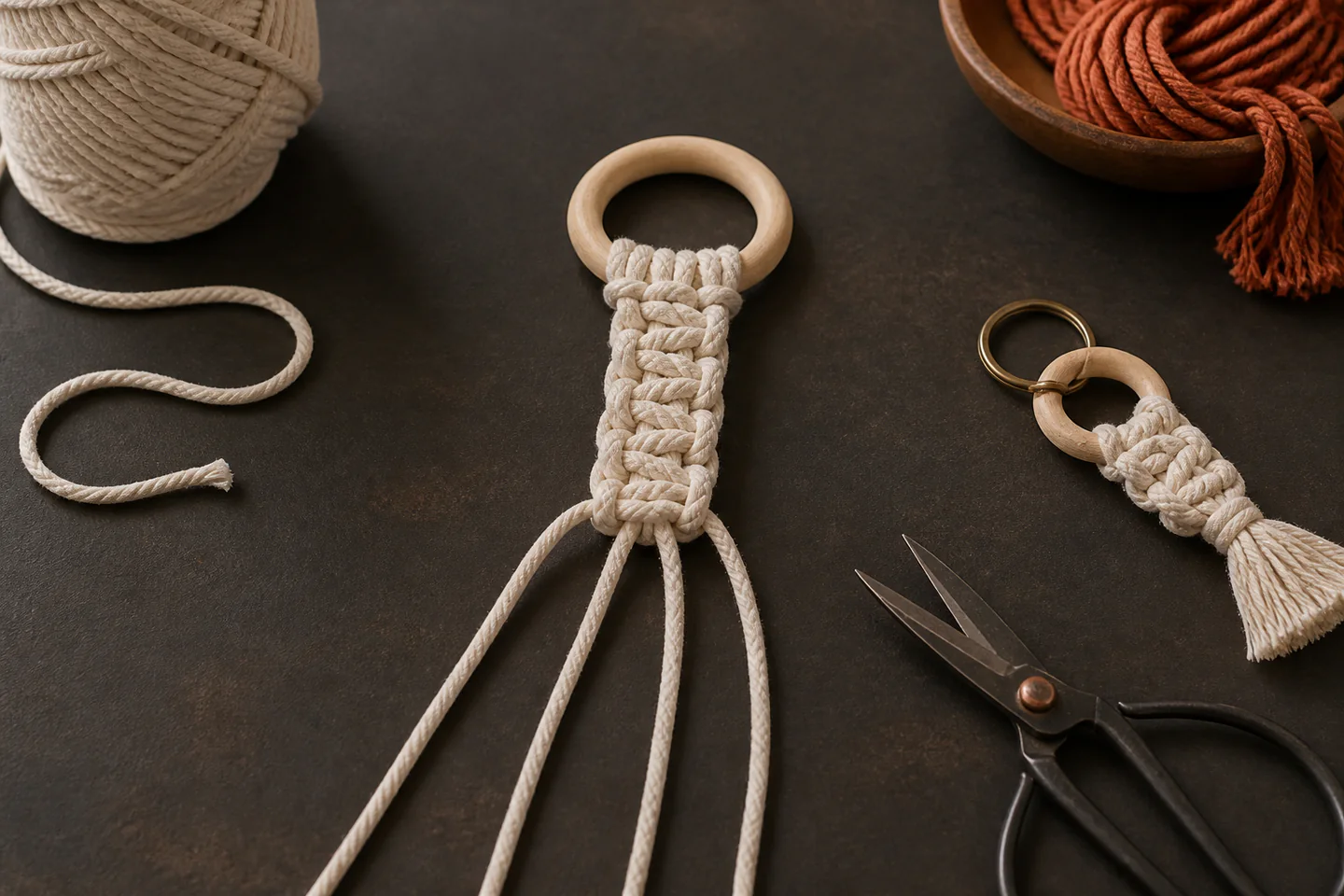
Cut four equal lengths of soft 3 mm cotton cord, attach them to a ring with lark’s-head knots and practise a short band of alternating square knots. Mount the work so both hands can pull horizontally, use one completed knot as the spacing reference and stop to comb the cords straight every few rows. A keyring or narrow plant hanger makes the tension visible without committing metres of cord to an uneven first panel.
- 01
Begin with a single-twist or three-ply cotton cord whose construction is easy to see and undo.
- 02
Measure from a written cutting list and label long cords before they tangle.
- 03
Anchor the ring or dowel at a comfortable working height; a loose project twists while the knot is tightened.
- 04
Pull matching working cords with the same angle and force instead of tightening one strand at a time.
- 05
Leave fringe trimming until the work has hung overnight and the knots have settled.
What to expect
Most of the work is measuring and managing cord
The knots are learnable in minutes. The finished shape depends on cord allocation, mounting height, tension and recognising which strands are carrying the structure.
Cord use
A compact hanger can consume many times its finished length because knots shorten the working cords. Add a sensible allowance and keep a spare length from the same batch.
Tension
A very tight knot is not automatically a neat knot. Consistent direction and spacing matter more than maximum force.
Twist
Single-twist cord brushes into a soft fringe but untwists easily; braided cord stays tidy but produces a different finish.
Pattern reading
Diagrams name the holding and working cords. Marking the left working strand during practice prevents mirrored rows.
Finishing
Trim only after checking weight and level. A plant hanger must support its intended pot securely without relying on decorative fringe.
Core method
Build from knots that have a clear job
Mount securely
Fix a ring or dowel to a stable rail, clothing rack or closed door hook that can take the light practice load. Work with the project centred and high enough that the cords hang freely. Never use a temporary decorative fixing for a loaded plant hanger.
Separate working and holding cords
Lay every strand flat, identify the centre fillers and move only the outside working cords. Practise left-facing and right-facing half knots, then combine them into a square knot that does not spiral.
Measure repeats
Use a ruler or a small card spacer rather than judging every gap independently. Check the width after each row and loosen a knot immediately if the panel begins to lean.
Finish for the actual load
For decoration, trim and brush only after the piece settles. For a hanger, seat an empty pot, then add weight gradually over a protected surface and inspect every gathering knot before use.
Useful products
Products with a clear job in the setup
The suo long kit is the broad starter route; the keyring kit limits the first project and reduces waste; the UHAPEER set adds more cord and fittings for repeat projects. Choose one route, not all three.
suo long Macramé Starter Kit with 3 mm Cord and Instructions
The 3 mm cord is large enough to read each knot and the included hardware supports several small exercises.
suo long Macramé Keychain Making Kit with Tutorials
Short pieces are easier to manage and make uneven square knots obvious before a larger hanging.
UHAPEER DIY Macramé Kit with 656 ft Cotton Cord
It extends the same cord-based method without requiring specialist machinery.
First project
Make one eight-knot keyring
A narrow object gives fast feedback on mounting, direction and tension while using very little cord.
- 01
Cut and label
Cut four equal strands from the pattern and mark the working pair with removable clips.
- 02
Attach to the ring
Fold each strand and make matching lark’s-head knots with the ridges facing the same way.
- 03
Tie one square knot
Make a left half knot followed by a right half knot and compare both sides before tightening.
- 04
Repeat with a spacer
Use a small card to keep eight knots evenly separated or packed, according to the design.
- 05
Gather the cords
Use the pattern’s wrapping knot or secure finish and test it with a steady hand pull.
- 06
Trim after resting
Hang the keyring overnight, comb the ends and make one level final cut.
What can wait
What can wait until the first result
Scale, colour and decoration are easy to add later; they do not correct a panel that leans or a gathering knot that slips.
- 01
Large wall hangings
They multiply measuring errors and cord tangles before basic tension is repeatable.
- 02
Heavy plant pots
The load, ring, fixing and cord all need checking; practise with an empty lightweight pot first.
- 03
Large bead assortments
Hole size must match the cord and decoration can obscure the knot structure.
- 04
Fringe combs and steamers
A clean brush and careful trimming are enough for the first small piece.
- 05
Many cord constructions
Changing material while learning makes tension and shrinkage harder to compare.
Upgrade path
Upgrade the repeated limitation
Buy more cord or hardware when the same finished size or texture is limiting several projects.
Knot sample
About £5–£15Owned scissors + small cord roll
Learn direction and tension.Small finished object
About £10–£30Keyring or hanger kit
Practise measuring and secure finishing.Designed wall piece
About £30–£90Chosen cord, dowel and mounting board
Control scale, colour and negative space.Repeat commissions
About £100–£350+Bulk cord, cutting station and load records
Repeat dimensions and finishes consistently.Safety & care
Treat hanging work as a load, not only decoration
Cord, knots, rings and the wall fixing form one system. A neat-looking hanger can still slip, stretch or overload its support.
- Keep long cords organised and away from young children, pets, fans, heaters and walkways.
- Use a stable working support; do not pull against an unsecured chair, glass fitting or temporary adhesive hook.
- Test plant hangers gradually above a protected floor and use only wall fixings rated for the wall and expected load.
- Sharp scissors belong on the table rather than in a pocket or hanging among loose cords.
- Natural cord can shed fibres; ventilate during brushing and clean loose lint without creating airborne dust.
Outside help
When outside help earns its place
Clear diagrams or video are enough for the first square-knot sample. A workshop helps when reading complex charts, calculating cord for original designs or learning secure large-scale mounting.
Match the cord path exactly and pause after each half knot.
Ask whether cord, hardware, load testing and a finished project are included.
Representative UK learning options checked 28 August 2026; local prices, access, materials and tutor support vary.
Sources
Where the guidance came from
Cord makers and knot references establish construction and technique; experienced makers add recurring evidence about measuring, tangles, tension and finishing.
-
01
Bobbiny · product and cord guide
Cord constructions, diameters and intended craft uses.
Open source -
02
Craft Yarn Council · yarn standards
Shared terminology for comparing yarn and cord scale.
Open source -
03
Gathered · macramé knots guide
Illustrated beginner knot sequence and project context.
Open source -
04
Reddit · r/macrame
Community evidence on cord choice, measuring, mounting and tension problems.
Open source -
05
Heritage Crafts · macramé
Craft context and traditional hand-knotting practice.
Open source -
06
Amazon UK · Macramé Starter Kit with 3 mm Cord and Instructions
Exact product catalogue page or ISBN used for the recommendation; current price, seller, specification and availability should be confirmed.
Open source -
07
Amazon UK · Macramé Keychain Making Kit with Tutorials
Exact product catalogue page or ISBN used for the recommendation; current price, seller, specification and availability should be confirmed.
Open source -
08
Amazon UK · DIY Macramé Kit with 656 ft Cotton Cord
Exact product catalogue page or ISBN used for the recommendation; current price, seller, specification and availability should be confirmed.
Open source
Guide information and links checked 28 August 2026.