Beginner’s guide · Explore earth science
Cut wet and inspect often,
then polish one simple curve.
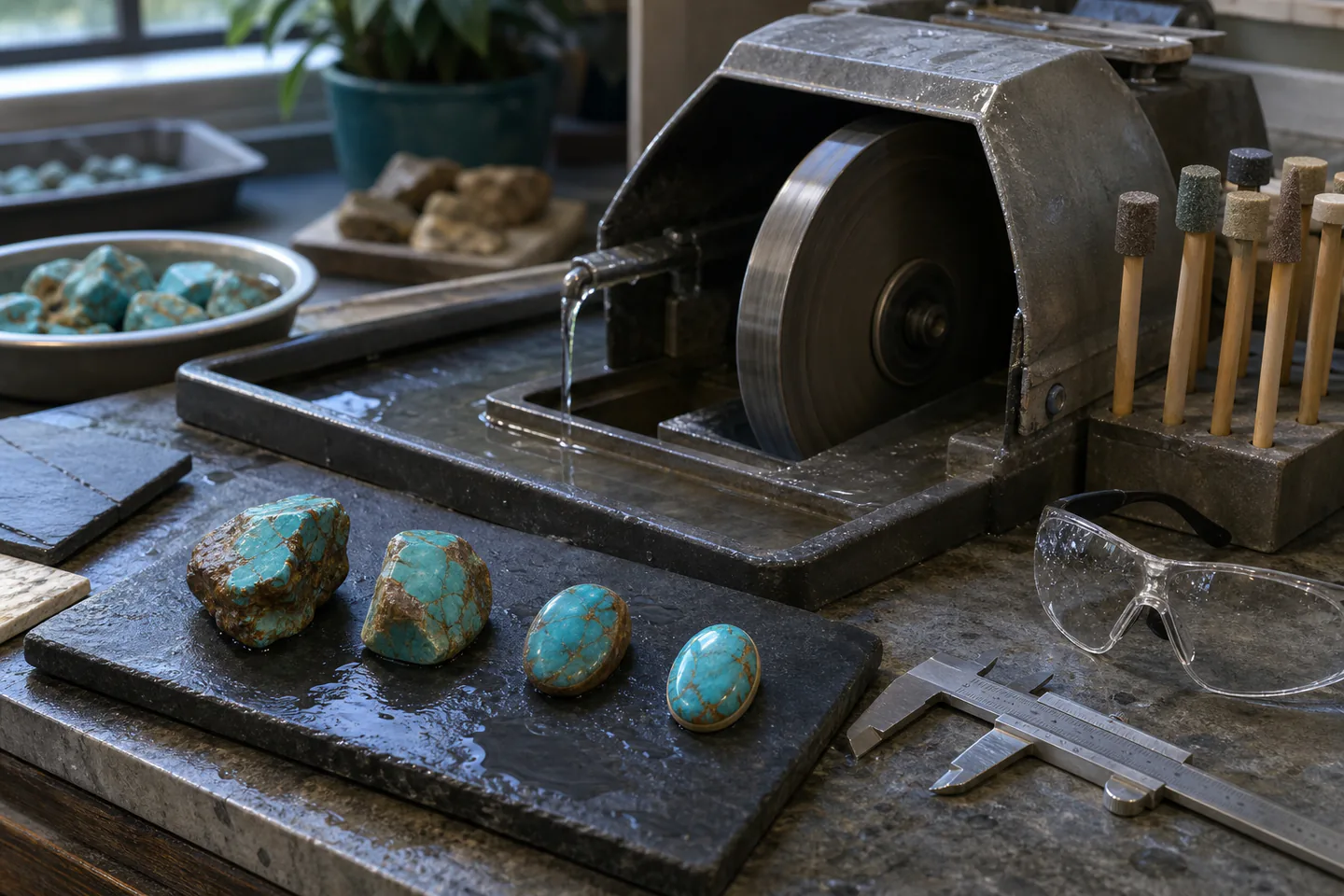
A supervised cabochon workshop teaches trim-saw cuts, wet grinding, doming, sanding and polish while controlling silica, wheel hazards and unknown stone.
Quick answer
Complete one cabochon before expanding the setup
Book a beginner session at a lapidary or geological club and use a tutor-approved common stone. Mark a simple oval, let the instructor demonstrate the guarded trim saw, grind wet through the workshop’s coarse-to-fine sequence while rotating the stone, create an even dome and girdle, remove every previous scratch before advancing and polish only after the surface is uniformly pre-polished.
- 01
Wet grinding suppresses dust and cools the stone but does not remove wheel, splash or electrical hazards. Record what happened during lapidary so the next attempt changes one known variable instead of several guesses.
- 02
Each finer stage removes scratches from the previous grit; skipping ahead preserves deep damage under polish. Record what happened during lapidary so the next attempt changes one known variable instead of several guesses.
- 03
A stable girdle protects the edge and gives a future setting a predictable seat. Record what happened during lapidary so the next attempt changes one known variable instead of several guesses.
- 04
Unknown minerals can contain silica, asbestos-like fibres, heavy metals or treatments and need identification before cutting. Record what happened during lapidary so the next attempt changes one known variable instead of several guesses.
What to expect
What lapidary is really like at the start
The useful beginner controls are preparation, one bounded task and a record of the result; specialist equipment matters only when it solves a repeated limitation.
Rough
Fractures, soft veins and undercutting appear as the surface is ground. Record what happened during lapidary so the next attempt changes one known variable instead of several guesses.
Shape
Uneven pressure creates flats, shoulders and a lopsided dome. Record what happened during lapidary so the next attempt changes one known variable instead of several guesses.
Scratch
One coarse grain carried forward can re-mark an entire finer stage. Record what happened during lapidary so the next attempt changes one known variable instead of several guesses.
Polish
Stone type determines suitable abrasive and polish; one compound is not universal. Record what happened during lapidary so the next attempt changes one known variable instead of several guesses.
Core method
The core lapidary method
Assess and mark
Identify the rough, inspect fractures and orient a modest template around sound material. Record what happened during lapidary so the next attempt changes one known variable instead of several guesses.
Trim under supervision
Use the guarded saw with the workshop feed method and keep hands outside the hazard zone. Record what happened during lapidary so the next attempt changes one known variable instead of several guesses.
Grind through grits
Keep water flowing, move continuously and clean stone, hands and station between stages. Record what happened during lapidary so the next attempt changes one known variable instead of several guesses.
Pre-polish and finish
Inspect dry under strong light, return to the correct stage for scratches and use the stone-appropriate polish. Record what happened during lapidary so the next attempt changes one known variable instead of several guesses.
Useful products
Products with a clear job in the route
Safety glasses are baseline protection, the face shield adds assessed splash and fragment coverage and the caliper checks girdle and symmetry; the machine and stone should come through a supervised workshop first.
3M SecureFit 200 Safety Glasses
They are easy to keep at the bench for routine impact risks.
Uvex Bionic Polycarbonate Face Shield
A visor increases coverage during controlled stone and workshop work.
Kynup Digital Caliper, 150 mm
It makes small fit differences visible instead of relying on feel.
First project
Cut one common-stone oval cabochon
Use a club-supplied blank or known rough and a simple dome so every grit can be inspected.
- 01
Confirm the stone and route
Ask the tutor about hazards, fracture, grit and polish compatibility. Record what happened during lapidary so the next attempt changes one known variable instead of several guesses.
- 02
Mark the template
Place a simple oval inside sound material. Record what happened during lapidary so the next attempt changes one known variable instead of several guesses.
- 03
Trim and establish the girdle
Follow the guarded saw and wheel procedure and keep the edge even. Record what happened during lapidary so the next attempt changes one known variable instead of several guesses.
- 04
Build the dome through grits
Rotate consistently and remove the complete previous scratch pattern. Record what happened during lapidary so the next attempt changes one known variable instead of several guesses.
- 05
Polish and review
Dry, inspect under bright light and record material, stages and defects. Record what happened during lapidary so the next attempt changes one known variable instead of several guesses.
What can wait
What can wait until the first result
Delay anything that adds cost, risk or another variable before the basic workflow has produced something you can review.
- 01
Buying a cabbing machine
Noise, water, drainage, wheels and maintenance are easier to understand after club use. Record what happened during lapidary so the next attempt changes one known variable instead of several guesses.
- 02
Unknown attractive rough
Appearance does not reveal hazardous minerals, treatments or fracture. Record what happened during lapidary so the next attempt changes one known variable instead of several guesses.
- 03
Freehand faceting
Angles, laps and optical design are a different specialist route. Record what happened during lapidary so the next attempt changes one known variable instead of several guesses.
- 04
Dry grinding
It creates dangerous dust and unnecessary heat. Record what happened during lapidary so the next attempt changes one known variable instead of several guesses.
Upgrade path
Add the capability you can now name
Each stage should remove a demonstrated constraint rather than make the setup look more advanced.
Use what you own
£0–£20Existing equipment and one written plan
Take a supervised cabochon workshop.Repeat the first route
About £50–£120 workshop; machines cost moreA complete repeatable starter setup
Repeat common stones on shared wet equipment.Add one capability
Often £50–£250One selected tool, service or learning resource
Buy personal PPE, templates or small hand tools for a known club workflow.Build specialist depth
Club, course or specialist dependentA documented specialist workflow
Consider a home machine only after drainage, power, guarding, dust, noise and material controls are designed.Safety & care
Wet work still needs guarding, extraction and material knowledge
Silica, unknown minerals, rotating wheels, splash and electricity make a club the sensible first venue.
- Use only identified tutor-approved stone and never cut fibrous, radioactive, arsenic-, mercury- or lead-bearing material casually.
- Keep wheels wet with guards and local controls in place and never dry grind silica-bearing stone.
- Wear fitted eye protection and any additional face, hearing or respiratory protection required by the risk assessment.
- Tie hair, remove loose clothing and jewellery and keep gloves away from rotating wheels unless the machine procedure explicitly requires them.
- Use electrically safe wet-work equipment, manage slurry as mineral waste and never wash settled solids into household drains.
Outside help
When outside help earns its place
A lapidary club or geological society workshop is the correct first purchase because it supplies guarded wet equipment, known rough and live correction.
Ask about material exclusions, PPE, slurry disposal, machine induction and whether one cabochon can be completed.
Use outside help after the first lapidary attempt can reveal the exact technique, access or safety problem that needs live correction.
Representative UK learning and access routes checked 1 September 2026; local prices, permissions, equipment and tutor support vary.
Sources
Where the guidance came from
Authoritative and specialist guidance supports the method and safety boundaries; community discussion contributes recurring beginner problems rather than unsupported claims.
-
01
Gem-A · Gemmology education
UK gemmology, materials and structured practical learning.
Open source -
02
HSE · Silicosis
Respirable silica hazard and control context.
Open source -
03
HSE · Abrasive wheels
Selection, mounting, guarding, training and use of abrasive wheels.
Open source -
04
Mindat
Mineral properties, localities, photographs and nomenclature reference.
Open source -
05
International Gem Society · Cabochon cutting
Cabochon shape, grinding stages and polishing overview.
Open source -
06
Reddit · r/Lapidary
Community evidence on machines, grits, contamination and beginner cabochons.
Open source -
07
Amazon UK · SecureFit 200 Safety Glasses
Exact Amazon UK product page or ISBN used for this recommendation; current price, seller, specification and availability should be confirmed.
Open source -
08
Amazon UK · Bionic Polycarbonate Face Shield
Exact Amazon UK product page or ISBN used for this recommendation; current price, seller, specification and availability should be confirmed.
Open source -
09
Amazon UK · Digital Caliper, 150 mm
Exact Amazon UK product page or ISBN used for this recommendation; current price, seller, specification and availability should be confirmed.
Open source
Guide information and links checked 1 September 2026.