Beginner’s guide · Make & create
Cut the mechanism,
then design around it.
Begin with one box fold and one V-fold in plain card. Prototype the motion before adding illustration, because a beautiful panel cannot rescue a hinge that collides.
Quick answer
Prototype one box fold in scrap card
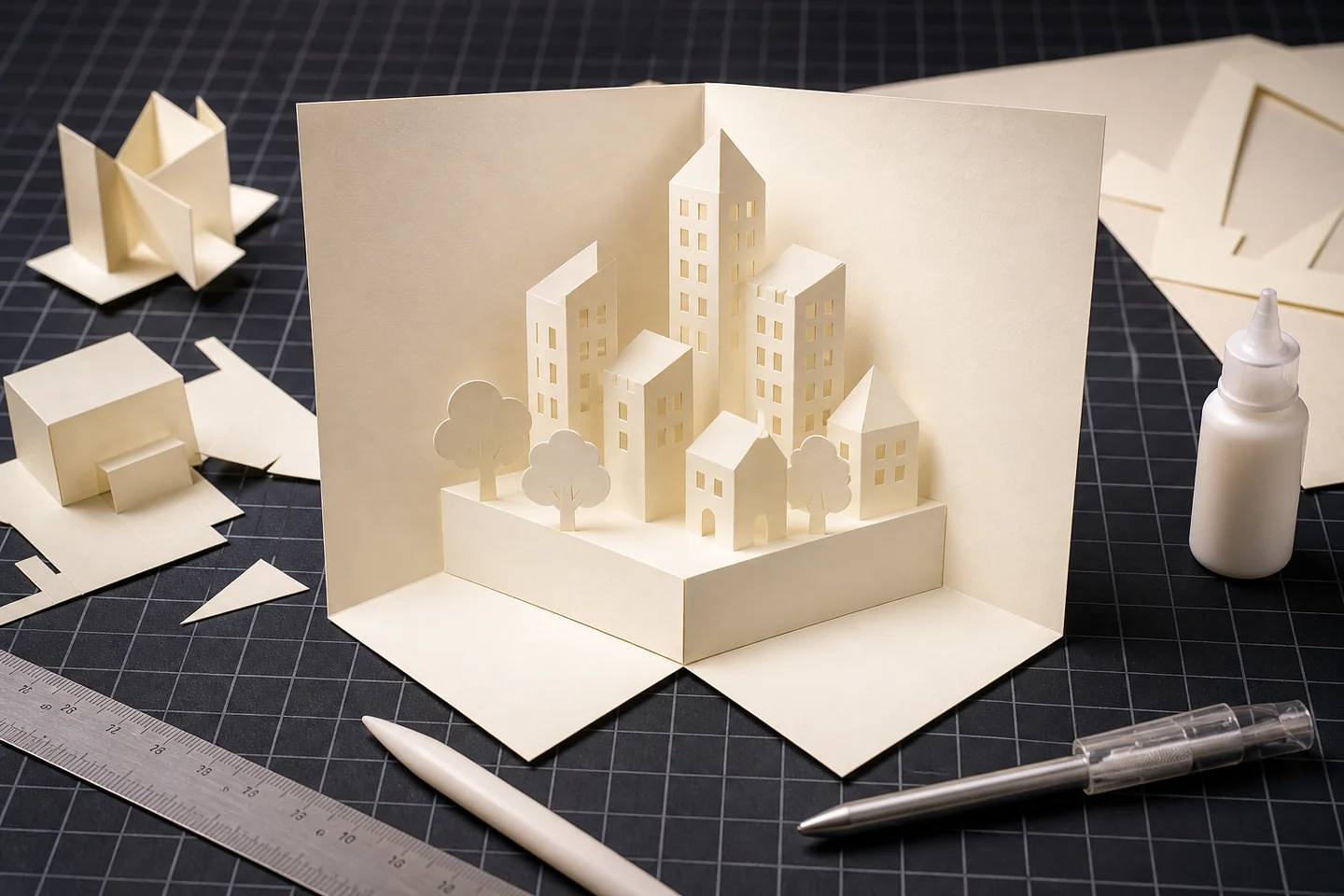
Fold a sheet of medium card in half, draw two equal parallel cuts crossing the fold and cut them with a sharp knife on a self-healing mat. Score the connecting fold line, push the tab inward and close the card to train the new mountain and valley folds. Open it slowly, check that the platform rises squarely and repeat in scrap until it closes without buckling. Only then glue a light decorative shape to the front of the platform, keeping all artwork inside the closed card edges.
- 01
Mechanism comes before illustration. Prove opening, closing and clearances in plain scrap card before decorating.
- 02
Score fold lines with a blunt tool rather than cutting through fibres. A hinge needs compression, not a weakened slit.
- 03
Every moving piece needs space in both open and closed states. Test with tracing paper or rough shapes before applying glue.
- 04
Use tiny controlled amounts of paper adhesive and let structural joints dry while supported.
- 05
Craft knives are adult tools requiring a mat, sharp blade, safe ruler technique and a cut path away from every body part.
What to expect
A pop-up is a sequence, not a static sculpture
The card can look perfect at ninety degrees and still tear when fully opened or protrude when closed. Engineering means testing the whole movement repeatedly.
Fold
Grain direction and card thickness change how easily a hinge flexes. Heavy card is not always stronger once repeatedly bent.
Box
Parallel cuts create a platform whose depth controls how far the attached element moves towards the viewer.
V-fold
Angle and attachment points create rotation. Small placement changes alter motion dramatically.
Clearance
Tall artwork may hit the spine; wide elements can leave the outer edge. Close slowly and mark collision points.
Glue
Wet adhesive warps card and locks moving layers. Apply only to marked tabs and protect the mechanism.
Prototype
A rough white model is not wasted work; it records measurements for a clean final card.
Core method
Test the movement through the full opening arc
Choose one mechanism
Use a reputable printable or measured tutorial for a box fold. Mark cut, mountain and valley lines differently and keep a completed reference visible. Use uncoated medium card first so scoring, fibres and glue behaviour remain easy to see.
Cut and score safely
Work on a self-healing mat with bright light and a metal ruler used with fingers behind the guard edge. Make several light knife passes rather than forcing one deep cut. Score with a blunt stylus against the ruler and fold each hinge both ways before training its final direction.
Train and cycle the prototype
Push the platform through the card spine, close the card gently and burnish only the intended folds. Open from zero to 180 degrees several times, watching the corners. If it buckles, remake the geometry rather than trimming random moving edges.
Add light decoration
Create a paper shape smaller than the tested clearance envelope. Dry-fit with removable tape, mark the exact glue zone and attach only to the platform face. Let it dry closed under light even pressure, then open slowly and record the working dimensions.
Useful products
Products with a clear job in the setup
The OLFA knife and Fiskars A3 mat form the safe precision-cutting foundation, while Bearly Art glue’s fine tips help keep adhesive off moving folds. A metal ruler with a raised finger edge and a blunt scoring tool are also required if not already owned.
OLFA AK-1 Art Knife with 25 Blades
Replaceable sharp blades reduce tearing and make several light passes predictable.
Fiskars A3 Self-Healing Cutting Mat
A3 accommodates open cards and full sheets while the grid helps preserve right angles.
Bearly Art Precision Craft Glue Mini, 2 fl oz
A fine nozzle reduces squeeze-out and water load around hinges compared with a broad bottle.
First project
Build a pop-up city with one platform
A skyline attached to a single box fold gives a strong reveal while every structural edge remains visible and diagnosable.
- 01
Fold the base
Align the card edges and crease the centre without stretching the paper.
- 02
Mark equal cuts
Measure two parallel lines of identical length crossing the spine.
- 03
Cut and score
Use light knife passes for cuts and a blunt tool for the new fold.
- 04
Train the platform
Push it inward, close the card and cycle the movement several times.
- 05
Dry-fit a skyline
Keep it light and inside every edge when the card closes.
- 06
Glue only the face
Protect hinges, let the card dry supported and retest slowly.
What can wait
What can wait until the first result
Multiple mechanisms become much easier after one prototype has a measured clearance envelope and survives repeated closing.
- 01
Complex character mouths
They combine several folds, artwork alignment and collision points.
- 02
Very thick board
It resists tight hinges and changes the geometry shown in paper tutorials.
- 03
A digital cutting machine
Mechanism design and fold training remain the limiting skills.
- 04
Wet decorative media
Paint and heavy glue can warp the precisely tested movement.
- 05
Edition production
Repeat cards require templates, jigs and quality checks that one successful original does not prove.
Upgrade path
Upgrade the repeated limitation
Add mechanisms after the prototype explains exactly which new movement the card needs.
Box-fold card
About £20–£55Knife, mat, card and glue
Learn cut, score and clearance.V-fold scenes
About £30–£80Scoring tools and tracing paper
Add rotation and layered depth.Complex mechanisms
About £50–£160Books, templates and precision rulers
Coordinate tabs, pivots and pull elements.Original editions
About £150–£800+Digital design, cutter and production jigs
Repeat a tested design consistently.Safety & care
Protect hands and respect the paper engineer’s design
Sharp blades and copyrighted templates are the practical boundaries. Build legitimate projects, keep the cut path controlled and never redistribute paid files or scans.
- Craft knives are adult tools: use a stable mat, sharp intact blade and guarded ruler technique with every cut directed away from the body.
- Cap and count blades, collect broken tips and use a suitable sharps container rather than loose household waste.
- Ventilate and follow labels for adhesives, inks and coatings and keep them away from food, flame, children and pets.
- Use templates only under their stated licence; do not redistribute paid files, scans of books or copied commercial designs.
- Support long sessions with good light, neutral wrists and breaks, because repeated tiny cuts and close focus can strain hands and eyes.
Outside help
When outside help earns its place
Robert Sabuda’s free mechanisms are enough for a first card. A workshop earns its place when a paper engineer can diagnose V-fold geometry, pull tabs and multi-page sequencing in physical prototypes.
Begin with one named mechanism and preserve the licence terms.
Ask whether tools, card, templates and take-home prototypes are included.
Representative UK learning options checked 18 August 2026; local prices, access, materials and tutor support vary.
Sources
Where the guidance came from
Established paper engineers and museum educators provide tested mechanisms. Tool makers and active paper communities add evidence about blade control, card grain, adhesives and failure during repeated movement.
-
01
Robert Sabuda · Pop-up templates
Free mechanisms and project templates from an established paper engineer.
Open source -
02
Robert Sabuda · Single-sheet layer
A specific foundational mechanism and assembly sequence.
Open source -
03
Smithsonian Learning Lab · Pop-up lesson
Museum learning context for paper mechanisms.
Open source -
04
OLFA · AK-1 art knife
Manufacturer specifications and blade context.
Open source -
05
Reddit · r/popupbooks
Community evidence on mechanisms, books, prototypes and tools.
Open source -
06
Amazon UK · AK-1 Art Knife with 25 Blades
Exact product catalogue page or ISBN used for the recommendation; current price, seller, specification and availability should be confirmed.
Open source -
07
Amazon UK · A3 Self-Healing Cutting Mat
Exact product catalogue page or ISBN used for the recommendation; current price, seller, specification and availability should be confirmed.
Open source -
08
Amazon UK · Precision Craft Glue Mini, 2 fl oz
Exact product catalogue page or ISBN used for the recommendation; current price, seller, specification and availability should be confirmed.
Open source
Guide information and links checked 18 August 2026.