Beginner’s guide · Make & build
Tune beyond borders
one band at a time.
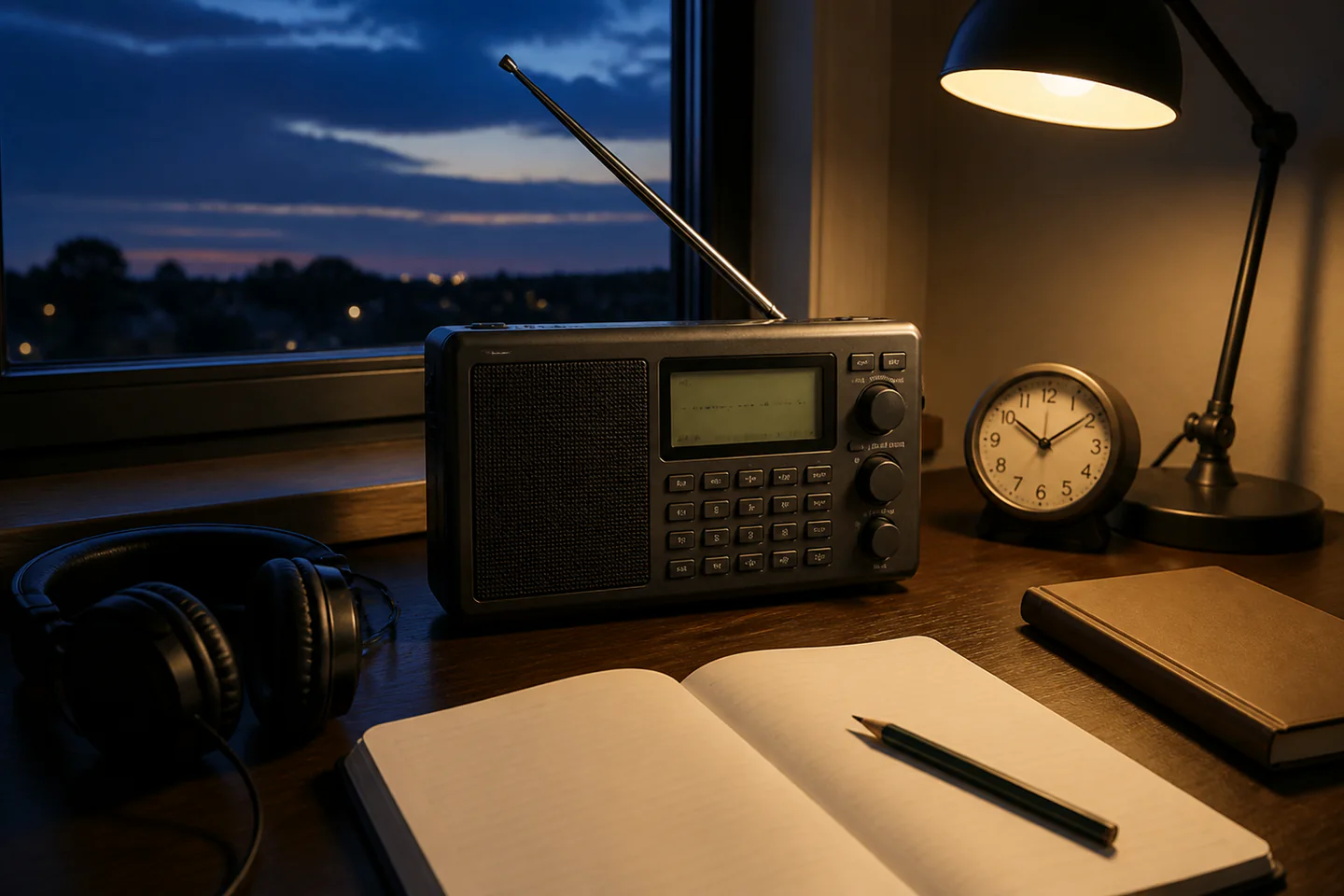
A portable receiver, a quiet room and a simple log are enough to begin. Learn how time, frequency, mode and electrical noise affect what reaches you before buying a large aerial.
Quick answer
Start with a portable digital receiver
Choose a receiver that covers shortwave and displays frequency clearly. Begin with known broadcast schedules around dusk, log in UTC and compare the built-in aerial in two rooms before attaching any long wire.
- 01
Use UTC in the listening log so schedules and reports remain unambiguous. Record the setting, measurement or observation that mattered so the next attempt can be changed for a reason rather than by guesswork.
- 02
Tune recognised broadcast bands first instead of scanning the entire spectrum without a plan. Record the setting, measurement or observation that mattered so the next attempt can be changed for a reason rather than by guesswork.
- 03
Move away from chargers, LED lamps, computers and solar equipment before assuming the signal is weak. Record the setting, measurement or observation that mattered so the next attempt can be changed for a reason rather than by guesswork.
- 04
Extend only the aerial length the receiver maker supports because too much signal can overload a portable set. Record the setting, measurement or observation that mattered so the next attempt can be changed for a reason rather than by guesswork.
- 05
Listen only; transmitting requires appropriate equipment, knowledge and licensing. Record the setting, measurement or observation that mattered so the next attempt can be changed for a reason rather than by guesswork.
What to expect
Propagation makes the dial change with time
Shortwave signals reflect and refract through the ionosphere, so a frequency heard strongly tonight may fade or disappear at another hour or season.
Time and band
Lower shortwave frequencies tend to travel better after dark while higher bands often open in daylight, although conditions vary. Schedules narrow the search. In shortwave radio listening, this is worth checking before the next stage because a small adjustment now is easier than undoing a finished result.
Noise
Modern homes contain many switching power supplies. A battery-powered receiver outdoors or in another room is a powerful diagnostic comparison. In shortwave radio listening, this is worth checking before the next stage because a small adjustment now is easier than undoing a finished result.
Selectivity
A strong neighbour station can spill into the desired channel. Bandwidth choices and careful tuning matter more than maximum volume. In shortwave radio listening, this is worth checking before the next stage because a small adjustment now is easier than undoing a finished result.
Modes
Broadcast AM is the simplest start. Single sideband reception opens amateur, maritime and utility listening but costs more and requires finer tuning. In shortwave radio listening, this is worth checking before the next stage because a small adjustment now is easier than undoing a finished result.
Core method
Search with time, band and purpose
Learn the controls
Identify band selection, direct frequency entry, tuning steps, bandwidth and external-aerial limits in the manual. Disable unnecessary charging noise during tests. In shortwave radio listening, this is worth checking before the next stage because a small adjustment now is easier than undoing a finished result.
Choose a target
Use a current broadcaster schedule or recognised band chart to select three likely frequencies for the present UTC time. In shortwave radio listening, this is worth checking before the next stage because a small adjustment now is easier than undoing a finished result.
Reduce noise
Run on battery, switch off nearby chargers and LED lights where safe, and compare positions near different windows. In shortwave radio listening, this is worth checking before the next stage because a small adjustment now is easier than undoing a finished result.
Log the result
Record UTC, frequency, mode, station or language, signal quality, location and aerial. A short log reveals repeatable openings. In shortwave radio listening, this is worth checking before the next stage because a small adjustment now is easier than undoing a finished result.
Useful products
Products with a clear job in the setup
These receivers step from simple analogue tuning to digital memories and finally SSB capability. The cheapest set is useful only if its simplicity matches your goal.
XHDATA D220 Portable FM/AM/Shortwave Radio
Large manual controls and battery operation make room-to-room noise testing easy.
XHDATA R108 Portable Airband Shortwave Digital Receiver
Digital frequency entry makes schedule-led listening much less frustrating.
XHDATA D-808 Portable Shortwave Receiver with SSB
SSB and finer tuning broaden the signals that can be understood rather than merely heard.
First project
Log three signals across one evening
A small planned listening session teaches more than hours of random scanning.
- 01
Set UTC
Put a UTC clock on the phone or radio and write the date, location and receiver in the log. In shortwave radio listening, this is worth checking before the next stage because a small adjustment now is easier than undoing a finished result.
- 02
Choose a broadcast band
Select three current scheduled frequencies likely to serve Europe at the present hour. In shortwave radio listening, this is worth checking before the next stage because a small adjustment now is easier than undoing a finished result.
- 03
Test two positions
Listen on the built-in aerial near one window, then repeat from a quieter room or safe outdoor position. In shortwave radio listening, this is worth checking before the next stage because a small adjustment now is easier than undoing a finished result.
- 04
Identify carefully
Wait for a spoken station name, language, interval signal or schedule match rather than deciding from one musical fragment. In shortwave radio listening, this is worth checking before the next stage because a small adjustment now is easier than undoing a finished result.
- 05
Repeat later
Return to the strongest frequency after thirty to sixty minutes and note how fading and noise changed. In shortwave radio listening, this is worth checking before the next stage because a small adjustment now is easier than undoing a finished result.
What can wait
What can wait until the first result
A large antenna cannot compensate for not knowing when or where to listen.
- 01
Long outdoor wire
It can overload a portable receiver and introduces lightning, property and installation responsibilities. In shortwave radio listening, this is worth checking before the next stage because a small adjustment now is easier than undoing a finished result.
- 02
Expensive communications receiver
Better filters help only after local electrical noise and schedule-led tuning are understood. In shortwave radio listening, this is worth checking before the next stage because a small adjustment now is easier than undoing a finished result.
- 03
Signal-decoding software
Digital modes require audio routing, mode knowledge and lawful handling; first learn stable manual tuning and logs. In shortwave radio listening, this is worth checking before the next stage because a small adjustment now is easier than undoing a finished result.
Upgrade path
Upgrade the repeated limitation
Spend on the limitation demonstrated in the listening log.
Try it
£25–£60Portable AM shortwave set and written log
Strong broadcasters and household noise become recognisable.Tune repeatably
£55–£120Digital frequency display, memories and bandwidth choices
Schedules and station comparisons become easier.Add SSB
£90–£180SSB-capable portable and careful fine tuning
Amateur and utility voice signals become intelligible.Improve reception
VariableApproved external aerial, common-mode control and outdoor listening
Weak-signal performance improves after overload and safety are considered.Safety & care
Listen lawfully and install aerials safely
Receiving broadcasts is straightforward, but some communications are private and aerials can create electrical hazards.
- Follow UK law on receiving and disclosing non-broadcast communications; do not act on or share private traffic. Follow current manufacturer, food-safety, electrical or local guidance wherever it applies.
- Never place an aerial near overhead lines and disconnect outdoor conductors during storms. Follow current manufacturer, food-safety, electrical or local guidance wherever it applies.
- Use only external aerial arrangements and input levels permitted by the receiver maker. Follow current manufacturer, food-safety, electrical or local guidance wherever it applies.
- Do not transmit on any frequency without suitable licensed equipment and the required amateur-radio licence. Follow current manufacturer, food-safety, electrical or local guidance wherever it applies.
Outside help
When outside help earns its place
Listening clubs and amateur-radio societies can demonstrate propagation, local noise hunting and receiver controls. A portable receiver and one good schedule are enough for the first evening.
Use one complete lesson that covers preparation, the main technique, troubleshooting and finishing. For a first shortwave radio listening project, following one coherent method is more useful than combining partial instructions from several creators.
Outside help earns its place when safe setup, equipment access or live correction would remove a real obstacle. Ask what materials, supervision and take-home result are included before booking.
Representative UK learning options checked 30 August 2026; local prices, access, materials and tutor support vary.
Sources
Where the guidance came from
The method is grounded in specialist, manufacturer and public guidance, then checked against recurring beginner problems and the exact products linked here.
-
01
Radio Society of Great Britain · Radio listening
UK radio and listening context.
Open source -
02
HFCC · International schedules
Coordinated shortwave broadcast schedule data.
Open source -
03
ShortwaveSchedule
Searchable schedule used to plan beginner listening targets.
Open source -
04
BBC Reception Advice
Broadcast reception and interference guidance.
Open source -
05
ARRL · Propagation
Reference for ionospheric conditions and HF propagation.
Open source -
06
Amazon UK · D220 Portable FM/AM/Shortwave Radio
Exact Amazon UK product page or ISBN used for the recommendation; current price, seller, specification and availability should be confirmed.
Open source -
07
Amazon UK · R108 Portable Airband Shortwave Digital Receiver
Exact Amazon UK product page or ISBN used for the recommendation; current price, seller, specification and availability should be confirmed.
Open source -
08
Amazon UK · D-808 Portable Shortwave Receiver with SSB
Exact Amazon UK product page or ISBN used for the recommendation; current price, seller, specification and availability should be confirmed.
Open source
Guide information and links checked 30 August 2026.