Beginner’s guide · Play & perform
Tune both strings in each course,
then let the pick carry the pulse.
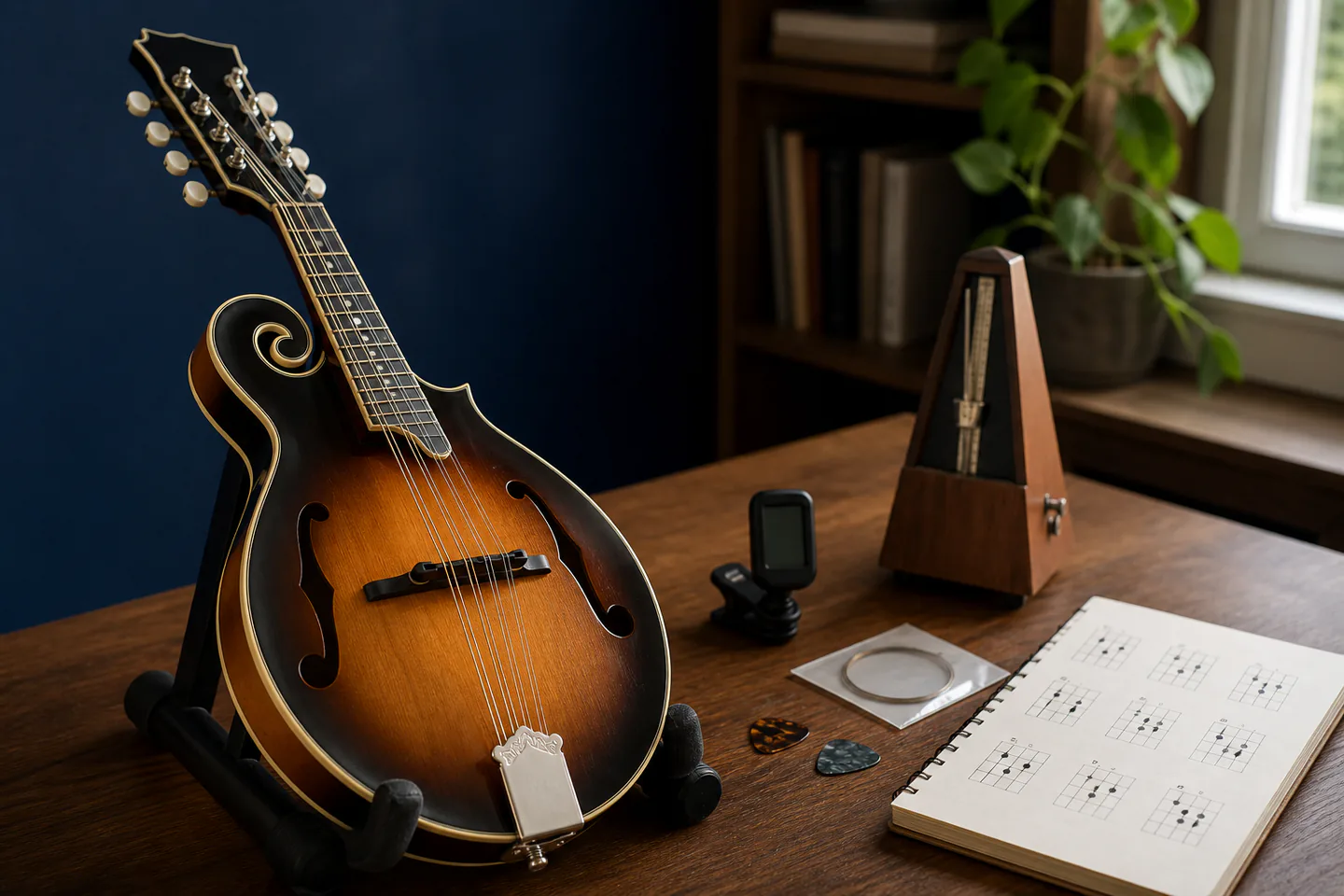
A setup-checked A-style mandolin, relaxed pick grip and G-D-A-E tuning can produce two chords and a short melody in the first practice cycle.
Quick answer
Complete one short mandolin tune before expanding the setup
Rent or buy a conventional A-style mandolin from a shop that checks bridge placement, nut height, fret condition and string action, tune each paired course gradually to G-D-A-E with a clip tuner, hold the pick without a clenched thumb, strum open courses on a steady down-up pulse, learn two comfortable open chords and then play a short one-octave tune using downstrokes on counted beats before introducing alternating picking.
- 01
A mandolin has four paired courses; both strings in each course should agree in pitch. Record what happened during mandolin so the next attempt changes one known variable instead of several guesses.
- 02
High action and poorly cut nut slots can make a beginner press far harder than healthy technique requires. Record what happened during mandolin so the next attempt changes one known variable instead of several guesses.
- 03
Pick direction connects directly to pulse, so slow counted strokes are more useful than random speed. Record what happened during mandolin so the next attempt changes one known variable instead of several guesses.
- 04
Short frequent practice protects fingertips and reveals tuning and setup changes. Record what happened during mandolin so the next attempt changes one known variable instead of several guesses.
What to expect
What mandolin is really like at the start
The useful beginner controls are preparation, one bounded task and a record of the result; specialist equipment matters only when it solves a repeated limitation.
Tuning
Adjusting one string of a pair changes tension and can make the other drift slightly. Record what happened during mandolin so the next attempt changes one known variable instead of several guesses.
Pressure
Double strings require accuracy but should not require a crushing grip on a well-set instrument. Record what happened during mandolin so the next attempt changes one known variable instead of several guesses.
Pick
Too little pick depth improves speed only by producing thin inconsistent tone. Record what happened during mandolin so the next attempt changes one known variable instead of several guesses.
Style
Bluegrass chop, Irish melody and tremolo share fundamentals but develop different right-hand priorities. Record what happened during mandolin so the next attempt changes one known variable instead of several guesses.
Core method
The core mandolin method
Confirm the setup
Have a teacher or reputable shop check action, nut, bridge, frets and structural condition before blaming the hands. Record what happened during mandolin so the next attempt changes one known variable instead of several guesses.
Tune in pairs
Approach each note gradually, compare both strings and recheck all courses after tension changes. Record what happened during mandolin so the next attempt changes one known variable instead of several guesses.
Build pulse with open strings
Use a small pick motion and count down and up strokes at a relaxed tempo. Record what happened during mandolin so the next attempt changes one known variable instead of several guesses.
Alternate chord and melody work
Strum two chords for time, then play a short scale-based tune with deliberate pick direction. Record what happened during mandolin so the next attempt changes one known variable instead of several guesses.
Useful products
Products with a clear job in the route
The Ortega provides a conventional A-style route subject to a setup check, and the compact tuner makes paired-course tuning quick enough to begin every session.
Ortega Guitars RMAE40SBK A-Style Mandolin
A conventional A-style instrument supports widely available beginner material.
D’Addario NS Micro Headstock Tuner PW-CT-12
Accurate tuning makes paired mandolin strings and open-G banjo practice easier to diagnose.
First project
Play two chords and an eight-bar melody
Use a slow pulse, short practice blocks and only the finger pressure needed for a clean note.
- 01
Check fit and setup
Sit with the instrument stable and have action, bridge and nut inspected by an experienced player. Record what happened during mandolin so the next attempt changes one known variable instead of several guesses.
- 02
Tune G-D-A-E by course
Tune gradually from low to high, match each pair and recheck after the full pass. Record what happened during mandolin so the next attempt changes one known variable instead of several guesses.
- 03
Practise counted open strokes
Play downstrokes on beats and upstrokes between them without squeezing the pick. Record what happened during mandolin so the next attempt changes one known variable instead of several guesses.
- 04
Learn two open chords
Place fingers close to frets, release excess pressure and change on a four-beat count. Record what happened during mandolin so the next attempt changes one known variable instead of several guesses.
- 05
Add the short melody
Learn two bars at a time with planned pick direction and record one complete take. Record what happened during mandolin so the next attempt changes one known variable instead of several guesses.
What can wait
What can wait until the first result
Delay anything that adds cost, risk or another variable before the basic workflow has produced something you can review.
- 01
Fast tremolo
Even relaxed alternate motion and pulse should precede sustained speed. Record what happened during mandolin so the next attempt changes one known variable instead of several guesses.
- 02
Closed chop chords
They demand stretch and pressure beyond the first open shapes. Record what happened during mandolin so the next attempt changes one known variable instead of several guesses.
- 03
Very heavy strings
Tension and setup should be chosen with a teacher or technician. Record what happened during mandolin so the next attempt changes one known variable instead of several guesses.
- 04
Amplification
Acoustic timing and tone reveal the first technique more clearly. Record what happened during mandolin so the next attempt changes one known variable instead of several guesses.
Upgrade path
Add the capability you can now name
Each stage should remove a demonstrated constraint rather than make the setup look more advanced.
Use what you own
£0–£20Existing equipment and one written plan
Rent or use a setup-checked A-style mandolin.Repeat the first route
About £150–£500 including setupA complete repeatable starter setup
Complete several open-chord songs and simple tunes.Add one capability
Often £50–£250One selected tool, service or learning resource
Choose bluegrass, old-time, Irish or classical technique with a teacher.Build specialist depth
Club, course or specialist dependentA documented specialist workflow
Join slow sessions and develop tremolo, closed chords and ensemble timing.Safety & care
Setup and relaxation protect hands and the instrument
Paired steel strings create useful resistance, but pain and excessive pressure are not progress.
- Stop at sharp pain, numbness or persistent wrist and thumb tension and have both technique and setup checked.
- Tune up gradually with the face away from the string path and replace corroded or damaged strings.
- Use a strap or seated hold that stabilises the instrument without lifting the fretting shoulder.
- Store the mandolin in stable temperature and humidity and never force bridge, truss rod or machine heads.
- Keep amplification and headphone levels conservative when pickups or backing tracks are added.
Outside help
When outside help earns its place
A mandolin teacher or slow beginner session helps with setup, pick depth, direction and the different demands of chord and melody styles.
Choose instruction that starts with standard tuning and relaxed time rather than immediate speed.
Use outside help after the first mandolin attempt can reveal the exact technique, access or safety problem that needs live correction.
Representative UK learning and access routes checked 1 September 2026; local prices, permissions, equipment and tutor support vary.
Sources
Where the guidance came from
Authoritative and specialist guidance supports the method and safety boundaries; community discussion contributes recurring beginner problems rather than unsupported claims.
-
01
Peghead Nation · Beginning mandolin
Pick direction, rest stroke, chords, scales and tune sequence.
Open source -
02
Peghead Nation · Beginning musician resources
Tuning and beginner-course progression.
Open source -
03
Mandolin Cafe · Standard mandolin tuning
G-D-A-E paired-course tuning guidance.
Open source -
04
Mandolin Cafe · Forums
Setup, instruments, picks and technique experience.
Open source -
05
D’Addario · Mandolin strings
Manufacturer string gauges, materials and instrument compatibility.
Open source -
06
Reddit · r/mandolin
Community evidence on shop setup, action, first instruments, tuning and practice.
Open source -
07
Amazon UK · RMAE40SBK A-Style Mandolin
Exact Amazon UK product page or ISBN used for this recommendation; current price, seller, specification and availability should be confirmed.
Open source -
08
Amazon UK · NS Micro Headstock Tuner PW-CT-12
Exact Amazon UK product page or ISBN used for this recommendation; current price, seller, specification and availability should be confirmed.
Open source
Guide information and links checked 1 September 2026.