Beginner’s guide · Research & collect
Learn the movement on a tray,
not inside a valuable watch.
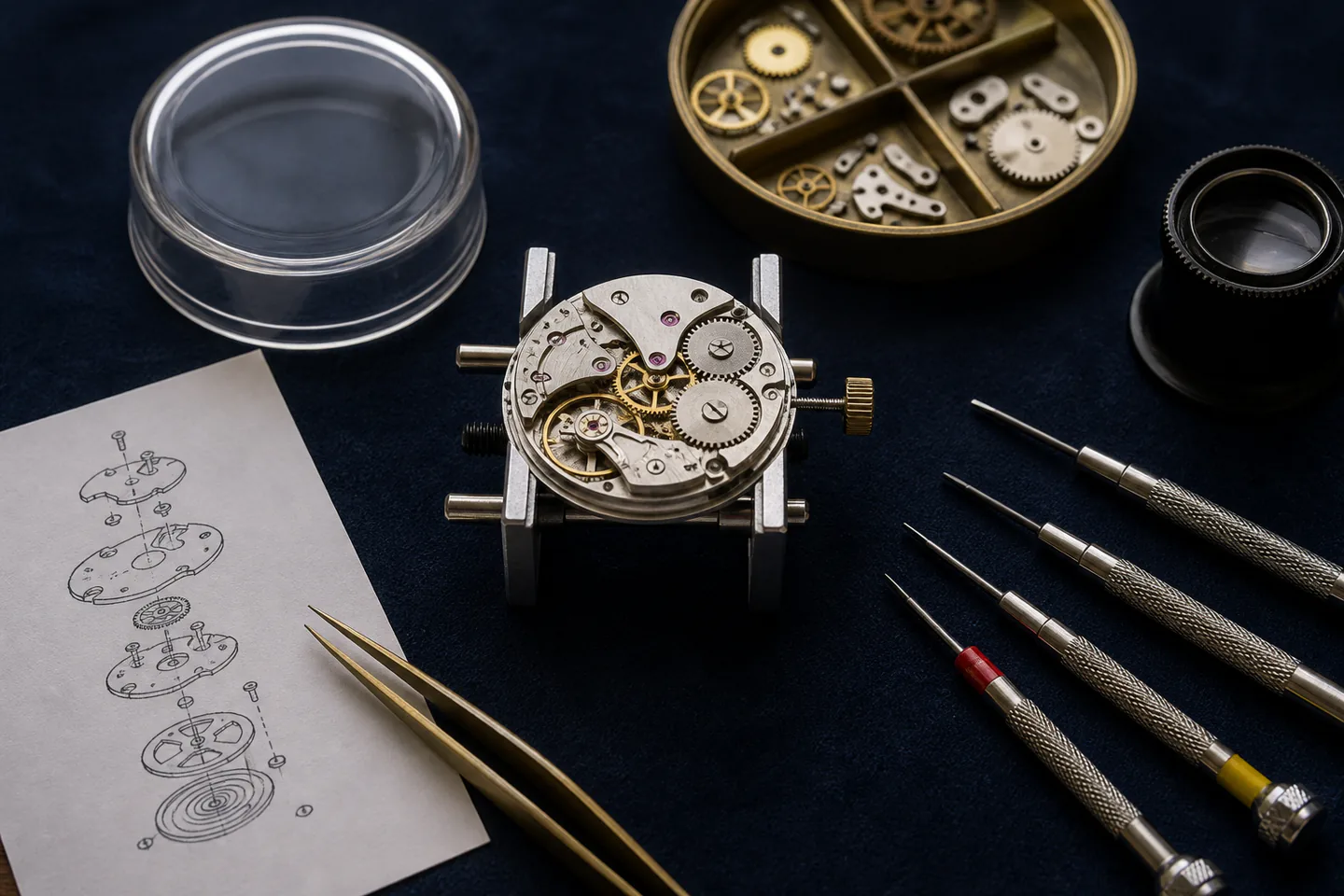
A large inexpensive hand-wound movement, strict parts order and technical sheet teach disassembly and reassembly before cleaning, oiling or regulation.
Quick answer
Complete one practice movement reassembly before expanding the setup
Take a recognised beginner course or use its stated practice movement, choose a large inexpensive hand-wound calibre with a technical sheet and no sentimental case, record baseline winding and timekeeping without claiming accuracy, release spring tension by the documented method, photograph every layer, store screws and parts in numbered covered compartments and complete one supervised dry disassembly and reassembly before attempting chemical cleaning, lubrication or regulation.
- 01
The movement’s technical documentation takes priority over a generic video. Record what happened during mechanical watch repair so the next attempt changes one known variable instead of several guesses.
- 02
Stored mainspring energy can release parts or damage teeth if the train is opened under tension. Record what happened during mechanical watch repair so the next attempt changes one known variable instead of several guesses.
- 03
Watch oils are selected and placed in microscopic amounts; random oiling can spread contamination and stop the movement. Record what happened during mechanical watch repair so the next attempt changes one known variable instead of several guesses.
- 04
A complete service includes inspection, cleaning, lubrication, assembly, adjustment and testing, not merely opening the case. Record what happened during mechanical watch repair so the next attempt changes one known variable instead of several guesses.
What to expect
What mechanical watch repair is really like at the start
The useful beginner controls are preparation, one bounded task and a record of the result; specialist equipment matters only when it solves a repeated limitation.
Scale
Screws and springs can look interchangeable while differing in thread, shoulder, length or purpose. Record what happened during mechanical watch repair so the next attempt changes one known variable instead of several guesses.
Force
A bridge that will not seat usually has a pivot, wheel or jewel out of alignment. Record what happened during mechanical watch repair so the next attempt changes one known variable instead of several guesses.
Cleanliness
Dust, fingerprints and excess lubricant are mechanically significant at movement scale. Record what happened during mechanical watch repair so the next attempt changes one known variable instead of several guesses.
Diagnosis
Poor timekeeping can come from wear, magnetism, balance, escapement, lubrication or case condition. Record what happened during mechanical watch repair so the next attempt changes one known variable instead of several guesses.
Core method
The core mechanical watch repair method
Choose the training movement
Use a course-supported large hand-wound calibre with parts availability and a technical sheet. Record what happened during mechanical watch repair so the next attempt changes one known variable instead of several guesses.
Build the evidence tray
Create numbered compartments, print the diagram and photograph baseline and every removal stage. Record what happened during mechanical watch repair so the next attempt changes one known variable instead of several guesses.
Control stored energy and parts
Follow the documented let-down method and remove bridges only when the train is safe and free. Record what happened during mechanical watch repair so the next attempt changes one known variable instead of several guesses.
Reassemble without force
Place each wheel and bridge, confirm pivots visually and test freedom only at the defined stages. Record what happened during mechanical watch repair so the next attempt changes one known variable instead of several guesses.
Useful products
Products with a clear job in the route
The stand magnifier supports inspection, the fine tweezers support low-force handling and the safety glasses protect against launched springs; movement holders and screwdrivers should come from the chosen course list.
Carson LL-10 10× LumiLoupe Stand Magnifier
A stand leaves delicate paper, specimens or small finds undisturbed.
MMOBIEL Seven-Piece Precision Tweezer Set
Several profiles help reach small parts while keeping organised trays undisturbed.
3M SecureFit 200 Safety Glasses
They are easy to keep at the bench for routine impact risks.
First project
Strip and reassemble one course-approved hand-wound movement
Do not clean or oil during the first pass; the goal is controlled parts order and a freely seated train.
- 01
Record the starting state
Photograph the movement, note winding feel and timegrapher or observation results without making promises. Record what happened during mechanical watch repair so the next attempt changes one known variable instead of several guesses.
- 02
Prepare the numbered tray
Print the movement sheet, label compartments and cover every group as it leaves the movement. Record what happened during mechanical watch repair so the next attempt changes one known variable instead of several guesses.
- 03
Release energy correctly
Use the movement-specific let-down method under supervision before opening the train. Record what happened during mechanical watch repair so the next attempt changes one known variable instead of several guesses.
- 04
Disassemble by system
Photograph and group the keyless work, train, escapement and balance without mixing screws. Record what happened during mechanical watch repair so the next attempt changes one known variable instead of several guesses.
- 05
Reassemble and verify seating
Return parts in reverse order, inspect pivots and stop rather than pressing a reluctant bridge. Record what happened during mechanical watch repair so the next attempt changes one known variable instead of several guesses.
What can wait
What can wait until the first result
Delay anything that adds cost, risk or another variable before the basic workflow has produced something you can review.
- 01
Valuable or sentimental watches
One slipped tool or unavailable part can make the loss disproportionate. Record what happened during mechanical watch repair so the next attempt changes one known variable instead of several guesses.
- 02
Automatic and calendar modules
They add springs, timing relationships and hidden parts before the base train is reliable. Record what happened during mechanical watch repair so the next attempt changes one known variable instead of several guesses.
- 03
Ultrasonic cleaning
Solutions, baskets, material compatibility and complete drying need a documented system. Record what happened during mechanical watch repair so the next attempt changes one known variable instead of several guesses.
- 04
Regulation and hairspring work
Adjustment without diagnosis can damage an extremely delicate component. Record what happened during mechanical watch repair so the next attempt changes one known variable instead of several guesses.
Upgrade path
Add the capability you can now name
Each stage should remove a demonstrated constraint rather than make the setup look more advanced.
Use what you own
£0–£20Existing equipment and one written plan
Take a taster session and study one movement sheet.Repeat the first route
About £60–£250 plus a practice movementA complete repeatable starter setup
Dry-strip and reassemble a large hand-wound practice calibre.Add one capability
Often £50–£250One selected tool, service or learning resource
Learn controlled cleaning and lubrication with supervised inspection.Build specialist depth
Club, course or specialist dependentA documented specialist workflow
Progress to automatic, calendar and fault correction through formal horology training.Safety & care
A watch can be valuable even when it is not expensive
History, parts scarcity and water resistance can be lost through an apparently small intervention.
- Release mainspring tension by the movement-specific method before opening the train and wear eye protection around springs.
- Use lidded trays, low-force tools and a movement holder and never press a bridge that is not seated.
- Keep solvents, cleaning fluids and oils labelled, ventilated and away from flame, food, children and pets.
- Do not claim water resistance after opening a case; pressure testing requires appropriate equipment and procedure.
- Stop at radioactive luminous paint, corrosion, broken jewels, damaged hairspring or an irreplaceable part and consult a qualified watchmaker.
Outside help
When outside help earns its place
Formal instruction earns its place at the start because energy release, pivot seating, cleaning and microscopic lubrication are difficult to judge from video alone.
Choose the specified training movement and use the tutor’s tool, cleaning and lubrication system.
Progress through theory, manual-wind service and assessment before automatic or chronograph work.
Representative UK learning and access routes checked 1 September 2026; local prices, permissions, equipment and tutor support vary.
Sources
Where the guidance came from
Authoritative and specialist guidance supports the method and safety boundaries; community discussion contributes recurring beginner problems rather than unsupported claims.
-
01
British Horological Institute · Practical route: watches
Structured training route from manual wind to advanced movements.
Open source -
02
British Horological Institute · Watch servicing module
Disassembly, cleaning, lubrication, reassembly and fault-finding scope.
Open source -
03
British Horological Institute · Home
Current beginner courses, workshops and professional context.
Open source -
04
ETA · Technical information
Manufacturer calibre sheets and movement-specific service data.
Open source -
05
HSE · COSHH basics
Cleaning-fluid, oil and exposure-control principles.
Open source -
06
Reddit · r/watchrepair
Community evidence on practice movements, lost parts, tools, oiling and training limits.
Open source -
07
Amazon UK · LL-10 10× LumiLoupe Stand Magnifier
Exact Amazon UK product page or ISBN used for this recommendation; current price, seller, specification and availability should be confirmed.
Open source -
08
Amazon UK · Seven-Piece Precision Tweezer Set
Exact Amazon UK product page or ISBN used for this recommendation; current price, seller, specification and availability should be confirmed.
Open source -
09
Amazon UK · SecureFit 200 Safety Glasses
Exact Amazon UK product page or ISBN used for this recommendation; current price, seller, specification and availability should be confirmed.
Open source
Guide information and links checked 1 September 2026.