Beginner’s guide · Write & create
Invent one place under pressure.
Let daily life reveal the world.
Begin with a person trying to do an ordinary task inside one unusual constraint. Build only the place, rule, resource and consequence needed for that scene; expand the setting when a story asks a new question.
Quick answer
Build outward from a task the reader understands
Choose an ordinary action—getting breakfast, crossing town, repairing clothing or asking for help. Add one world-specific constraint, decide who benefits and who pays for it, then write 500 words in which the character completes or fails the task. Record only the facts the scene made true and the questions it opened.
- 01
A rule becomes believable through cost, workaround and unequal impact, not through a paragraph announcing that the world has rules.
- 02
Start local. A kitchen, market, shrine, station or workshop reveals economics, technology, custom and power through use.
- 03
Research real analogues for materials, climates and institutions, while avoiding the assumption that one culture is interchangeable with another.
- 04
Keep uncertainty visible in notes. Mark ideas as fixed, provisional or unknown so an early brainstorm does not become accidental canon.
What to expect
A detailed world can still feel empty
Readers experience a setting through choices, expectations and consequences. Quantity of lore matters less than whether details affect people consistently.
Scale
A continent invites hundreds of disconnected decisions. One neighbourhood creates useful relationships between route, work, food, status and risk.
Systems
Magic, technology or law matters when access, limits and failure change what characters can do.
Culture
Clothing, names and festivals are surface details unless values, memory, disagreement and material conditions support them.
History
People inherit institutions and stories, but they interpret them differently. A single official timeline is not the whole past.
Maps
A map can expose distance and resource problems, yet decorative coastlines do not create narrative stakes by themselves.
Continuity
Contradictions are normal during drafting. A small record of established facts makes deliberate revision possible.
World logic
Connect constraint, response and consequence
Start with pressure, not a catalogue
Write one sentence that changes daily life: water is delivered only when the tide exposes a road; spoken promises are physically visible; every powered machine attracts a dangerous organism. Define the boundary, the common workaround and one way the rule can fail. A useful premise creates choices instead of solving every problem.
Locate power and ordinary work
Ask who controls the scarce resource, who maintains the workaround, who is excluded and who can break the rule safely. Then follow an ordinary worker, child, trader, patient or traveller for one task. Their tools, schedule, language and assumptions reveal more than a neutral tour of government departments.
Research components separately
If the setting borrows a real climate, craft, belief or historical institution, use specialist and primary material for that component. Keep notes on what is observed, what is inferred and what is invented. Combining several sources is safer than relabelling one living culture as an exotic fictional society.
Keep a working canon
After the scene, record names, distances, rules and consequences that now matter. Add the source or reasoning for technical choices and mark unresolved questions. Revise the world when story pressure exposes a weak assumption; consistency should support the narrative, not protect an early idea from improvement.
Useful products
Two guided approaches and movable continuity notes
Timothy Hickson’s book examines systems, cultures and story use; 30 Days of Worldbuilding supplies a paced prompt sequence. Index cards keep facts and scene implications movable. None is needed before writing the first local scene, and the two books should be sampled rather than followed simultaneously.
Timothy Hickson On Writing and Worldbuilding: Volume I
Its chapters turn magic and culture ideas into questions about limits, consequences and reader experience.
A. Trevena 30 Days of Worldbuilding
A daily question can prevent a blank-page project from becoming an unbounded encyclopedia.
Silvine Record Cards 152 × 102 mm, Pack of 100
Movable cards make systems and contradictions visible without specialist software.
First world
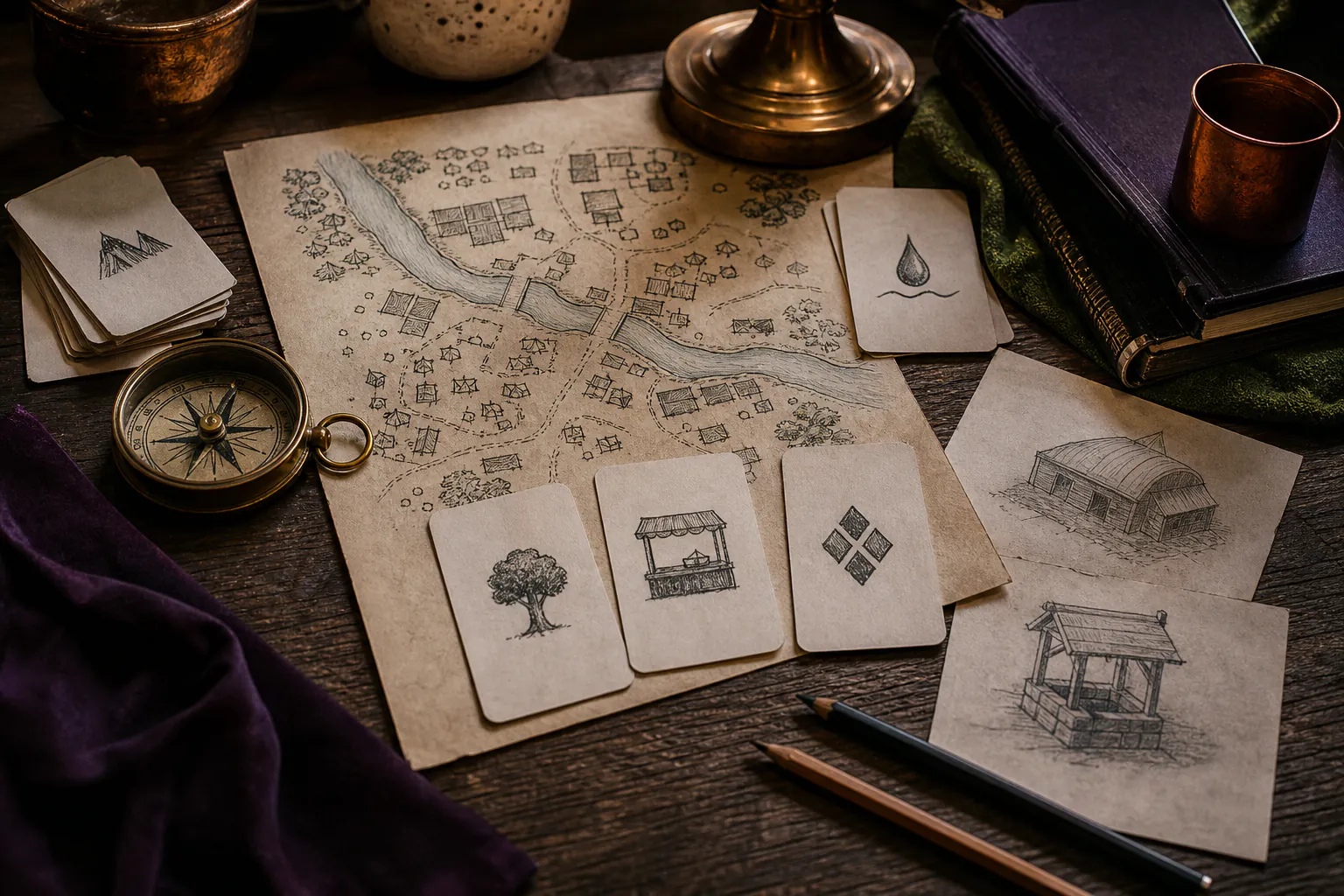
Build a market around one scarce resource
Choose a resource people need, a rule controlling it and a character who arrives wanting something before the market closes.
- 01
Name the resource
Choose water, fuel, medicine, information or another necessity with a concrete use.
- 02
Set the constraint
Decide why access is limited and what physical or social boundary enforces that limit.
- 03
Place three workers
Identify who supplies, checks and repairs the system and what each person wants.
- 04
Give the character a task
Make the objective specific enough to succeed or fail within the scene.
- 05
Show a workaround
Let someone bend, exploit or adapt to the rule in a way that reveals local knowledge.
- 06
Create a consequence
Make an action change price, safety, reputation, access or obligation.
- 07
Write 500 words
Stay in the character’s experience and resist pausing for background the moment it occurs to you.
- 08
Record the canon
List only established facts, provisional ideas and the next question the story genuinely needs.
What can wait
What can wait until the story reaches it
Unanswered areas are not holes when the current characters cannot encounter or affect them.
- 01
A world map
Draw the local route first. Continental geography matters when distance, climate, travel or political scale enters the story.
- 02
Complete languages
Naming patterns and a few social distinctions may be enough. Linguistics is its own deep hobby when a constructed language becomes the goal.
- 03
Thousands of years of history
Create the remembered event, disputed version and surviving institution that affect the present scene.
- 04
Every magic rule
Define the abilities, costs and failure relevant now, then test how people organise around them before adding exceptions.
- 05
Illustrated reference binders
A beautiful bible is useful only if it supports writing, play or art instead of postponing it.
Upgrade path
Expand along lines of consequence
A larger world earns its detail when movement, conflict or viewpoint makes neighbouring systems relevant.
One pressured place
Free500-word scene + fact log
Test whether the central rule changes ordinary choices.Connected district
About £7 for cardsThree locations, routes and competing groups
See how resources and information move.Story world bible
About £10–£25Selected prompts, sources and continuity index
Support a longer draft or game without fixing every detail.Collaborative setting
Free to £100+Shared documents, maps and playtests
Expose unclear assumptions through other people’s choices.Research & respect
Research people as people, not ingredients
Worldbuilding can reproduce stereotypes when a creator borrows surface features without understanding context, difference or living ownership.
- Use multiple reputable sources and distinguish a historical record, modern community practice, interpretation and invention in private notes.
- Do not treat a living culture, religion, disability or traumatic history as a ready-made aesthetic or a single unified worldview.
- Check names, symbols, stories and traditional knowledge whose commercial or community use carries legal or ethical restrictions.
- Research material limits—food, water, transport, labour and waste—before claiming that one spectacular technology solves a whole society.
- When publishing, credit specialist and sensitivity input appropriately and retain responsibility for the final creative choices.
Outside help
When another reader improves the world
A class is optional. Feedback is useful when readers cannot understand a rule from the scene or when research touches experience outside the writer’s competence.
Practise making a setting believable through observed everyday detail before inventing at continental scale.
Choose one that critiques scenes and research decisions, not only maps and lore lists.
Free university material and representative UK workshop pricing checked 2 August 2026; feedback depth and specialist expertise vary.
Sources
Where the guidance came from
Creative-writing teaching grounds the world in perception and scene; specialist worldbuilding advice and community discussion expose common overbuilding problems.
-
01
OpenLearn · Building a believable world
How observed detail and ordinary routines make a written world feel as if it exists beyond the page.
Open source -
02
OpenLearn · Start writing fiction
Free introductory work on character, setting, genre and practical fiction exercises.
Open source -
03
Brandon Sanderson · Worldbuilding lectures
Working fantasy author’s free lectures on magic systems, setting and story interaction.
Open source -
04
r/worldbuilding · Getting started discussions
Recurring practitioner advice about scope, consistency, maps and writing before exhaustive lore.
Open source -
05
Amazon UK · On Writing and Worldbuilding Volume I
Exact product page, model or ISBN, observed price and availability checked for this guide.
Open source -
06
Amazon UK · 30 Days of Worldbuilding
Exact product page, model or ISBN, observed price and availability checked for this guide.
Open source -
07
Amazon UK · Silvine record cards pack of 100
Exact product page, model or ISBN, observed price and availability checked for this guide.
Open source
Guide information and links checked 2 August 2026.