Beginner’s guide · Cook & bake
Bake one dependable loaf.
Let time develop the dough.
Start with a weighed yeasted loaf made from flour, water, salt and yeast. Learn dough feel, fermentation and doneness in a simple tin before chasing sourdough or elaborate scoring.
Quick answer
Weigh the dough and repeat one formula
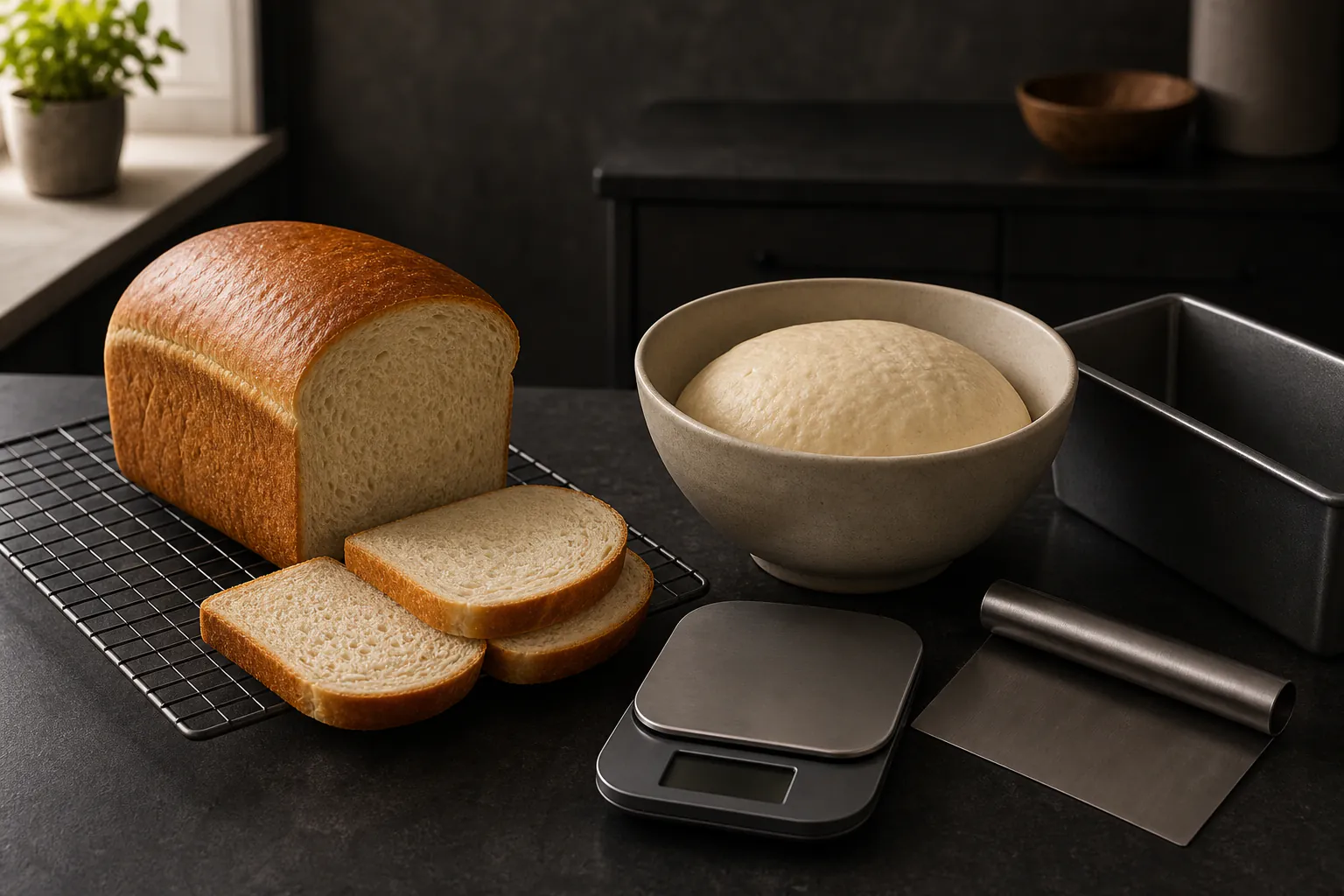
Use a reliable beginner recipe for one yeasted white or mixed-flour loaf. Weigh every ingredient, mix until no dry flour remains, rest briefly, then knead or fold until the dough becomes smoother and elastic. Let it rise until visibly expanded, shape it tightly enough to hold structure, proof in a greased 2 lb tin and bake until deeply coloured and fully cooked.
- 01
Flour absorbs different amounts of water. A slightly sticky dough often becomes manageable with rest and folds; adding lots of flour makes a dry loaf.
- 02
Yeast activity changes with dough temperature, room temperature and salt. The dough’s expansion matters more than a fixed minute count.
- 03
Raw flour can carry harmful bacteria. Do not taste raw dough and clean flour dust and surfaces after mixing.
- 04
Sourdough is a separate fermentation practice. Commercial yeast gives a clearer first lesson in dough development and proofing.
What to expect
The recipe is a framework and fermentation is alive
Two kitchens can follow the same clock and produce different dough. Temperature, flour, shaping and the oven explain much of the variation.
Mixing
Dry pockets become dense streaks. Scrape the bowl and hydrate all flour before judging texture.
Gluten
Kneading and folds organise the dough, but rest also develops strength. More force is not always better.
Bulk rise
A cool room may take much longer. Over-fermented dough becomes fragile and hard to shape.
Shaping
Surface tension supports height; too much degassing removes all internal variation.
Proof
Under-proofed bread can split and feel dense; over-proofed dough may collapse or bake flat.
Bake
Colour, internal structure and temperature indicate doneness. Cutting hot bread releases steam and makes the crumb gummy.
Core method
Control quantities, temperature and fermentation evidence
Choose a simple dependable formula
Use bread flour, water, instant or easy-bake yeast and fine salt from a reputable tested recipe. Check whether the yeast is mixed directly or rehydrated. Weigh to the gram, and for very small yeast quantities use a scale capable of fine resolution or the recipe’s level spoon measure.
Develop the dough without burying it in flour
Mix until no dry flour remains and rest for ten to twenty minutes if the method allows. Knead on a lightly oiled or minimally floured surface, or use stretch-and-fold rounds in the bowl. Look for increasing smoothness and elasticity. Keep a note of water retained rather than changing it unknowingly each bake.
Judge fermentation from change
Cover the dough to prevent a skin and place it in a stable moderate environment, not on a dangerously hot radiator. Mark the starting level in a straight-sided container if useful. End bulk fermentation when the dough is airy, expanded and responsive, then shape and place seam-down in the prepared tin.
Bake, cool and evaluate
Preheat the oven fully. Score only if the recipe requires it and use steam only by a safe documented method. Bake to strong colour and an internal temperature consistent with the recipe, remove from the tin and cool on a rack before slicing. Record crumb, crust, flavour and proofing evidence for the next loaf.
Useful products
Measure accurately, contain the first shape and handle dough cleanly
The fine-resolution scale improves repeatability, the 2 lb tin supports a familiar sandwich loaf and the scraper divides and cleans sticky dough. The banneton set is a later freeform-loaf route; it is not necessary for the first tin loaf.
Etekcity Digital Kitchen Scale, 0.1 g to 5 kg
It supports the fastest route to explaining why two loaves differ.
MasterClass Non-Stick 2 lb Loaf Tin
It removes freeform spreading as a variable while fermentation and shaping are learned.
Zulay Kitchen Three-Piece Stainless Dough Scraper Set
It supports tidy folding, dividing and cleanup without a powered mixer.
Kook Banneton and Bread Tool Set
It shows the practical next step toward unsupported artisan-style loaves.
First project
Bake the same tin loaf twice
The second bake is part of the project. Change only one documented variable, such as proof length or water by 10 g.
- 01
Read the whole recipe
Confirm ingredient form, tin size, oven temperature and approximate stages.
- 02
Weigh and mix
Use separate containers, avoid raw tasting and hydrate every patch of flour.
- 03
Develop and bulk ferment
Knead or fold, cover and watch expansion rather than only the timer.
- 04
Shape and proof
Create surface tension, place in the greased tin and stop before collapse.
- 05
Bake fully
Use a preheated oven, strong colour and recipe-appropriate internal doneness.
- 06
Cool, record and repeat
Wait before slicing, photograph the crumb and alter one variable next time.
What can wait
What can wait until the first result
A reliable loaf comes from repetition before specialist fermentation or presentation tools.
- 01
A sourdough starter
It adds feeding, acidity and variable leavening. Learn dough and proofing with yeast first.
- 02
A stand mixer
One loaf can be mixed by hand and teaches texture directly.
- 03
A Dutch oven
It is useful for freeform loaves but unnecessary for a supported tin loaf.
- 04
Decorative scoring tools
Good fermentation and safe simple slashing matter before patterns.
- 05
Large flour stockpiles
Flour ages and attracts pests. Buy enough for repeated fresh practice.
Upgrade path
Upgrade the repeated limitation
Change the loaf form or fermentation only after the baseline can be explained.
Tin loaf
About £32 toolsScale + bowl + scraper + 2 lb tin
Learn repeatability and proofing.Freeform loaf
About £20+Banneton + baking surface
Test shaping without side support.Long cold fermentation
MinimalFridge space + schedule
Develop flavour and timing flexibility.Sourdough
Mostly flour and timeMaintained starter + fermentation records
Add wild culture and greater variability.Safety & care
Treat flour, heat and steam as food-safety and burn risks
Bread is ordinary food, but raw flour, hot tins, steam and underbaked enriched dough deserve normal kitchen controls.
- Do not eat raw flour or dough; wash hands and clean surfaces and utensils after mixing.
- Keep flour dust low, close bags carefully and consider respiratory sensitivity when tipping or cleaning.
- Use oven gloves, stable dry surfaces and caution with steam; never pour water onto hot glass or an oven floor unless the appliance method explicitly allows it.
- Keep children and pets away from hot trays, blades and rising dough containing unsafe raw ingredients.
- Cool bread before storage, watch for mould and follow recipe-specific controls for eggs, dairy or fillings.
Outside help
When outside help earns its place
A class can diagnose shaping and fermentation by touch, but a tested recipe and two repeated loaves are enough to start.
Use tested beginner recipes and visual proofing guidance.
Check whether the class teaches one repeatable loaf and provides weights and temperatures.
Representative UK prices and free learning routes checked 3 August 2026; local availability, materials and tutor support vary.
Sources
Where the guidance came from
Established baking education supplies tested technique; UK food-safety guidance establishes raw flour and kitchen controls.
-
01
King Arthur Baking · Bread guide
Tested bread recipes, techniques and troubleshooting.
Open source -
02
King Arthur Baking · Proofing bread
Visual and tactile evidence for ending proof.
Open source -
03
King Arthur Baking · Best breads for beginners
Beginner recipe selection and manageable first loaves.
Open source -
04
Food Standards Agency · Raw flour safety
Food-safety context for uncooked flour and dough.
Open source -
05
Amazon UK · Etekcity digital kitchen scale
Exact product page, model or ISBN, observed price and availability checked for this guide.
Open source -
06
Amazon UK · MasterClass 2 lb loaf tin
Exact product page, model or ISBN, observed price and availability checked for this guide.
Open source -
07
Amazon UK · Stainless dough scraper set
Exact product page, model or ISBN, observed price and availability checked for this guide.
Open source -
08
Amazon UK · Banneton bread set
Exact product page, model or ISBN, observed price and availability checked for this guide.
Open source
Guide information and links checked 3 August 2026.