Beginner’s guide · Make & build
A low-power flight with parachute or streamer recovery
Build for a safe recovery, not just a launch.
Start with a low-power launch set, a simple skill-level-one rocket and an organised UK club launch. Learn straight assembly, motor retention and recovery checks before chasing altitude.
Quick answer
Use a complete low-power set at an organised launch
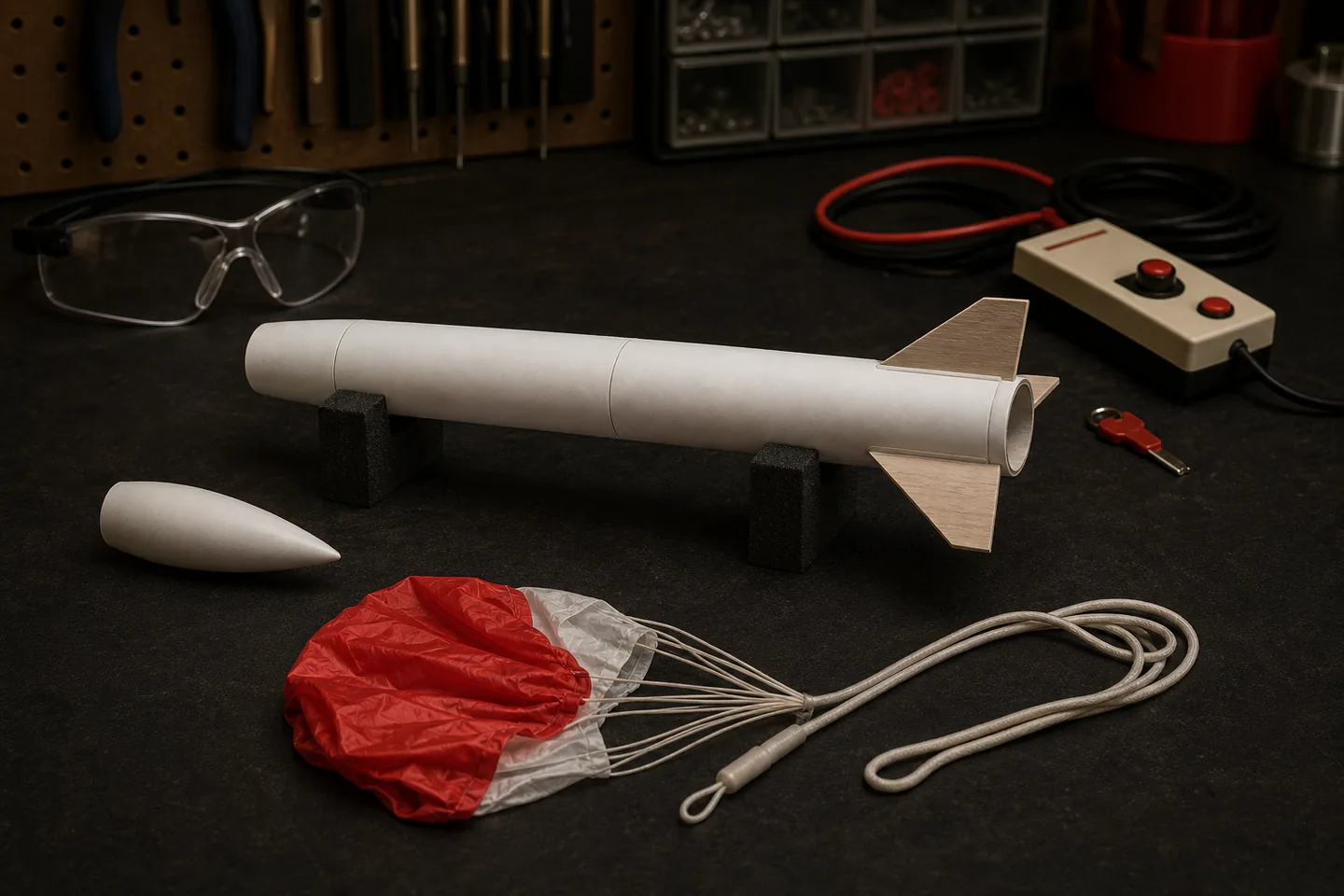
Build a simple Estes Alpha III–type rocket exactly to the instructions, keeping fins and launch lug straight and the body light. Arrange a launch through a UK rocketry club or another site with permission, insurance and suitable airspace. At the field, use only the manufacturer-recommended certified motor, prepare the recovery wadding and parachute, perform the safety-code checks and launch from the electrical controller at the required distance.
- 01
A model rocket is not a firework. It uses a purpose-made motor, stable airframe, recovery system and controlled electrical launch process.
- 02
Rocket motors are age-restricted hazardous goods and may not be posted by ordinary methods; source and store them through lawful specialist channels.
- 03
Wind, dryness, airspace, spectators, livestock and recovery area can cancel a launch even when the rocket is ready.
- 04
Adding weight, changing motor or enlarging fins alters stability and performance; follow tested kit and motor combinations first.
What to expect
The build is quick; safe launch conditions are the scarce resource
A small rocket may take an evening to assemble but still needs paint to cure, a suitable motor, legal site arrangements, good weather and a recovery plan.
Alignment
Crooked fins or launch lugs create drag and can make the rocket bind on the rod or fly unpredictably.
Mass
Heavy decorative paint and glue reduce performance and can shift the balance intended by the kit.
Motors
Impulse, delay and ejection charge must match the rocket and field; substitutions require knowledgeable checking.
Recovery
Parachutes tangle and elastic degrades. Pack, inspect and protect the system from the hot ejection gases each flight.
Weather
Wind can carry a small rocket far beyond the pad; wet ground, drought and poor visibility change launch safety.
Access
A large open field still requires permission and airspace awareness; an organised club removes much guesswork.
Core method
Build straight, light and inspectable
Inventory and dry-fit the kit
Read all instructions before using adhesive. Identify body tube, nose cone, motor mount, launch lug, fins and recovery parts. Dry-fit the motor mount and recovery connection, check that tubes are round and remove only the moulding flash the instructions identify. Keep motors away from the build table until launch preparation.
Align structural parts
Use a door frame, guide or printed fin jig to keep each fin parallel to the body and evenly spaced. Apply the recommended adhesive sparingly and let every joint cure undisturbed. Make smooth fillets only when instructed. The launch lug must line up so the rocket slides freely down the full launch rod.
Prepare the recovery system
Attach shock cord and parachute or streamer exactly as designed, avoiding sharp knots and heat-damaged elastic. At the field, use the required amount of flame-resistant recovery wadding or a suitable reusable protector, then fold rather than crush the canopy and confirm it slides freely in the clean tube.
Use a formal launch sequence
The range safety process selects an appropriate motor and pad position, checks stability and construction, clears the area and controls the countdown. Insert the igniter only at the pad as directed, connect the controller after the range is safe and retrieve only when permission is given and the rocket has landed.
Useful products
Products with a clear job in the setup
The Alpha III Launch Set is the simplest coherent route. The separate Alpha III kit suits someone joining a club that already supplies launch equipment. Porta-Pad II and controller are a later personal-range option and still require a lawful site, motors and range process.
Estes Alpha III Launch Set 1427
The moulded fin unit limits alignment errors and the pad/controller remain useful for later low-power rockets.
Estes Alpha III Model Rocket Kit 1256
It teaches assembly and recovery without duplicating range hardware already available at an organised launch.
Estes Porta-Pad II and Electron Beam Controller
It is standard-style low-power hardware and avoids improvised ignition or unstable home-made pads.
First project
Build and recover an Alpha III
Its moulded fin unit reduces alignment work while the motor mount, launch, wadding and parachute still teach the full flight sequence.
- 01
Read and inventory
Match every component to the instructions and choose the recommended adhesive.
- 02
Assemble the motor section
Install the mount and retention parts in the specified direction and depth.
- 03
Keep the airframe straight
Align fin unit and launch lug and allow every joint to cure fully.
- 04
Arrange the launch
Confirm club, field, insurance, motor supply, weather and current safety rules.
- 05
Pack recovery and inspect
Use suitable wadding, untangled lines and the recommended motor and delay.
- 06
Launch and log
Follow the range officer, recover safely and record motor, wind, flight and any damage.
What can wait
What can wait until the first result
Altitude, clusters and scratch design can wait until several low-power recoveries are predictable.
- 01
Buying motors by guesswork
Use only combinations recommended for the exact rocket and approved by the launch organiser.
- 02
High-power certification hardware
Larger motors add regulation, construction, recovery and field requirements far beyond the first kit.
- 03
A scratch-built design
A proven kit teaches the relationship between mass, stability and recovery before simulation and testing.
- 04
Launching from a public park
Open space is not automatic permission, safe airspace, insurance or fire control.
- 05
Maximum-altitude paint and modifications
Build light and observable; a flight too high to recover is not a better first result.
Upgrade path
Upgrade the repeated limitation
Upgrade through better repeatability, instrumentation and design understanding—not motor size alone.
Club launch set flight
About £45–£70 plus motorsSimple rocket + shared range knowledge
Learn complete low-power recovery.Second skill-level kit
About £20–£45Separate fins + different recovery
Improve alignment and construction.Personal launch equipment
About £45–£90Pad + controller + lawful field
Own the range hardware, not the permission.Simulated original design
About £60+Design software + tested components
Predict stability and performance before flight.Safety & care
Treat motors, airspace and range control as non-negotiable
The principal hazards are ignition, wildfire, unstable flight, aircraft conflict, falling hardware and unsafe retrieval.
- Follow the current UKRA safety code, the launch organiser and any CAA or landowner conditions for the site and flight.
- Use commercially made certified model-rocket motors only as intended; never modify, dismantle, burn or casually post them.
- Keep the safety key removed until the range is clear, use electrical ignition and stand at the specified distance.
- Cancel for unsuitable wind, dry vegetation, poor visibility, people, animals, roads, power lines or aircraft in the area.
- Do not chase a rocket into unsafe land, trees, roads or power lines; ask the landowner or range officer and accept a lost model when necessary.
Outside help
When outside help earns its place
An organised launch is more valuable than a conventional classroom because it provides experienced inspection, a controlled range and an appropriate motor supply.
Contact organisers first about insurance, motors, age rules, field conditions and whether beginners can bring a launch set.
Use the exact kit instructions for adhesives, motor recommendations and recovery packing.
Representative UK product, club, lesson and venue costs checked 9 August 2026; local prices, access, weather, materials and tutor support vary.
Sources
Where the guidance came from
UK rocketry organisations and manufacturer instructions govern the safe launch process; specialist suppliers and community builders add practical motor and recovery experience.
-
01
UK Rocketry Association · Safety
UK safety code, organisational and flight context.
Open source -
02
UK Rocketry Association · Clubs
Routes to organised UK launch sites and experienced support.
Open source -
03
Estes · Model rocket safety code
Manufacturer safety principles for low-power model rocketry.
Open source -
04
Estes · Instructions
Primary kit assembly and launch documentation.
Open source -
05
The Rocketry Forum
Long-running community reports on building, motors, recovery and launches.
Open source -
06
Amazon UK · Estes Alpha III Launch Set
Exact product page, model or ISBN, observed price and availability checked for this guide.
Open source -
07
Amazon UK · Estes Alpha III kit
Exact product page, model or ISBN, observed price and availability checked for this guide.
Open source -
08
Amazon UK · Estes Porta-Pad II and controller
Exact product page, model or ISBN, observed price and availability checked for this guide.
Open source
Guide information and links checked 9 August 2026.