Beginner’s guide · Make & build
Build a small speaker you can explain.
Test the circuit before the cabinet.
Start with a low-voltage stereo amplifier board and matched small full-range drivers. Prove clean sound on the bench, then build a simple sealed enclosure and learn what the box changes.
Quick answer
Make the electrical system work before designing the furniture
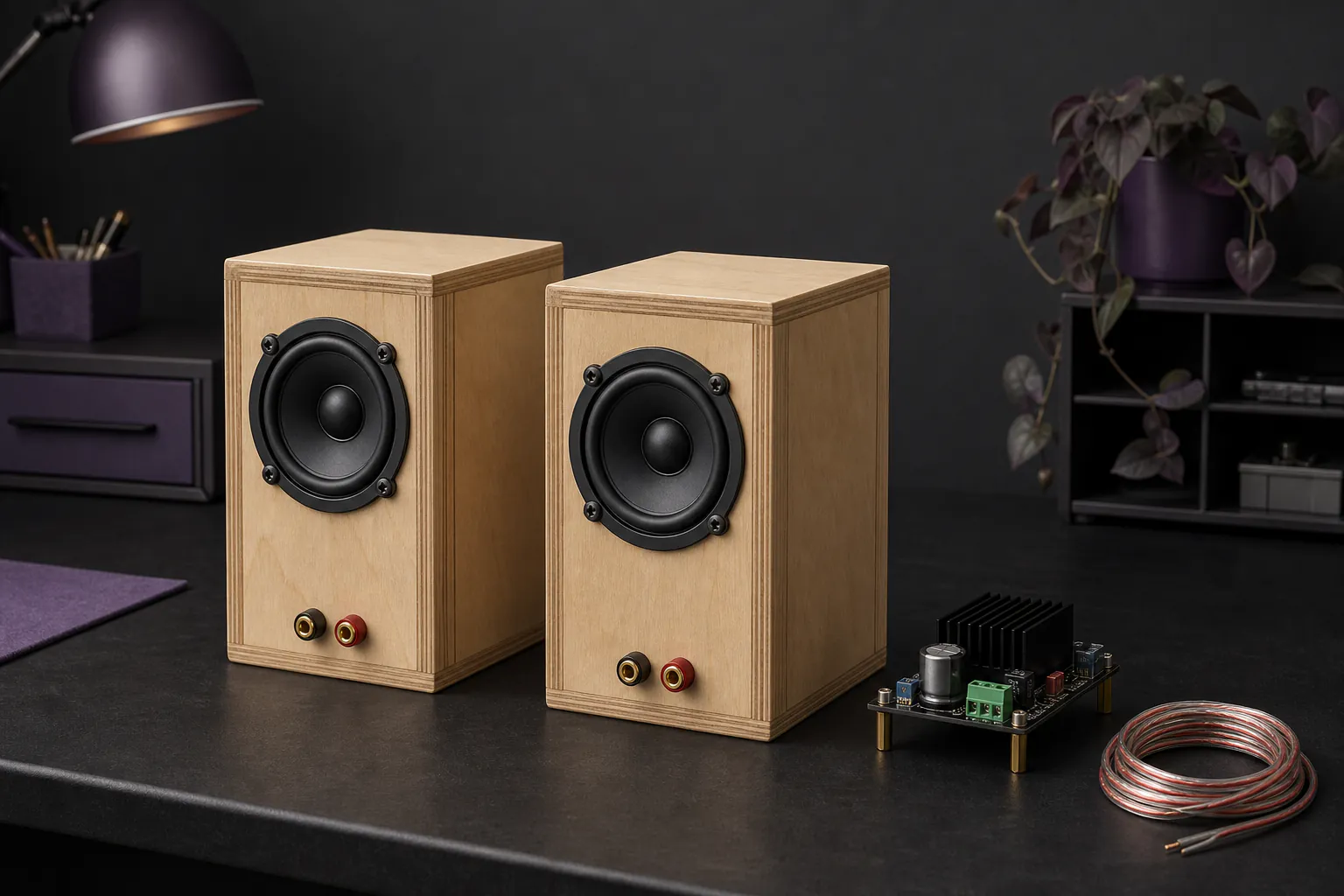
Use a 5 V stereo Bluetooth amplifier board with two 4-ohm 5 W full-range drivers and ordinary speaker cable. Verify the board supply polarity and current requirement, wire one channel at a time and test quietly with the drivers resting securely in the open. Once both channels are clean, build two small rigid sealed boxes and add strain relief so terminals cannot short.
- 01
Amplifier wattage is not a promise of loudness or compatibility; supply voltage, load impedance, distortion and driver limits interact.
- 02
The beginner parts shown form a modest low-voltage test system. The larger 2 × 50 W board is an upgrade, not a drop-in replacement.
- 03
A speaker cabinet is part of the acoustic system. A random port can make bass worse, so the first box is sealed and conservative.
- 04
Exposed amplifier boards need ventilation, non-conductive mounting and insulated connections.
What to expect
The box and compatibility matter as much as neat woodwork
A speaker can make sound with loose parts in minutes, but clean reliable playback requires correct loads, sensible volume and a cabinet that does not buzz.
Impedance
The amplifier must support the drivers’ nominal impedance. Parallel wiring changes the load and can overheat a board.
Power
Marketing numbers often quote ideal maximum output. Begin at low volume and stop if the driver distorts or the amplifier overheats.
Polarity
Both drivers should move in the same acoustic direction. Reversed polarity weakens centred bass and imaging.
Enclosure
Size, leaks and panel flex alter bass and noise. A sealed prototype is forgiving but still benefits from rigid joints.
Source
Bluetooth adds pairing, compression and possible noise. Test another source or cable before blaming the driver.
Expectation
Small inexpensive full-range drivers will not produce deep room-filling bass; the project teaches the system honestly.
Core method
Treat the speaker as one electrical and acoustic system
Check every rating together
Read the amplifier supply range and supported speaker impedance. Confirm each driver impedance and continuous power rating, then choose a supply that meets the board specification without exceeding it. Do not assume a connector shape proves voltage or polarity. Draw the left channel, right channel and power connections before wiring.
Prove quiet, clean sound on the bench
Mount the board on a non-conductive surface. With power disconnected, strip only enough cable for the terminals and prevent loose copper strands. Connect one driver per channel, set volume low, apply the correct supply and play speech or familiar music. Listen for hum, scraping and distortion, then check board temperature.
Build simple sealed enclosures
Make two equal rigid boxes with the driver fixed airtight to the front and enough internal depth for the magnet and terminals. Seal joints, add a small amount of suitable damping if the design permits and provide cable strain relief. Do not add a reflex port copied from an unrelated design; port tuning depends on driver data and box volume.
Compare changes rather than guessing
Listen at the same position and volume before and after the driver enters the box. Note bass extension, midrange colour, buzzes and stereo placement. Fix air leaks and loose panels first. Measurement microphones and crossover design become useful when the project moves beyond one full-range driver per channel.
Useful products
A modest low-voltage system and a clear power upgrade
The 5 V amplifier and matching 4-ohm 5 W driver pair make the approachable first electrical route; add speaker wire and an enclosure. The larger cased TPA3116 board shows the next amplifier class but requires appropriately rated drivers and a correctly specified DC supply.
DollaTek XH-A158 Bluetooth 5.0 5 W × 2 Amplifier Board
Its 5 V format keeps the first circuit approachable and pairs sensibly with small 4-ohm drivers.
Gikfun 2-Inch 4-Ohm 5 W Full-Range Drivers, Pair
Their stated impedance and modest rating fit the purpose of the checked low-voltage board route.
Amazon Basics 16-Gauge Speaker Wire, 15.24 m
It is more than adequate for short low-voltage speaker runs and makes polarity easier to maintain.
DollaTek TPA3116 Bluetooth 5.0 2 × 50 W Amplifier Board with Shell
It offers a meaningful increase in capability rather than decorative extras.
First project
Build a sealed desktop stereo pair
Make both channels work on the bench, then construct two matching boxes from plywood or MDF with no port and no exposed terminals.
- 01
Read the ratings
Record board supply, supported impedance and driver impedance and power before connecting anything.
- 02
Prepare safe wiring
Use short insulated runs, tidy stripped ends and no loose strands; keep power disconnected.
- 03
Test one channel
Play speech quietly and confirm clean output before adding the second driver.
- 04
Check stereo polarity
Wire both positive terminals consistently and centre a mono voice between the speakers.
- 05
Make two rigid boxes
Cut equal panels, dry-fit, glue and seal joints, then mount drivers without air gaps.
- 06
Add strain relief and listen
Secure cables, ventilate the board and compare the boxed sound at moderate volume.
What can wait
What can wait until the first result
Wait until the first pair exposes a specific acoustic or practical problem.
- 01
A two-way crossover
Multiple drivers require acoustic measurement and filter design; a random generic crossover rarely matches them.
- 02
A bass-reflex port
Port diameter and length depend on driver parameters and box volume. An untuned hole is not free bass.
- 03
High-power amplification
It requires compatible drivers, supply, cooling, protection and safe enclosure details.
- 04
Premium cable
Correct gauge, secure connections and sensible length matter more than exotic materials in this small build.
- 05
Decorative finish first
Make the cabinet airtight and quiet before veneer, paint or elaborate joinery.
Upgrade path
Upgrade the repeated limitation
Move up by redesigning the whole compatible chain, not swapping one impressive number.
Bench stereo
About £31 plus supply5 V board + two 5 W full-range drivers
Learn wiring, polarity and clean limits.Sealed desktop pair
About £15–£50 materialsRigid matching cabinets + strain relief
Hear how enclosure and leaks change sound.Measured full-range design
About £60–£200Documented drivers + modelled boxes + measurement
Tune size and damping with evidence.Two-way system
About £150+Woofer, tweeter, crossover and measurement gear
Extend bandwidth while adding substantial design work.Safety & care
Keep electrical and hearing risk inside the small scale
This guide stays with low-voltage DC modules. Household mains wiring and high-power amplifier construction need qualified design and proper enclosures.
- Use a regulated DC supply within the amplifier specification and verify connector polarity before applying power.
- Never work on mains wiring or an open mains-powered supply; use certified external adapters.
- Mount boards on standoffs, insulate terminals, provide ventilation and keep loose metal away.
- Begin at low volume, stop at audible distortion and protect hearing during repeated tests.
- Wear eye and respiratory protection when cutting sheet material and control MDF or wood dust appropriately.
Outside help
When outside help earns its place
A maker space becomes useful for accurate cabinet cutting or measurement equipment, not because a first low-voltage prototype requires a course.
Use specialist explanations for enclosures, crossovers and driver terminology.
Choose supervised woodworking access with dust controls and tool instruction.
Representative UK prices and free learning routes checked 3 August 2026; local availability, materials and tutor support vary.
Sources
Where the guidance came from
Specialist loudspeaker resources establish compatibility, enclosure and crossover principles; UK safety guidance covers wood dust and workshop practice.
-
01
Parts Express · Speaker building resources
Specialist articles, calculators and terminology for DIY loudspeakers.
Open source -
02
Parts Express · Build your own speakers
Overview of drivers, cabinets and complete speaker projects.
Open source -
03
Parts Express · Building a crossover
Why multi-driver crossover work requires component and acoustic decisions.
Open source -
04
HSE · Woodworking health and safety
UK guidance on dust, machinery, ventilation and workshop risk.
Open source -
05
Amazon UK · DollaTek XH-A158 Bluetooth amplifier board
Exact product page, model or ISBN, observed price and availability checked for this guide.
Open source -
06
Amazon UK · Gikfun 2-inch full-range driver pair
Exact product page, model or ISBN, observed price and availability checked for this guide.
Open source -
07
Amazon UK · Amazon Basics 16-gauge speaker wire
Exact product page, model or ISBN, observed price and availability checked for this guide.
Open source -
08
Amazon UK · DollaTek TPA3116 2 × 50 W amplifier
Exact product page, model or ISBN, observed price and availability checked for this guide.
Open source
Guide information and links checked 3 August 2026.