Beginner’s guide · Make & create
Start with soap
that is already soap.
Melt a pre-saponified base, pour two plain bars and learn clean melting, simple moulding and sensible additive limits. Cold-process soap is a rewarding next method, but it is a different project with lye, calculations and a cure period.
Quick answer
Make two plain bars before adding fragrance
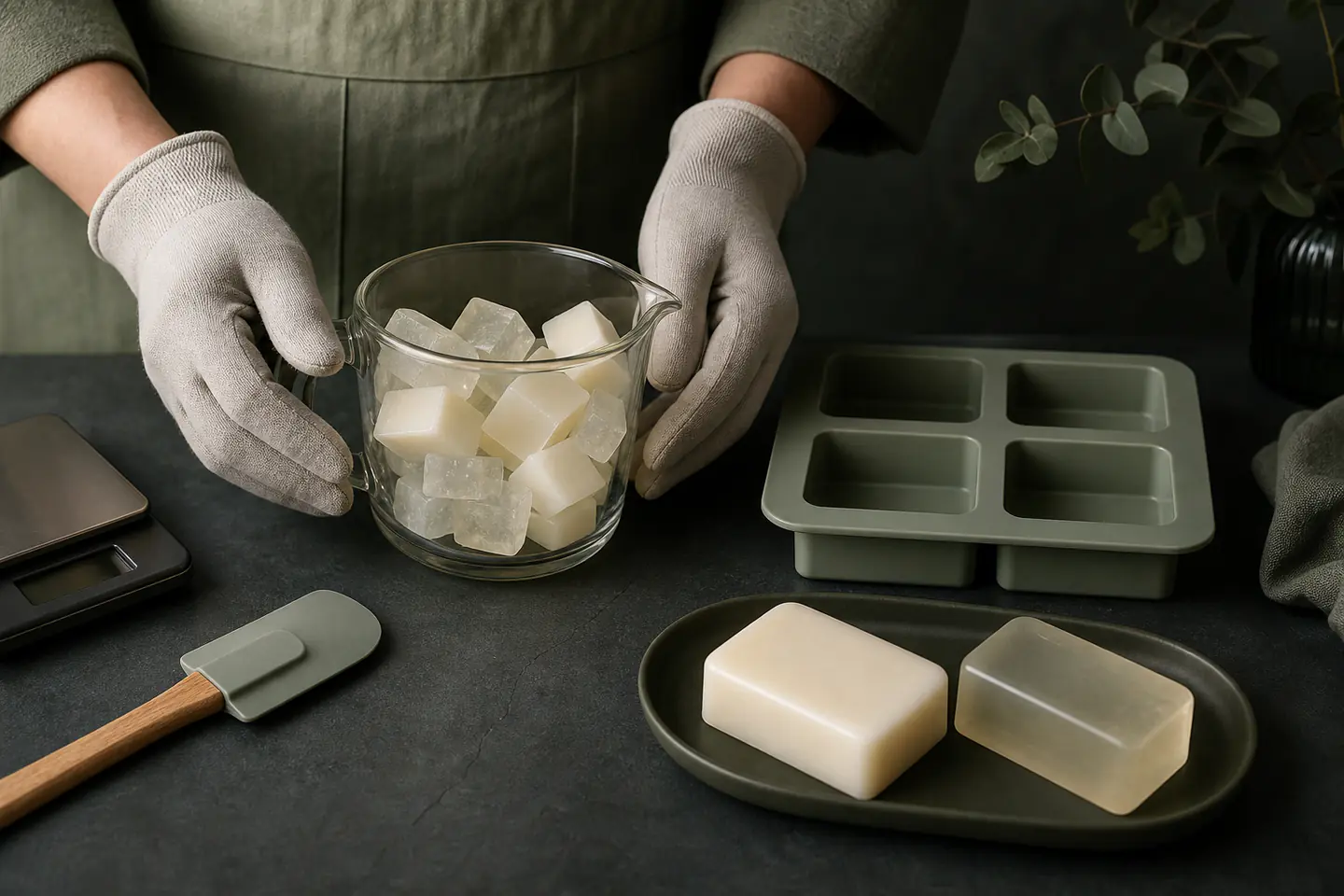
Buy a reputable pre-made melt-and-pour base and a simple silicone cavity mould, or use a clean heat-safe silicone mould you already own. Cut only enough base for two bars, melt it gently, pour it and leave it completely undisturbed until firm.
- 01
Melt-and-pour base has already been saponified. You do not handle sodium hydroxide and there is no multi-week cure.
- 02
Start uncoloured and unscented. The first batch is about avoiding overheating, bubbles, spills and premature unmoulding.
- 03
Use clean, dry, heat-safe equipment. Water droplets and random kitchen additions can shorten shelf life or spoil the finish.
- 04
If you later add colour or fragrance, use products documented for wash-off cosmetics and follow the supplier’s maximum rate by weight.
What to expect
The craft is simple; the finish still takes control
Melt-and-pour removes the chemistry and hazards of making soap from oils and lye, but it does not remove temperature, ingredient and storage decisions.
Melting
Small pieces melt evenly. Long bursts or direct high heat can boil the base, drive off water and leave a rubbery or shrunken bar.
Timing
A thin skin forms quickly. Have the mould level and ready before heating the base.
Bubbles
Stirring fast traps air. A gentle pour produces a cleaner face; surface bubbles are cosmetic, not a failed bar.
Sweating
Glycerine attracts moisture from humid air. Wrap fully cooled bars promptly and store them dry.
Additives
More is not better. Excess oil, wet botanicals or untested fragrance can soften the bar, separate or irritate skin.
Method limits
This teaches melting, colour, scent and mould design. It does not teach lye calculation, trace or cold-process formulation.
Choose a method
Choose the method before the shopping list
Melt-and-pour is the fast home route
The manufacturer has already reacted oils with an alkali and adjusted the formula so the solid base can be melted again. You cut, melt, customise within the supplier’s limits and mould it. A plain first bar can be used after it has fully cooled and hardened, although the maker’s instructions still take priority.
Cold process starts from oils and sodium hydroxide
Cold-process soap gives control over the oil recipe and finished character, but sodium hydroxide solution is corrosive, generates heat and requires protective equipment, accurate weighing, a checked lye calculation and a suitable work area. The poured soap also needs time to finish saponifying and lose excess water before use. Treat it as a later method to learn deliberately, not as the next decorative variation.
Soap for personal use is not automatically a product you may sell
A bar used to clean skin is a cosmetic product in Great Britain. If you make it available to consumers, the rules include a Responsible Person, a product safety assessment, documented manufacturing information, notification and compliant labelling. A gift or sale can move a kitchen experiment into regulated territory. Make for your own household first; check the current rules before distributing it.
Starter pair
A base and a mould are the working pair
The checked basket is intentionally plain: one kilogram of established clear base and two six-cavity silicone moulds. Begin with only two cavities so mistakes stay cheap.
Mystic Moments Stephensons Clear SLS-Free Soap Base, 1 kg
It removes lye handling from the first session and gives enough base for several small, comparable batches.
BREEZO Six-Cavity Rectangle Silicone Soap Moulds, Pack of 2
Individual cavities let a beginner test two bars and leave the rest of the mould empty.
First bars
Pour two plain test bars
Follow the base manufacturer’s melting instructions if they differ. The goal is a repeatable plain bar, not a layered showpiece.
- 01
Prepare a dry station
Clean the worktop, mould, knife, board, heat-safe jug and stirring tool. Keep children and pets out of the area. Set the flexible mould on a rigid tray before filling it.
- 02
Cut a small test quantity
Cut the base into even cubes and weigh enough for two mould cavities. Record the weight so the next batch is easy to repeat.
- 03
Melt gently
Use short microwave bursts or a gentle double-boiler method, stirring slowly between heats. Stop as soon as the last small pieces melt; do not let the base boil.
- 04
Pour once
Pour steadily into two cavities. Leave the top plain. If a few bubbles remain, treat them as useful evidence rather than adding another chemical to the first session.
- 05
Cool without moving
Leave the tray level until the bars are firm and cool throughout. Do not force a soft centre from the mould.
- 06
Unmould and store
Flex the silicone away from the bar, inspect the faces and wrap the fully cooled bars to limit moisture attraction. Label the batch date and base used.
Colour & scent
Add one variable at a time
Fragrance changes the formula
Choose a fragrance whose supplier explicitly documents cosmetic and soap use. The safe maximum depends on the particular fragrance, the product type and the supplier’s current documentation. Measure by weight; do not count drops or assume a candle fragrance rate applies to skin.
For a first scented test, use one small batch and stay within both the base maker’s and fragrance supplier’s limits. Keep the product name, batch information and usage document with your notes. If the bar becomes soft, cloudy or oily, adding more base is not a reliable safety correction.
Colour must also suit soap
Cosmetic mica, a liquid colour designed for melt-and-pour or a supplier-approved pigment is more predictable than food colouring. Vanilla-containing fragrance may darken a clear or pale base. Botanicals can turn brown, feel scratchy or introduce moisture; fresh fruit, milk, tea and flowers do not become shelf-stable merely because they are surrounded by soap.
Test function before decoration
Wash with the plain bar, let it drain and watch how quickly it softens. A draining soap dish often improves the experience more than another embed or layer.
Skip for now
What can wait
Buy an extra only when it answers a specific result from the plain bars.
- 01
Fragrance and a colour set
One documented wash-off fragrance is easier to dose and troubleshoot than a large mystery collection. The checked 10 ml Freshskin oil is an optional example, not part of the first two bars.
- 02
Dried flowers and food ingredients
They can discolour, scratch, spoil or create misleading skincare expectations. Decorative appeal is not proof of cosmetic suitability.
- 03
A soap cutter and loaf mould
Individual cavities avoid cutting and make small tests easy. A loaf becomes useful only when repeated batches justify identical slices.
- 04
An electric melter
A heat-safe jug or double boiler is sufficient for a few bars. A dedicated melter earns its storage space only at larger repeatable batch sizes.
- 05
Cold-process equipment
Goggles, gloves, a precision scale, dedicated lye-safe containers and a checked recipe belong to a separate learning plan.
Upgrade path
Move from shape to formulation deliberately
A better setup gives control over one new variable. It does not make an undocumented additive safe.
Plain melt-and-pour
About £19Reputable base + cavity mould
Learn clean melting, pour timing, cooling and storage without a fragrance or colour variable.One controlled variation
About £4–£12 extraOne documented fragrance or soap colour + gram scale
Learn repeatable dosage and see how one additive changes clarity, hardness and scent.Layering and embeds
£10–£35 extraSmall jugs + mister + planned temperatures
Add adhesion, colour bleed and timing decisions while keeping the same pre-made base.Cold process
Often £60–£150+PPE + precision scale + lye-safe equipment + tested formula
Gain oil formulation and texture control, while accepting corrosive materials, a cure period and much stricter process discipline.Safety
Hot base is still a burn and spill risk
Melt-and-pour is lower risk than handling lye, not risk-free.
- Use heat-safe vessels and short heating intervals; melted base and steam can burn.
- Keep the station dry and stable, with the flexible mould supported on a rigid tray.
- Use only additives documented for the intended cosmetic use and current supplier limits.
- Do not make medical, antibacterial or skin-treatment claims from a decorative home recipe.
- Label ingredients for household users and stop using a bar that causes irritation.
- Do not sell or distribute cosmetic soap until current GB or NI requirements for your market have been checked and met.
Classes
When a workshop is useful
A melt-and-pour class is optional. A reputable cold-process class can be useful when you want supervised lye handling and formulation rather than another decorative recipe.
Useful for colour, fragrance and mould techniques if you prefer shared equipment. Current UK examples ranged from a short community event to a full-day adult course.
Look for explicit PPE, lye safety, weighing, recipe calculation and take-home documentation. Avoid a class that treats a copied formula as universally safe.
Representative UK class listings checked 27 July 2026; dates, inclusions and prices change.
Sources
Where the guidance came from
Safety and legal points use regulator or specialist guidance; community discussions were used to find recurring beginner mistakes and expectations.
-
01
GOV.UK · Making cosmetic products available to consumers in Great Britain
Responsible Person, safety assessment, product information, notification and labelling obligations for cosmetics in Great Britain.
Open source -
02
GOV.UK · Consumer products: cosmetics
Definition and current high-level responsibilities for cosmetic products.
Open source -
03
Bramble Berry · Beginner’s guide to melt and pour
Specialist overview of pre-made bases, skin-safe fragrance and compatible colourants.
Open source -
04
Poison Control · Is it safe to make soap?
Risk comparison between pre-made melt-and-pour products and lye-based methods.
Open source -
05
r/soapmaking · Tips before making soap
Community distinction between beginner-friendly melt-and-pour and more advanced cold process.
Open source -
06
r/soapmaking · Melt and pour is a separate method
Experienced makers explain that melt-and-pour and cold or hot process have different chemistry and workflows.
Open source -
07
Mary Ward Centre · Melt & Pour Soap Making
Current £65 full-day class example used for representative course pricing.
Open source -
08
PECT · Soap Making Workshop
Current £15 short community workshop example used for representative course pricing.
Open source -
09
Amazon UK · Stephensons clear SLS-free base, 1 kg
Exact Mystic Moments listing, £12.99 observed price and current product page.
Open source -
10
Amazon UK · BREEZO six-cavity silicone moulds
Exact two-mould listing, £5.99 observed price and in-stock status.
Open source -
11
Amazon UK · Freshskin Baby Powder fragrance oil, 10 ml
Exact cosmetic-grade soap-use listing and £3.99 observed price; supplier limits still need checking before use.
Open source
Guide information and links checked 27 July 2026.