Beginner’s guide · Make & build
Hear a signal
without a battery.
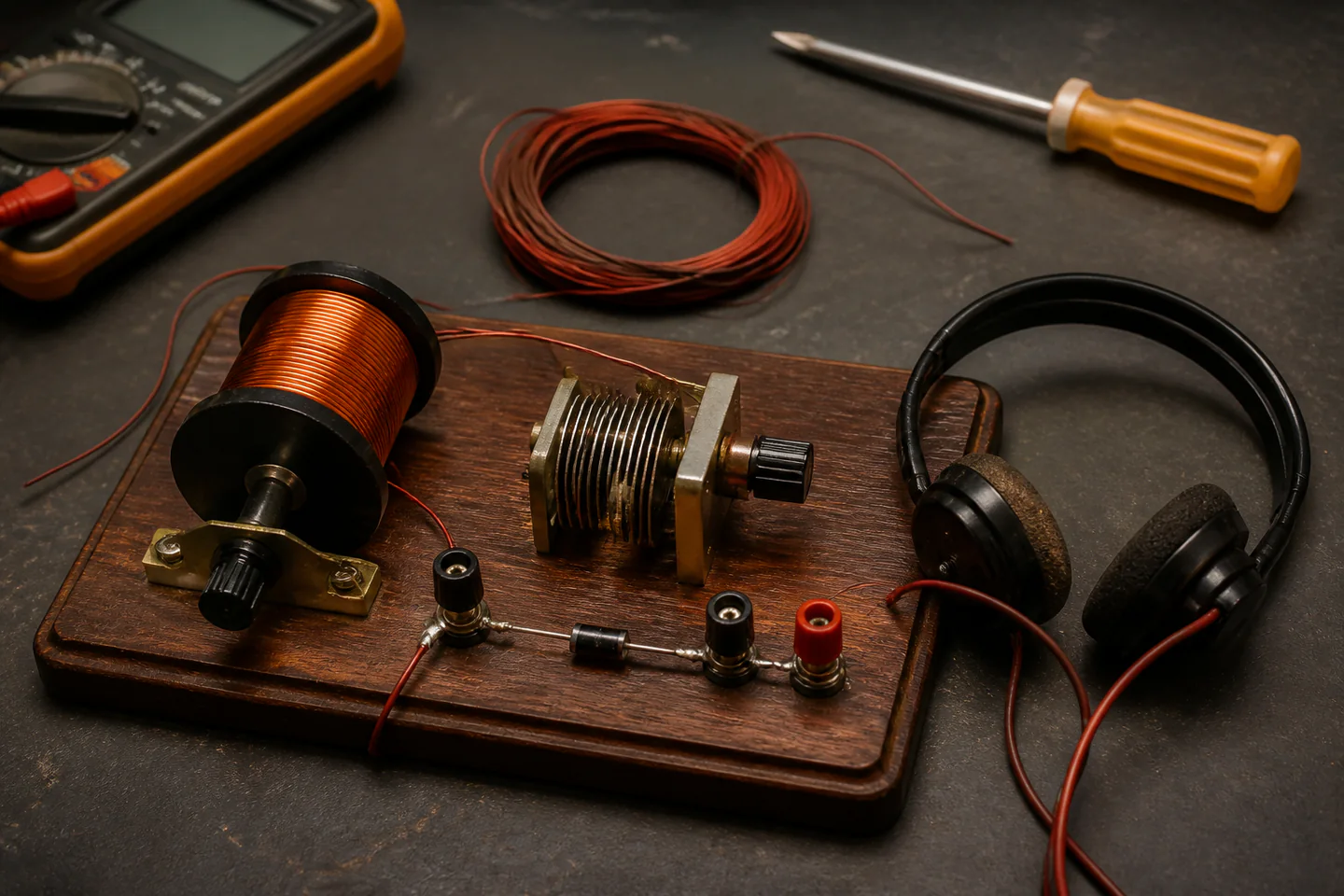
A crystal set uses an aerial, tuned coil, diode and sensitive earpiece to recover energy from a strong AM broadcast. Start from a documented kit and treat the aerial and earth as part of the circuit.
Quick answer
Use a complete kit near a strong AM signal
Choose a kit with a clear circuit diagram, germanium or Schottky detector and high-impedance earpiece. Build and continuity-test it indoors, then connect only a safely arranged aerial and earth that follow current local electrical and lightning guidance.
- 01
Confirm that usable medium-wave AM broadcasts can be received in your area before expecting a crystal set to work. Record the setting, measurement or observation that mattered so the next attempt can be changed for a reason rather than by guesswork.
- 02
Follow one circuit diagram exactly and mark each connection after it passes a continuity check. Record the setting, measurement or observation that mattered so the next attempt can be changed for a reason rather than by guesswork.
- 03
Use the high-impedance earpiece or matching transformer specified by the design. Record the setting, measurement or observation that mattered so the next attempt can be changed for a reason rather than by guesswork.
- 04
Keep the detector and coil leads short and mechanically secure. Record the setting, measurement or observation that mattered so the next attempt can be changed for a reason rather than by guesswork.
- 05
Disconnect any long outdoor aerial during storms and whenever the set is unattended. Record the setting, measurement or observation that mattered so the next attempt can be changed for a reason rather than by guesswork.
What to expect
The circuit is simple because the signal supplies the power
A crystal radio can be an elegant first electronics project, but reception depends heavily on station strength, aerial, earth, coil and earpiece sensitivity.
Local signals
A passive set cannot amplify a faint signal. Distance, transmitter power, buildings and electrical noise can make a correct circuit quiet. In crystal radio building, this is worth checking before the next stage because a small adjustment now is easier than undoing a finished result.
Aerial and earth
The long wire and return path collect the radio-frequency energy. A short indoor lead may be useful for testing but can limit the result. In crystal radio building, this is worth checking before the next stage because a small adjustment now is easier than undoing a finished result.
Detector
The diode rectifies the tuned signal so audio remains. The exact part and orientation matter more than its visual size. In crystal radio building, this is worth checking before the next stage because a small adjustment now is easier than undoing a finished result.
Earpiece
Ordinary low-impedance headphones load the circuit heavily. Use the earpiece named by the design or an appropriate matching transformer. In crystal radio building, this is worth checking before the next stage because a small adjustment now is easier than undoing a finished result.
Core method
Prove each passive stage separately
Read the circuit
Identify the tuned coil and capacitor, detector diode, earpiece, aerial and earth before handling parts. Translate the schematic into labelled physical connection points. In crystal radio building, this is worth checking before the next stage because a small adjustment now is easier than undoing a finished result.
Build mechanically
Mount the coil, terminals and tuning part so wires cannot rotate or touch accidentally. Scrape enamel wire only where a connection is intended. In crystal radio building, this is worth checking before the next stage because a small adjustment now is easier than undoing a finished result.
Test continuity
With no aerial attached, use a meter to check coil continuity and verify that intended joints conduct while separate nodes remain separate. In crystal radio building, this is worth checking before the next stage because a small adjustment now is easier than undoing a finished result.
Add reception safely
Connect the specified earpiece, then a conservatively routed aerial and suitable earth under current guidance. Tune slowly in a low-noise location. In crystal radio building, this is worth checking before the next stage because a small adjustment now is easier than undoing a finished result.
Useful products
Products with a clear job in the setup
The first item is the project; the iron and meter are reusable diagnostic tools if the chosen kit requires soldering.
EIGHT Innovation Crystal Set AM Radio Science Project Kit with Transistor Option
A kit avoids sourcing an unsuitable earpiece or detector separately.
Antex XS25 25 W Soldering Iron
A known fixed-power iron is preferable to an unbranded high-wattage tool for small components.
AstroAI AM33D Digital Multimeter
Continuity testing can locate an open coil or missed connection without guessing.
First project
Tune one known local station
A single verified signal is a better milestone than adding amplification before the passive set is understood.
- 01
Check the band
Use a normal AM receiver or coverage information to identify a strong local medium-wave station and a quiet time for testing. In crystal radio building, this is worth checking before the next stage because a small adjustment now is easier than undoing a finished result.
- 02
Inventory the kit
Match every coil, diode, tuning part, terminal and earpiece to the diagram before assembly. In crystal radio building, this is worth checking before the next stage because a small adjustment now is easier than undoing a finished result.
- 03
Build and inspect
Make each mechanical and electrical connection in sequence, then inspect diode orientation and enamel-wire preparation. In crystal radio building, this is worth checking before the next stage because a small adjustment now is easier than undoing a finished result.
- 04
Test the circuit
Use continuity checks recommended by the instructions and resolve every open or unintended short before connecting an aerial. In crystal radio building, this is worth checking before the next stage because a small adjustment now is easier than undoing a finished result.
- 05
Tune safely
Attach the approved aerial and earth arrangement, wear the earpiece and move the tuning control very slowly through the expected frequency. In crystal radio building, this is worth checking before the next stage because a small adjustment now is easier than undoing a finished result.
What can wait
What can wait until the first result
Amplifiers and elaborate coils obscure the achievement if the basic tuned detector has never produced a signal.
- 01
Mains-derived earth
Never improvise a connection to household wiring, gas pipes or an unknown conductor. Use only a safe arrangement supported by current guidance. In crystal radio building, this is worth checking before the next stage because a small adjustment now is easier than undoing a finished result.
- 02
Large permanent outdoor aerial
A long wire adds lightning, property and planning responsibilities. Prove the project and obtain competent advice first. In crystal radio building, this is worth checking before the next stage because a small adjustment now is easier than undoing a finished result.
- 03
Multi-band regenerative receiver
Powered feedback receivers are rewarding later but introduce oscillation, alignment and licensing questions beyond a passive first set. In crystal radio building, this is worth checking before the next stage because a small adjustment now is easier than undoing a finished result.
Upgrade path
Upgrade the repeated limitation
Change one reception limitation at a time.
Try it
£18–£60Documented kit, sensitive earpiece and safe short test aerial
Circuit reading and passive detection become tangible.Diagnose it
£15–£50 extraMeter, better terminals and documented component values
Open coils and weak joints are easier to separate from reception limits.Improve selectivity
£15–£60Carefully wound coil and quality tuning capacitor
Nearby stations can be separated more clearly.Add audio carefully
£10–£60Battery-powered high-impedance buffer or amplifier
Faint audio becomes easier to hear after the passive detector is verified.Safety & care
Treat the aerial as an outdoor electrical conductor
The receiver is passive, but a long wire can encounter lightning, overhead lines and static charge.
- Never erect an aerial near overhead power lines or where a falling wire could reach them. Follow current manufacturer, food-safety, electrical or local guidance wherever it applies.
- Disconnect and earth or secure outdoor aerials according to competent current guidance before storms and when unattended. Follow current manufacturer, food-safety, electrical or local guidance wherever it applies.
- Do not use mains earth, gas pipes or unknown household conductors as an improvised connection. Follow current manufacturer, food-safety, electrical or local guidance wherever it applies.
- Solder only with a stable stand, ventilation, eye protection and careful hand-washing after handling solder. Follow current manufacturer, food-safety, electrical or local guidance wherever it applies.
Outside help
When outside help earns its place
A radio-club demonstration is particularly valuable for aerial safety and diagnosing local reception. The first passive kit can otherwise be completed from one detailed manual.
Use one complete lesson that covers preparation, the main technique, troubleshooting and finishing. For a first crystal radio building project, following one coherent method is more useful than combining partial instructions from several creators.
Outside help earns its place when safe setup, equipment access or live correction would remove a real obstacle. Ask what materials, supervision and take-home result are included before booking.
Representative UK learning options checked 30 August 2026; local prices, access, materials and tutor support vary.
Sources
Where the guidance came from
The method is grounded in specialist, manufacturer and public guidance, then checked against recurring beginner problems and the exact products linked here.
-
01
Radio Society of Great Britain · Beginners
UK radio learning and safety context.
Open source -
02
ARRL · Technical information service
Radio fundamentals and project reference.
Open source -
03
Electronics Notes · Crystal radio
Circuit explanation for passive detector receivers.
Open source -
04
BBC Reception Advice
UK broadcast reception and interference context.
Open source -
05
Electrical Safety First
UK electrical safety guidance.
Open source -
06
Amazon UK · Crystal Set AM Radio Science Project Kit with Transistor Option
Exact Amazon UK product page or ISBN used for the recommendation; current price, seller, specification and availability should be confirmed.
Open source -
07
Amazon UK · XS25 25 W Soldering Iron
Exact Amazon UK product page or ISBN used for the recommendation; current price, seller, specification and availability should be confirmed.
Open source -
08
Amazon UK · AM33D Digital Multimeter
Exact Amazon UK product page or ISBN used for the recommendation; current price, seller, specification and availability should be confirmed.
Open source
Guide information and links checked 30 August 2026.