Beginner’s guide · Make & create
Make your first row of crosses.
Start small, finish it.
Begin with a small counted kit for the quickest complete route, or choose a simple chart and buy 14-count Aida, matching stranded cotton and a blunt tapestry needle separately. Learn how to read the grid, keep every top stitch facing the same way and finish a first design without buying a large organiser full of supplies.
Quick answer
The quickest useful answer
Buy a small counted cross-stitch kit that includes 14-count Aida, stranded cotton, a blunt needle and a chart. Use ordinary scissors from home. A complete learning kit removes colour matching and fabric sizing from the first attempt, while still teaching the same counting and stitch direction used on larger designs.
- 01
Choose a design you would genuinely display, but keep the finished area around postcard size or smaller.
- 02
Start near the centre of both the chart and fabric so the design stays positioned correctly.
- 03
Make every lower diagonal in one direction and every top diagonal in the other. Consistent top legs make the surface look even.
- 04
Stop after a small, correct section rather than racing to finish. Cross-stitch is repetitive, and counting accurately matters more than speed.
What to expect
What cross-stitch is really like
Counted cross-stitch is closer to following pixel art than drawing freehand. Each chart square tells you where one X-shaped stitch belongs. The movement is simple; the hobby comes from careful counting, colour changes and the gradual reveal of the picture.
Rhythm
Long runs of one colour become calm and repetitive. Scattered single stitches and frequent colour changes are slower and easier to miscount.
Results
Your first stitches can look tidy within one sitting. A finished small picture still takes hours, and a large full-coverage chart can take months or years.
Mess
There is almost none. The recurring nuisance is short thread ends, loose needles and tangled floss rather than dust, paint or wet materials.
Space
A small hoop, folded chart and thread pouch fit beside a chair. Large frames, floor stands and extensive thread storage are later choices, not entry requirements.
Mistakes
A misplaced stitch can shift an entire section. Unpicking is normal, so check nearby landmarks before adding many stitches around a doubtful area.
The back
It should be secure and not excessively bulky, but it does not need to resemble the front. A finished, flat front matters more than a showpiece reverse.
Two routes
Choose a complete kit or build your own
Route one: a complete counted kit
This is the most reliable first purchase. A good kit supplies a chart, correctly sized fabric, the required thread colours and a needle. The selected DMC Tranquil Rose duo kit includes two pieces of 14-count Aida, eight colour cuts, a needle, instructions and one 15.7 cm wooden hoop. Ordinary scissors are the only household tool still needed. Follow the kit’s strand count and finishing instructions because these can vary.
A kit is not automatically easy. Check the finished dimensions and photograph before buying. Avoid a first design with a dark background, extensive isolated stitches, metallic thread, beads, many fractional stitches or a large area completely covered in stitching.
Route two: a chart plus separate supplies
Choose a small chart first, then buy the exact thread colours listed by its designer. For an ordinary beginner chart, 14-count white Aida and a blunt size 24 tapestry needle are a forgiving baseline. You can use a small hoop you already own, stitch with the fabric held in your hands, or add a hoop later if maintaining even tension is difficult.
This route offers far more choice, including free downloadable charts, but it creates extra decisions. Confirm the chart’s fabric count, finished stitch dimensions, colour key, number of strands and any backstitch or fractional stitches before ordering supplies. A pattern designed for linen or very high-count fabric is not converted into a beginner project simply by buying Aida.
Counted, stamped and printed kits
A counted chart keeps the fabric blank and asks you to transfer each symbol by counting. A stamped or printed kit places marks on the fabric for you to cover or wash away. Both can produce a finished picture, but they teach different habits. This guide uses counted cross-stitch because it is the most transferable route into downloadable charts and traditional kits.
Starter kit
One complete route or one chart-led route
Choose the complete DMC duo kit by itself. If you prefer a separate chart, pair the Aida and size 24 needles with only the thread colours that chart names. The Q-Snap is a later frame option, so it does not belong in either first basket.
DMC Tranquil Rose Cross Stitch Duo Kit
The kit includes two small counted designs, 14-count fabric, threads, needle, instructions and a hoop, so the first session begins with stitching rather than calculations.
DMC White 14-Count Aida, 55 × 50 cm
Light 14-count Aida makes the holes visible and matches the most common beginner guidance.
Bohin No. 24 Tapestry Needles, Pack of 6
Size 24 suits 14-count Aida and the blunt tip finds the existing holes instead of splitting the fabric threads.
Q-Snap Needlework Frame, 8 × 8 inches
It can hold a wider area evenly once a hoop or stitching in hand has become a real limitation.
Chart & stitches
Read the chart before threading the needle
Match the chart to the fabric
A chart is a square grid. Each symbol normally represents one stitch over one Aida block, and the key assigns a thread colour to that symbol. Fabric count describes how many blocks fit into one inch. On 14-count Aida, fourteen stitches cover one inch, so a 70-stitch-wide design occupies about 5 inches before you add a fabric margin. Higher counts make the same chart physically smaller and the holes harder to see.
Find the centre
Charts usually mark their horizontal and vertical centres. Fold the fabric lightly in both directions or count to its centre, match that point to the chart centre and begin nearby. This avoids finishing the picture too close to an edge. Leave enough unused fabric for holding, washing and framing rather than cutting tightly around the stated finished design size.
Make one consistent X
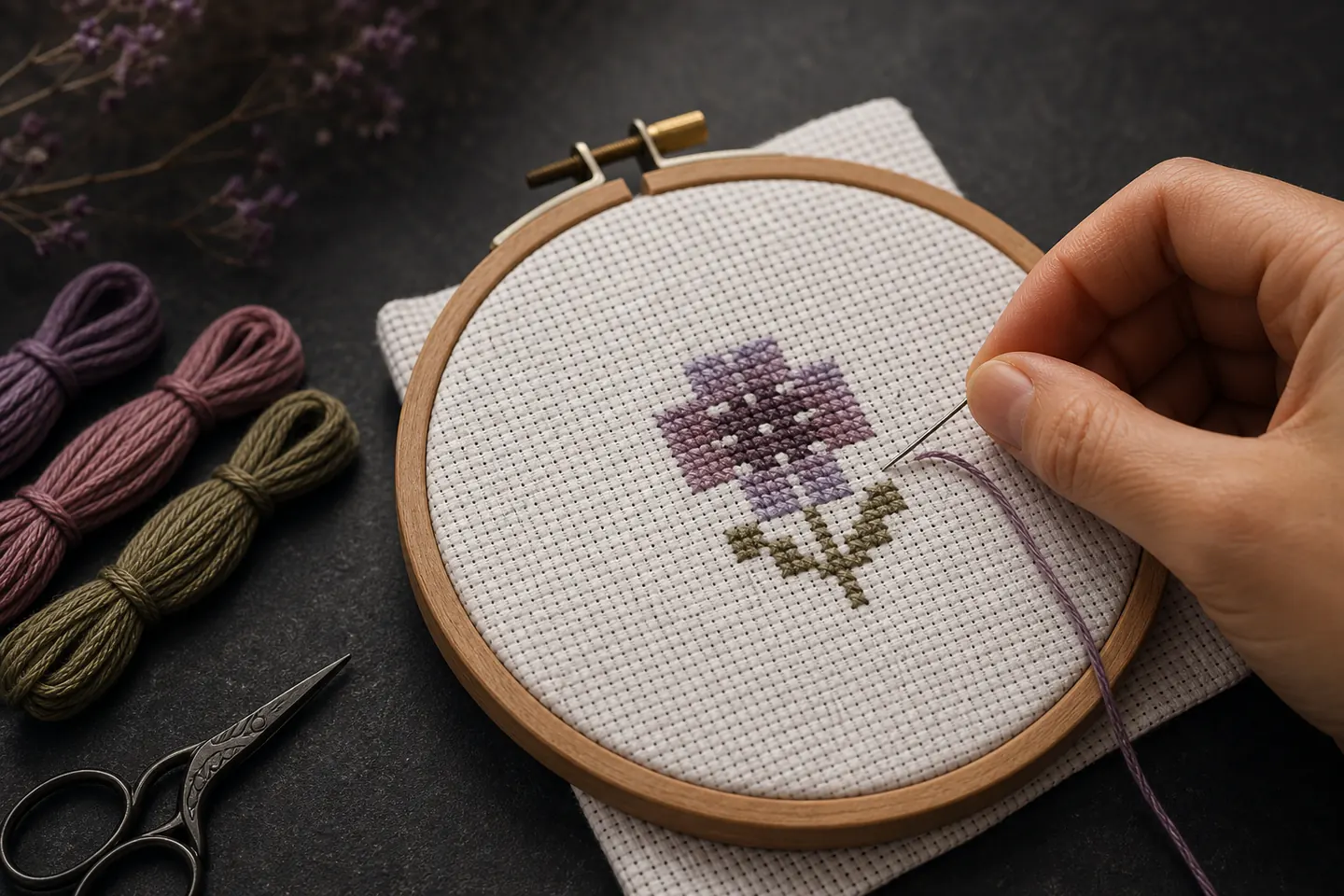
Bring the needle up through a hole, cross diagonally to the opposite corner, then complete the other diagonal. Work all lower legs in the same direction and all top legs in the same direction across the project. You can complete each X individually or make a row of half stitches and return across it; both are valid when the final top legs agree.
Use the number of strands specified
Six-strand embroidery cotton is designed to separate. Many 14-count charts use two strands, but the chart or kit is the authority. Separate one strand at a time and recombine the required number to reduce tangles. Do not double two strands through the needle unless that is how you deliberately intend to produce four working strands.
Secure thread without a bulky knot
Leave a short tail on the back and trap it beneath the first few stitches, use a loop start when the strand arrangement allows it, or weave a finished tail beneath several existing stitches. Large knots can create bumps and may show after framing. Keep thread travels on the back reasonably short, but do not turn the reverse into a separate perfection project.
Mark your progress
Work one manageable area at a time and mark completed chart squares with pencil, highlighter tape or a compatible digital pattern app. Check a few fixed landmarks before changing colour. When something no longer lines up, stop and count from a known correct point before adding more stitches.
First project
Complete a small first section
The first useful result is not a framed masterpiece. It is a small block of correctly counted stitches with even tension and matching top legs. Use the learning kit or any similarly small counted design.
- 01
Prepare
Wash and dry your hands, gather the chart, fabric, needle, one thread colour and scissors, then work under a bright lamp. Keep every other colour in the packet until needed.
- 02
Centre
Find the chart centre and fabric centre. Mount the fabric in the supplied hoop without stretching the square weave out of shape, or hold a small piece in your hands if that is comfortable.
- 03
Thread
Cut a manageable length, separate the number of strands stated by the chart and thread the blunt tapestry needle. Avoid an extremely long piece because repeated pulling increases tangles and wear.
- 04
Stitch one landmark
Choose a short nearby run of the same symbol. Count from the centre, make the lower diagonal repeatedly, then return with the top diagonal. Check that the row occupies the intended chart squares.
- 05
Secure and inspect
Weave the tail beneath stitches on the back and trim it. Turn the work over, check that the fabric remains flat and that every top leg faces the same direction.
- 06
Continue in short sessions
Mark the chart, park the needle safely and return to the next nearby block. Several accurate sessions are more useful than one long session that ends with eye strain and a large counting error.
Skip for now
What can wait
These are genuine cross-stitch tools and materials, but none is required to learn the basic counted stitch.
- 01
A huge thread collection
Buy the colours required by the current chart. A complete range is expensive, needs storage and still does not choose a suitable project for you.
- 02
Dark, linen or very high-count fabric
They can produce beautiful results, but finding holes and recovering from miscounts is less forgiving than on white 14-count Aida.
- 03
Metallic and speciality threads
They fray, twist and behave differently from ordinary cotton. Add them after you can keep tension even with standard stranded cotton.
- 04
A floor stand
A stand can reduce the need to hold a large frame, but it occupies space and must fit your chair, frame and stitching method. Try the hobby first.
- 05
A full-coverage design
Large charts with every square stitched create impressive pictures, but the time, colour changes and counting load make them poor tests of whether you enjoy the basic rhythm.
- 06
Perfect-back rules
Secure ends, avoid large knots and do not carry thread across very long empty distances. Beyond that, choose methods that keep the front flat and the project enjoyable.
Upgrade path
What later upgrades actually change
Upgrade only when you can name the limitation. Better organisation does not make the crosses for you, but it can reduce set-up time, lost colours and tension problems on larger work.
Try it
About £15Small complete counted kit, ordinary scissors and a bright lamp
Removes colour matching and fabric calculations so you can test counting, threading and stitch rhythm.Choose your own charts
About £12–£30 per small project14-count Aida, exact chart colours, size 24 needle and an optional small hoop
Opens far more designs and lets you reuse tools, while adding decisions about size, materials and colour purchasing.Hold larger work evenly
About £15–£30An 8-inch Q-Snap or another frame sized to the fabric
A wider clamped area can hold tension evenly, but the frame is bulkier and needs spare fabric around the design.Organise repeat projects
About £10–£40Bobbins or thread drops, labelled project bags, spare needles and a simple needle minder
Reduces tangles and missing colours when a chart uses many shades. It does not improve an unsuitable pattern or poor lighting.Work on large charts
£40 to several hundred poundsScroll frame or large Q-Snap, stand, chart-management app and dedicated storage
Supports more fabric and longer sessions. Compatibility, posture and storage become more important than headline size.Finishing
Finish, wash and display it
Decide whether washing is appropriate
Clean hands and a project bag prevent much of the need for washing. Before wetting a finished piece, check the kit and thread instructions, especially when it contains hand-dyed fabric, overdyed floss, beads, soluble printing or adhesive. Colourfast DMC cotton and ordinary Aida are commonly washed gently, but not every material combination is equivalent.
Wash without scrubbing
Use cool or lukewarm water and a small amount of mild soap. Let the piece soak briefly, move it gently, rinse thoroughly and do not wring it. Roll it in a clean towel to remove excess water, reshape it and dry it flat.
Press from the reverse
Place the design face-down on a clean towel so the stitches are not flattened against a hard board. Use the fabric manufacturer’s appropriate iron setting and press from the back. Keep heat away from beads, metallic fibres and materials whose instructions prohibit ironing.
Leave framing room
A finished design can remain in a decorative hoop, be laced or mounted for a frame, or become a card, patch, cushion panel or ornament. Do not trim close to the stitches until the final method is decided. Professional framing becomes useful for valuable work, unusual materials or a finish you want protected for years.
Safety
Keep the needle controlled
Cross-stitch is low-mess and low-risk, but a blunt tapestry needle can still puncture skin, become lost in upholstery or be swallowed. Treat needle control and comfortable posture as part of the setup.
- Use a needle minder, magnetic dish or closed case whenever the needle is not in the fabric. Count needles before putting the project away.
- Keep needles, small scissors, beads and loose thread beyond the reach of children and pets. Do not leave a threaded needle on a chair or sofa.
- Work under bright, directed light and take regular distance and movement breaks. Stop when you are squinting, gripping hard or hunching closer to the chart.
- Choose a frame you can hold without wrist strain. A Q-Snap can be steadier than a hoop, but community reports repeatedly describe it as heavier and less portable.
- Store scissors closed and use them only for thread and fabric. A small pair is convenient, not essential, when safe household scissors already do the job.
- Check material instructions before washing or ironing. Heat, dyes, printed guides and speciality fibres do not all behave like standard colourfast cotton on white Aida.
Classes & groups
When a class or group becomes useful
You can learn the basic X from a kit booklet and a short tutorial. Outside help becomes useful when you want immediate feedback on tension, finishing, linen, fractional stitches or a large chart, or when regular shared stitching time is part of the appeal.
Useful for shared stitching time, local shop knowledge and practical help with a confusing chart. Check libraries, community centres and independent needlework shops.
Convenient for a specific skill such as chart reading, finishing or working on evenweave. Confirm the materials list and whether a recording is included before paying.
A structured UK option for broader hand-embroidery skills, offered online and in person from beginner to advanced levels. It is an enrichment route, not a requirement for starting cross-stitch.
UK course availability checked 27 July 2026; local groups, dates and prices change.
Sources
Sources
See what shaped the advice.
Manufacturer technique guides, exact UK product pages, specialist fabric and frame specifications, current course information, repeated community experience and the licensed hero photograph were checked for this revision.
-
01
DMC · Cross-stitch fabric guide
Established what fabric count means, why Aida is widely used for cross-stitch and DMC’s recommendation of 14-count Aida for beginners.
Open source -
02
DMC · Step-by-step cross-stitch diagrams
Established the basic X, row methods, fractional-stitch context and the importance of keeping every top leg in the same direction.
Open source -
03
DMC · How to read a cross-stitch chart
Established the relationship between chart squares and fabric blocks, symbol keys, centre marks and marking completed chart areas.
Open source -
04
DMC · How to begin cross-stitch
Established starting near the centre, securing thread without a bulky knot, working rows, counting carefully and avoiding long thread carries.
Open source -
05
DMC · Cross-stitch needles
Established the blunt point and elongated eye used for counted work, and confirmed reference 1771/2 as a pack of six size 24 needles.
Open source -
06
DMC · Free cross-stitch patterns
Confirmed a current source of downloadable charts and the option to identify or purchase the DMC colours used by a selected pattern.
Open source -
07
Zweigart · Easy Count Grid Aida 14ct
Established the specialist 14-count Aida option with a washable ten-stitch grid and 100% cotton composition for later large-chart counting support.
Open source -
08
Q-Snap · Original needlework frames
Established the original frame system, available size range and ribbed clamp design intended to secure fabric without a screw hoop.
Open source -
09
r/CrossStitch · Advice for a first kit
Repeated practitioner advice favoured a small inexpensive all-in-one kit, 14-count fabric and a design small enough to finish, while warning that kit quality and complexity vary.
Open source -
10
r/CrossStitch · Hoops, Q-Snaps and stretcher bars
Repeated experience compared firmer Q-Snap tension and a larger working area with extra bulk, weight, portability and possible wrist discomfort.
Open source -
11
r/CrossStitch · Q-Snap, hoop or stitching in hand
Added recurring practitioner experience that frame preference varies, Q-Snaps need spare fabric and can feel heavier, while hoops remain compact and inexpensive.
Open source -
12
r/CrossStitch · Knots and securing thread
Repeated advice supported loop starts or weaving and burying ends, warned that knots can form bumps, and prioritised a good front over an immaculate reverse.
Open source -
13
Royal School of Needlework · Courses
Confirmed current UK online and in-person hand-embroidery learning routes from beginner to advanced levels and current Autumn 2026 booking information.
Open source -
14
DMC · Meditative Mandala cross-stitch kit care guidance
Established DMC’s general finished-work care sequence: mild soap, gentle rinsing, towel rolling, drying flat and pressing from the reverse at a suitable fabric setting.
Open source -
15
Pexels · Close-up of woman embroidering with needle
Supplied the free-to-use base photograph for the text-free hero. The image was cropped, colour-graded and converted to a 1600 × 1000 WebP.
Open source -
16
Amazon UK · DMC Tranquil Rose duo kit
Exact two-design kit contents, 14-count Aida, hoop, £14.72 observed price and current availability.
Open source -
17
Amazon UK · DMC white 14-count Aida
Exact 55 × 50 cm DMC fabric page, £8.45 observed price and in-stock status.
Open source -
18
Amazon UK · Bohin No. 24 tapestry needles
Exact six-needle pack, £3.22 observed price and current availability.
Open source -
19
Amazon UK · Q-Snap 8 × 8 frame
Exact original Q-Snap frame page, £28.88 observed import price and current availability.
Open source
Guide information and links checked 27 July 2026.