Beginner’s guide · Observe & photograph
Invite a visit,
not dependence.
Begin by observing local crows, jackdaws, rooks or magpies before offering anything. Small amounts, a clean ground tray and predictable boundaries make feeding safer for birds and neighbours.
Quick answer
Observe first, then offer a tiny portion on a clean tray
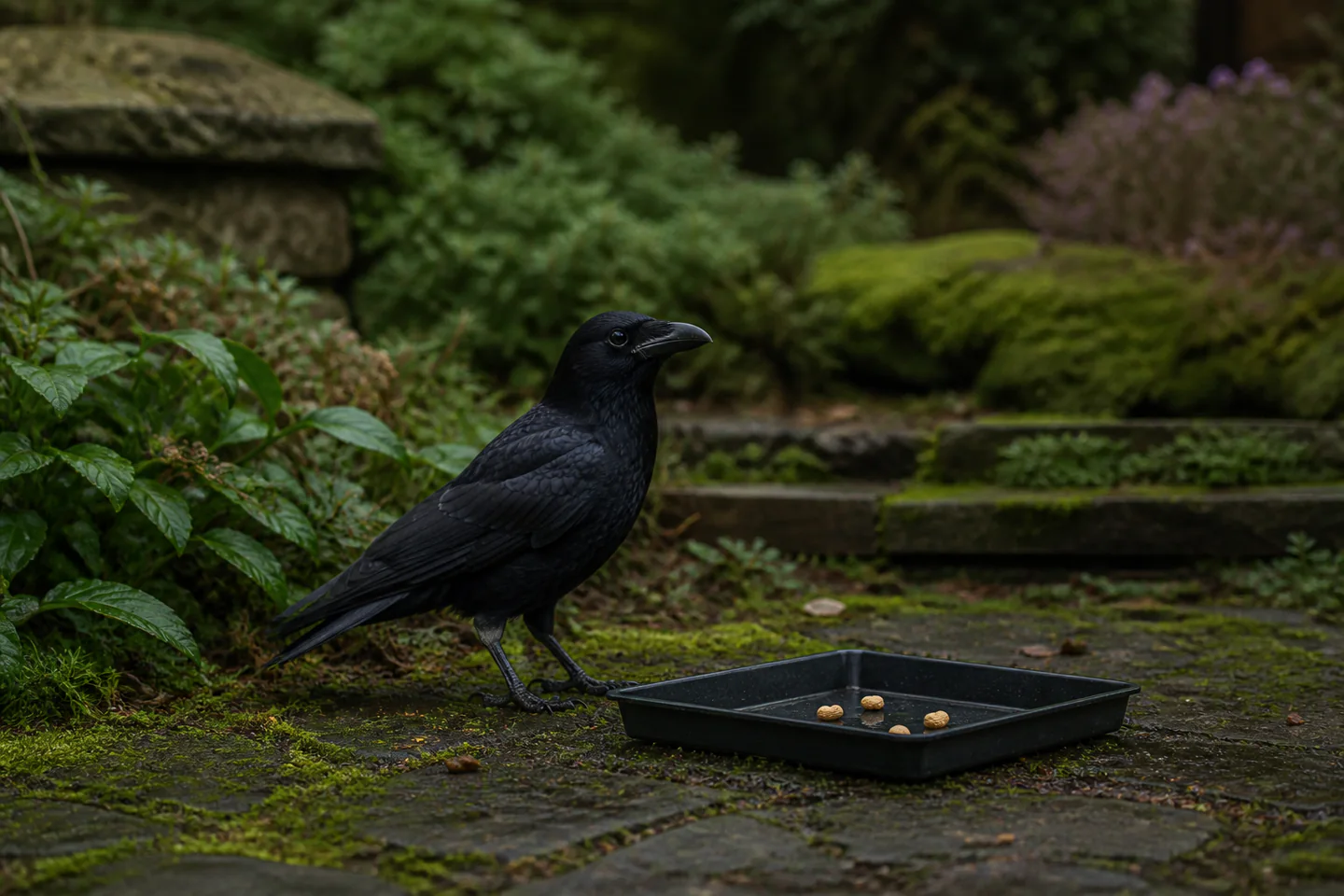
Spend several days noting which corvid species already use the area, what time they pass and whether cats, roads or nesting birds make the spot unsuitable. If feeding is appropriate, place a washable ground tray in an open location and offer only a small amount of suitable fresh food that will be eaten promptly. Watch from a distance, remove leftovers, wash the tray and skip days regularly. The aim is a brief observation opportunity, not to summon a flock or replace natural foraging.
- 01
Correct identification matters because crows, rooks, jackdaws, ravens, jays and magpies differ in behaviour, flock size and local context.
- 02
Use small portions of suitable food such as plain unsalted nuts or quality bird food; avoid salty, mouldy, highly processed or spoiled leftovers.
- 03
Remove uneaten food before it attracts rats, foxes or gulls and clean the tray regularly to reduce disease transmission.
- 04
Do not feed beside roads, airports, active nests, livestock or places where gathering birds will disturb neighbours.
- 05
Wild birds choose whether to approach. Do not hand-feed, touch, tame, trap or encourage dependence. Follow current local rules and disease advice.
What to expect
Feeding changes behaviour faster than most beginners expect
Corvids are observant, social and capable of learning routines. That makes them rewarding to watch, but it also means oversized or perfectly timed meals can create waiting, noise, competition and conflict.
Identity
A field guide and binoculars prevent every black bird becoming “a crow” and reveal seasonal differences.
Trust
A bird may watch for days before approaching. Distance and consistency work better than walking towards it with food.
Numbers
One visitor can recruit others. Reduce or stop immediately if flock size, noise or mess grows.
Diet
Supplementary food is only a small extra. Variety in natural habitat matters more than a daily pile of treats.
Hygiene
Shared trays can spread pathogens through droppings and saliva; small portions and frequent cleaning are essential.
Boundaries
Skipping days and changing timing helps prevent the feeding station from becoming the centre of a bird’s routine.
Core method
Build the routine around observation and an exit plan
Identify the visitors
Use shape, call, bill colour, group behaviour and location to distinguish common British corvids. Record only what can be supported, and check seasonal or regional uncertainty with a current field guide. Observation without food is already the hobby and gives a baseline for judging any change.
Choose a low-conflict site
Select an open spot where birds can see approaching predators, well away from traffic, doors, children’s play areas and property boundaries. Avoid feeding near active nests or roosts. A low washable tray keeps food visible and easier to remove than scattering it across soil or grass.
Offer a measured sample
Put out a very small amount of suitable unsalted food, then step back indoors or well away. Stop when it is gone; do not top up repeatedly. Note who arrives, how quickly, whether food is cached and whether other wildlife is displaced. Never use food to draw a bird into risky proximity.
Clean and reassess
Remove leftovers and droppings, wash and dry the tray according to current garden-bird hygiene guidance and rotate or rest the site when needed. If rodents, aggression, crowding, neighbour complaints or disease signs appear, stop feeding, clean the area and follow official reporting advice.
Useful products
Products with a clear job in the setup
The ground tray keeps portions contained and removable. The RSPB guide supports correct identification, while the Nikon binoculars are a genuine observation upgrade that works even when no food is offered. Food itself is deliberately not treated as a single permanent product recommendation because ingredients, freshness, recalls and local wildlife advice change.
Gardman Compact Ground Feeder Tray
A tray is more controllable than throwing scraps across a lawn and makes leftover food obvious.
RSPB RSPB Pocket Guide to British Birds, Fifth Edition
It keeps the activity centred on learning birds rather than simply delivering food.
Nikon PROSTAFF P3 8×42 Binoculars
Eight-power magnification and a 42 mm objective are a practical general birdwatching combination.
First project
Run a seven-session corvid watch
Alternate food-free observation with two or three tiny feeding trials so changes are visible.
- 01
Map the area
Mark roads, cats, neighbours, nests, roosts and the safest observation point.
- 02
Identify without feeding
Use calls, shape and behaviour to log the existing visitors on three occasions.
- 03
Prepare one tray
Wash, rinse, dry and position it in the low-conflict open spot.
- 04
Offer a tiny portion
Use suitable fresh unsalted food once, then move well back.
- 05
Record the response
Note species, numbers, caching, aggression, noise and leftover time.
- 06
Rest and decide
Skip days, clean the tray and continue only if the effect remains small and safe.
What can wait
What can wait until the first result
More food and closer contact do not produce better observation; they mainly increase the consequences of getting the routine wrong.
- 01
Daily feeding at a fixed time
It can encourage waiting and dependence before local behaviour is understood.
- 02
Large sacks of one food
Freshness, storage and suitability matter; begin with tiny amounts already approved for wild birds.
- 03
Hand-feeding
Close contact can create unsafe expectations around people and adds bite and disease risk.
- 04
A permanent feeding table
A removable tray is easier to clean, relocate and stop using.
- 05
Calling or playback near nests
Disturbance is not justified for a closer photograph or interaction.
Upgrade path
Upgrade the repeated limitation
Upgrade the observation, identification and habitat before increasing food quantity.
Observation only
FreeNotebook + window or quiet outdoor view
Learn existing routes and species.Contained trial
About £10–£25Washable tray + small suitable portion
Test behaviour and hygiene.Identification setup
About £25–£180Field guide + binoculars
See plumage, bills and social behaviour.Habitat-led garden
About £50–£500+Native planting, water and safe structure
Support broader wildlife without a food queue.Safety & care
Protect birds, neighbours and the wider food web
Responsible feeding is conditional. Disease, nuisance, rodents, aggressive concentrations or local restrictions are reasons to reduce or stop, not problems to feed through.
- Follow current RSPB, BTO, Garden Wildlife Health and government disease advice; stop and report unusual illness or deaths through the recommended route.
- Wear gloves for dirty equipment, avoid inhaling dried droppings, wash hands and keep wildlife utensils separate from human food preparation.
- Never offer salty, mouldy, spoiled or heavily processed food, and do not leave wet leftovers or whole nuts where they create risk for other animals.
- Keep feeding away from roads, airport approaches, windows with collision risk, pets, livestock and active nests; comply with tenancy and local rules.
- Reduce or stop immediately if numbers, noise, aggression, droppings, caching, rodents or neighbour impact increase.
Outside help
When outside help earns its place
No class is needed. A local bird group walk or online identification session can improve species confidence while keeping the activity grounded in observation rather than taming.
Use current calls, distribution and garden-bird health guidance.
Choose a code-respecting trip that does not bait birds or disturb nests.
Representative UK learning options checked 17 August 2026; local prices, access, materials and tutor support vary.
Sources
Where the guidance came from
UK conservation and wildlife-health organisations define responsible feeding, hygiene and disease response; field guides and experienced bird communities add identification and behaviour context.
-
01
RSPB · What food can you give birds?
Current UK bird-feeding, habitat and welfare guidance.
Open source -
02
BTO · Garden birds and feeding
Evidence-led advice on supplementary feeding and garden monitoring.
Open source -
03
Garden Wildlife Health · Disease factsheets
Wild-bird disease recognition, hygiene and reporting information.
Open source -
04
GOV.UK · Avian influenza in wild birds
Current official disease and reporting guidance.
Open source -
05
Reddit · r/crows
Community experience of corvid behaviour, boundaries and unintended feeding effects.
Open source -
06
Amazon UK · Compact Ground Feeder Tray
Exact product catalogue page or ISBN used for the recommendation; current price, seller and availability should be confirmed.
Open source -
07
Amazon UK · RSPB Pocket Guide to British Birds, Fifth Edition
Exact product catalogue page or ISBN used for the recommendation; current price, seller and availability should be confirmed.
Open source -
08
Amazon UK · PROSTAFF P3 8×42 Binoculars
Exact product catalogue page or ISBN used for the recommendation; current price, seller and availability should be confirmed.
Open source
Guide information and links checked 17 August 2026.