Beginner’s guide · Make & create
Place the line,
then let colour breathe.
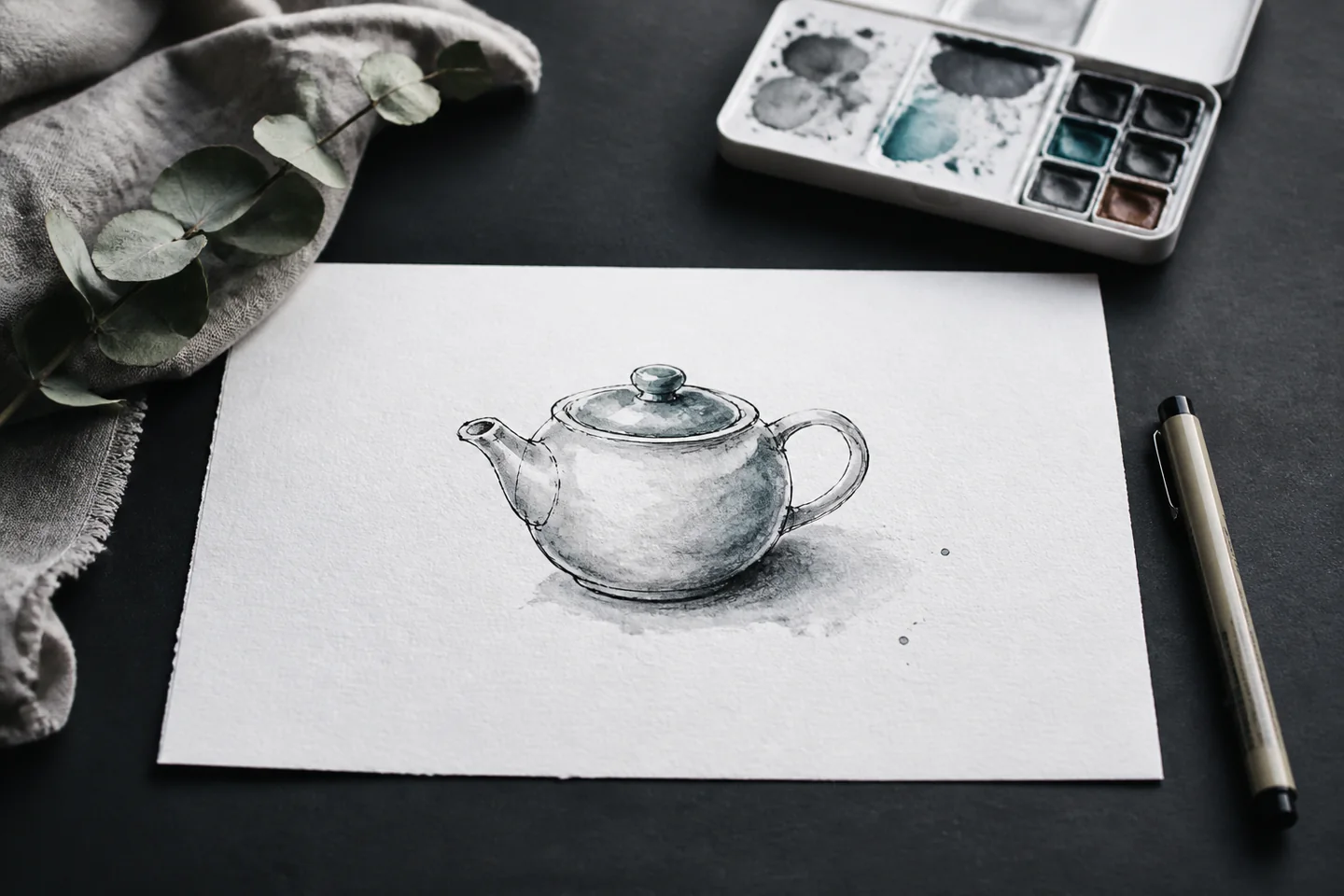
A waterproof fineliner, compact watercolour set and sturdy paper are enough. Start with a simple object and use wash to group light rather than colour every enclosed shape.
Quick answer
Draw one object in ink, then add only three wash values
Place a mug, plant pot or simple building in steady light. Draw the largest angles lightly with a waterproof fineliner, allowing overlaps and imperfect searching lines instead of tracing a heavy outline around every edge. Wait for the ink to dry according to its maker, then mix a pale dominant colour and place one connected shadow wash. Add a darker wash only at contact points and a small colour accent. Leave large areas of paper untouched.
- 01
Use ink documented as waterproof or water-resistant after drying and test it with the exact paper and paint before the finished sketch.
- 02
Line describes structure and selected edges; wash groups light, atmosphere and colour. Repeating every boundary in both can make the result rigid.
- 03
Watercolour dries lighter, so begin paler than expected and let the first wash settle before judging it.
- 04
A limited palette makes outdoor decisions faster and reduces muddy mixtures.
- 05
Work from safe stationary positions and ask permission before drawing on private premises or focusing closely on identifiable people.
What to expect
The charm comes from decisions that remain visible
Pen cannot be erased completely and watercolour resists overworking. That apparent limitation encourages clear observation, selective detail and acceptance of small deviations.
Proportion
Mark top, bottom, width and major angles before small texture. Ink confidence grows from measurement, not speed alone.
Line weight
A single fineliner can make lighter or darker emphasis through broken, repeated or closely spaced marks.
Drying
Ink that feels dry may still bleed under a wet brush. Test and allow the maker’s full setting time.
Wash
Mix enough before touching the page and carry a bead through connected shadow shapes.
White
Unpainted paper is the easiest bright light. Opaque white can be a later accent, not a rescue plan for every area.
Editing
A sketch can stop when the subject reads. Filling each blank space often removes the light and spontaneity.
Core method
Separate structure, shadow and accent
Test the materials together
Draw several lines with the selected pen on the actual paper, label the drying time and brush clean water across them. Test a pale wash, a second layer and a lifted edge. This prevents a beautiful drawing becoming the first compatibility experiment.
Measure with light ink decisions
Use small ticks for height, width and key intersections, then connect them with mostly straight searching lines. Look at the subject more than the page. Draw through overlaps mentally, but ink only the edges that explain the form. Leave distant or light-facing edges broken.
Connect the shadow family
Mix one generous puddle and identify every plane turned away from the light. Wet or paint those shapes as one family, varying intensity while the wash is damp. Skip local colour that conflicts with the value plan and avoid colouring enclosed spaces merely because the pen created them.
Add selective dark and colour
After the first wash is fully dry, place a darker contact shadow, one interior turn and a small colour note near the focus. Reassert only a few ink accents if needed. Step back, compare the distribution of white paper and stop before every mark becomes equal.
Useful products
Products with a clear job in the setup
Sakura’s assorted Micron set provides waterproof pigment liners in useful widths. The Cotman pocket set supplies a compact mixable watercolour palette, and the Aquafine pad gives the combination a robust cold-pressed surface. One waterproof pen is enough if the full pen set is unnecessary.
Sakura Pigma Micron Fineliner Pens, Six Assorted Sizes
Micron pigment ink is widely used for mixed-media line and the widths make emphasis easy to test.
Winsor & Newton Cotman Sketchers Pocket Set, 12 Half Pans
The range is established, refillable and small enough to encourage limited mixing.
Daler-Rowney Aquafine Cold-Pressed Watercolour Pad A4, 300 gsm
A4 sheets can be divided for tests and first sketches while preserving a watercolour surface.
First project
Sketch one mug in line and three washes
A cylinder, handle and cast shadow expose ellipse, overlap, white space and value grouping.
- 01
Run the waterproof test
Ink a scrap, wait fully and brush water across it.
- 02
Mark the proportions
Place height, width, ellipse centres and handle before contour.
- 03
Ink selected edges
Use broken light-facing lines and stronger overlap or contact marks.
- 04
Mix the pale wash
Connect the shadow family with one generous puddle.
- 05
Let it dry
Do not scrub a damp edge or chase backruns.
- 06
Place two accents
Add contact dark and one colour note, then stop.
What can wait
What can wait until the first result
A crowded pen case and complete colour chart can obscure the simple relationship between structure and light.
- 01
A fountain pen with unknown ink
Flow can be lovely, but water resistance and drying must be tested before a wash.
- 02
A 48-colour palette
Mixing three or four colours teaches relationships and keeps the field kit usable.
- 03
Masking fluid
White paper can be planned directly in a small first sketch.
- 04
Opaque correction paint
Accepting and designing around small ink errors is central to the medium.
- 05
An expensive leather sketchbook
Loose or modest paper makes tests and imperfect pages easier to use.
Upgrade path
Upgrade the repeated limitation
Upgrade portability, paper format or line character only after the basic line-and-value separation works.
Table study
About £30–£65Waterproof pen + pocket paint + paper
Learn structure and three values.Portable kit
About £45–£100Water brush/brush roll, clips and small book
Sketch outside with fewer loose items.Expressive line
About £60–£180Fountain pen or dip nib + tested ink
Vary width and character deliberately.Field practice
About £100–£350+Weatherproof bag, stool and larger paper options
Work longer and sequence locations.Safety & care
Keep tools, water and attention out of public routes
Sketching is low-risk, but blades, pigment water, trip hazards and privacy still need ordinary care.
- Use non-toxic labelled materials as intended, keep brush water out of drinking containers and wash hands after handling pigment.
- Do not point brushes with the mouth or use art palettes and cups for food; dispose of pigment residue according to local and maker guidance.
- When sketching outside, sit where bags, stools and boards do not obstruct paths, doors, cyclists, vehicles or emergency access.
- Respect private property, restricted sites and requests not to depict or publish identifiable people; simplify figures rather than staring or following.
- Protect work and materials from wind and rain, secure clips and never chase loose paper into traffic, water or unsafe ground.
Outside help
When outside help earns its place
The mug exercise and reputable demonstrations are enough. An urban-sketching meet can add motivation and location knowledge, while a taught workshop is most useful when it includes individual value and composition feedback.
Look for waterproof tests, connected washes and selective line.
Ask about walking distance, weather plan, group size and materials.
Representative UK learning options checked 17 August 2026; local prices, access, materials and tutor support vary.
Sources
Where the guidance came from
Material makers define ink and paper performance; established sketching organisations and artist communities add field workflow, drawing and wash evidence.
-
01
Sakura · Pigma Micron
Manufacturer pigment-ink and nib information.
Open source -
02
Winsor & Newton · Cotman Water Colours
Paint range, handling and colour information.
Open source -
03
Urban Sketchers · Manifesto
Established observational-sketching principles and global community context.
Open source -
04
Liz Steel · Sketching Now
Experienced pen-and-wash teaching and field practice.
Open source -
05
Reddit · r/urbansketchers
Community experience of portable kits, ink tests and location sketching.
Open source -
06
Amazon UK · Pigma Micron Fineliner Pens, Six Assorted Sizes
Exact product catalogue page or ISBN used for the recommendation; current price, seller and availability should be confirmed.
Open source -
07
Amazon UK · Cotman Sketchers Pocket Set, 12 Half Pans
Exact product catalogue page or ISBN used for the recommendation; current price, seller and availability should be confirmed.
Open source -
08
Amazon UK · Aquafine Cold-Pressed Watercolour Pad A4, 300 gsm
Exact product catalogue page or ISBN used for the recommendation; current price, seller and availability should be confirmed.
Open source
Guide information and links checked 17 August 2026.