Beginner’s guide · Observe & photograph
Learn one patch through wings and weather.
Observe without changing the encounter.
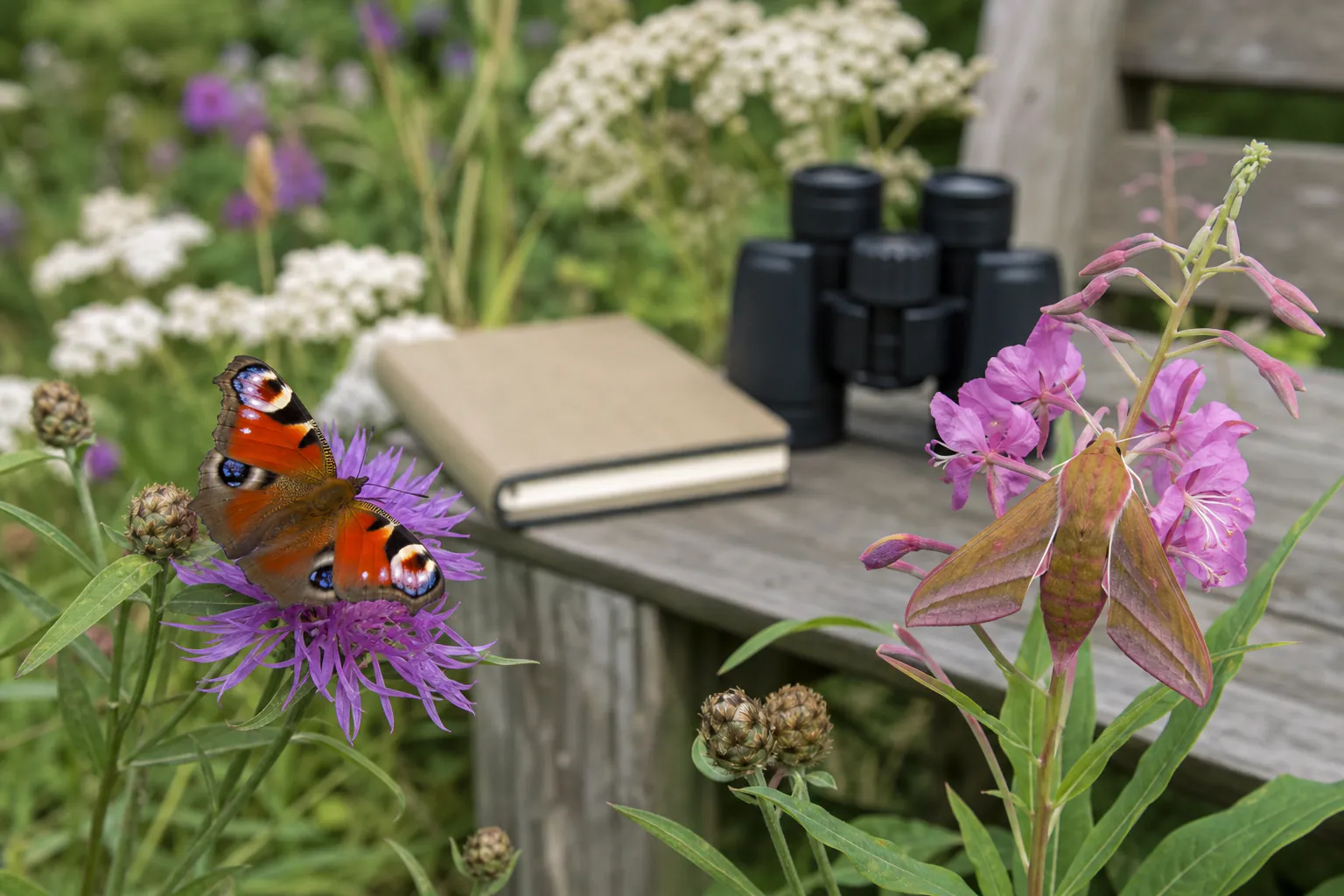
Start with a local sunny route, close-focusing binoculars and a regional guide. Record habitat, date and behaviour; add gentle moth observation only when darkness and wildlife can be treated responsibly.
Quick answer
Visit the same habitat in suitable weather
Choose a short flower-rich route and walk it in bright, calm weather between spring and early autumn. Use close-focusing binoculars or the naked eye, photograph only when it does not disturb the insect and record date, place, weather, plant and behaviour. Identify with a current UK guide, leaving uncertain records at family or “unknown” rather than forcing a name.
- 01
Many species vary by sex, generation, wear and viewing angle. A perfect guide illustration is not a promise about the individual.
- 02
Butterflies often need sun and warmth; moths are more diverse and many are active at night, but some fly by day.
- 03
Do not handle, net or collect insects for a casual start. Watch where they settle and protect the plant around them.
- 04
A 365 nm torch can attract or reveal some moths at a white sheet, but short low-impact observation is not the same as a managed moth trap.
What to expect
Weather and season decide what can be seen
An empty walk is information about conditions, timing and habitat. Repetition at one patch creates better knowledge than chasing a rare-species list.
Weather
Cool wind, rain and heavy cloud reduce activity. Shelter and sun pockets can matter within one site.
Season
Flight periods overlap and shift with latitude and weather. Check current local records rather than a fixed calendar.
Identification
Upperwing, underwing, antenna, resting posture, plant and size all help. One blurred photograph may not be enough.
Optics
Ordinary binoculars may not focus close enough. Close-focus models reduce the need to approach.
Night work
White sheets and light attractors can affect insects and neighbours. Keep sessions short and release any trapped moths correctly.
Records
A careful common-species record with location and date is more useful than a confident rare claim without evidence.
Core method
Let place and behaviour narrow the identification
Choose a repeatable local patch
Find a sunny garden, park edge, hedgerow or meadow route with permission and safe access. Note nectar plants, grasses, bare ground, shelter and nearby trees. Visit at similar times in different weeks. A repeated patch teaches flight periods and habitat associations that a one-off checklist cannot.
Observe before approaching
Stop several metres away and watch flight style, height, territorial circuits and preferred flowers. Raise binoculars slowly. If the insect closes its wings, repeatedly flushes or leaves, increase distance. Never trample larval food plants or surrounding vegetation for a cleaner photograph.
Record evidence, including uncertainty
Write date, approximate time, grid reference or location, temperature impression, sun, wind, habitat, plant and count. Photograph upper and lower wing views only when they occur naturally. Compare size with a familiar species or flower. Mark uncertain fields and return to the guide later.
Try moth observation gently
Begin with porch lights, flowering plants at dusk or a white sheet lit briefly in a dark garden. Avoid bright light in sensitive habitat, do not leave equipment unattended and never shine UV at eyes or animals. Photograph resting visitors, switch off and allow them to depart. Dedicated trapping needs specific welfare and release practice.
Useful products
Close focus for the field and separate guides for two large groups
Pentax Papilio binoculars focus at approximately half a metre and remain useful beyond insects. The butterfly and moth guides are complementary rather than interchangeable. The UV torch is optional for short responsible garden observation and is not required for daytime watching.
Pentax Papilio II 6.5 × 21 Binoculars
Their unusual near-focus ability suits butterflies while remaining useful for birds, plants and museums.
WILDGuides Britain’s Butterflies, Fourth Edition
It supports comparison beyond one ideal illustration and remains useful beside repeated local walks.
Bloomsbury Concise Guide to the Moths of Great Britain and Ireland
It complements the butterfly guide and keeps field use manageable for common macro-moths.
DARKBEAM 365 nm UV Torch
It is cheaper and simpler than a trap and can be switched off immediately when the session ends.
First project
Build a four-week local flight diary
Walk the same short route once a week in suitable weather and make a page for every identified species and unresolved observation.
- 01
Map the route
Choose safe access, sunny edges and plants that can be watched without trampling.
- 02
Check conditions
Prefer calm bright periods and accept that weather may make postponing sensible.
- 03
Watch movement first
Note flight height, behaviour and plant before lifting optics.
- 04
Record field clues
Write time, place, weather, size, wing views and confidence.
- 05
Identify after the walk
Use the relevant regional guide and retain uncertain records honestly.
- 06
Repeat weekly
Compare what appears, disappears and uses the same plants across the month.
What can wait
What can wait until the first result
The best next step is usually another visit, not more collecting or lighting equipment.
- 01
A specimen collection
It is unnecessary for a beginner and creates legal, ethical and preservation responsibilities.
- 02
A powerful UV floodlight
It affects a wider area, neighbours and wildlife; begin with passive observation or a brief small light.
- 03
A long telephoto lens
Close-focusing binoculars and respectful distance build identification skills before expensive photography.
- 04
Rare-species travel
Learn common local variation and habitat before adding travel pressure to sensitive sites.
- 05
A dedicated moth trap
It requires welfare, weather, identification and dawn-release planning; seek current specialist guidance first.
Upgrade path
Upgrade the repeated limitation
Upgrade the quality of records and habitat understanding before increasing capture effort.
Local naked-eye walks
FreeNotebook + repeated route
Learn season, weather and behaviour.Close-focus observation
About £100Papilio binoculars + butterfly guide
See field marks without crowding.Moth identification
About £17+Current guide + dusk observation
Enter a much larger group carefully.Structured recording
Mostly timeCounty recorder or monitoring scheme guidance
Make observations useful beyond a personal list.Safety & care
Put insect welfare and habitat before a record
Some species and sites are protected or sensitive. Check current local rules and recording guidance before trapping, handling or publicising precise locations.
- Stay on permitted access, avoid trampling larval food plants and never damage vegetation to expose an insect.
- Do not handle, refrigerate, net or collect butterflies or moths as part of this casual beginner route.
- Keep lights brief and local, never direct UV into eyes and stop if wildlife or neighbours are being disturbed.
- Do not publicise a sensitive species location without checking recorder and land-manager guidance.
- Clean footwear between sensitive habitats where biosecurity advice applies and take all equipment home.
Outside help
When outside help earns its place
A local recorder walk is valuable for field marks and habitat, but the independent route remains accessible and low-pressure.
Use current species pages, flight periods and recording guidance.
Check welfare method, accessibility, finish time and whether booking is required.
Representative UK prices and free learning routes checked 3 August 2026; local availability, materials and tutor support vary.
Sources
Where the guidance came from
Butterfly Conservation and specialist recording guidance establish identification, welfare and submission practices; the RPS code reinforces habitat-first conduct.
-
01
Butterfly Conservation · Identify a butterfly
UK identification resources, species accounts and flight information.
Open source -
02
Butterfly Conservation · Moth recorders handbook
Specialist recording, identification evidence and submission practice.
Open source -
03
Royal Photographic Society · Nature photographers code
Subject welfare, habitat, access and disturbance principles.
Open source -
04
UK Butterflies · Species index
Specialist photographic species reference and UK distribution context.
Open source -
05
Amazon UK · Pentax Papilio II binoculars
Exact product page, model or ISBN, observed price and availability checked for this guide.
Open source -
06
Amazon UK · Britain’s Butterflies fourth edition
Exact product page, model or ISBN, observed price and availability checked for this guide.
Open source -
07
Amazon UK · Concise Guide to Moths second edition
Exact product page, model or ISBN, observed price and availability checked for this guide.
Open source -
08
Amazon UK · DARKBEAM 365 nm UV torch
Exact product page, model or ISBN, observed price and availability checked for this guide.
Open source
Guide information and links checked 3 August 2026.