Beginner’s guide · Play & perform
Set the seat, count the pulse,
and finish one hands-separate song.
A touch-sensitive keyboard, balanced posture and short slow practice build chords, scales and a first tune without turning every mistake into repetition.
Quick answer
Complete one short first song before expanding the setup
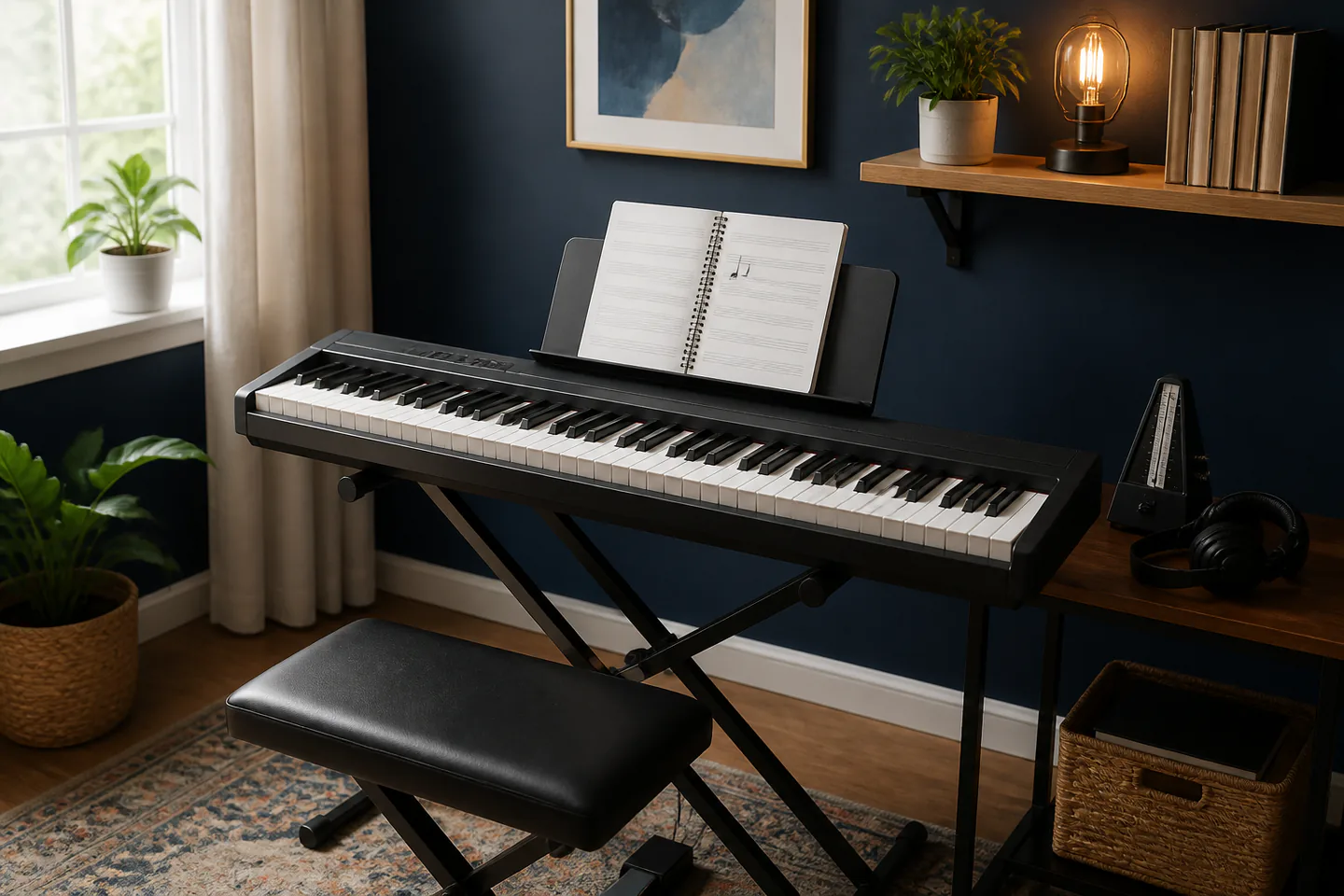
Use an acoustic piano or a touch-sensitive keyboard on a stable stand, centre an adjustable seat so the forearms are approximately level with the keys and keep shoulders and wrists free. Learn groups of black keys, finger numbers and middle C, clap and count the rhythm, practise a five-note pattern and simple I–V or I–IV–V chords, then learn a short piece hands separately in two-bar sections at a tempo where every note and rest is controlled before combining hands.
- 01
Balanced posture gives the arm and fingers room to move and should not require raised shoulders or collapsed wrists. Record what happened during piano and keyboard playing so the next attempt changes one known variable instead of several guesses.
- 02
Rhythm can be learned by clapping and counting before pitch and fingering are added. Record what happened during piano and keyboard playing so the next attempt changes one known variable instead of several guesses.
- 03
Slow accurate repetitions teach the movement that speed will later reveal. Record what happened during piano and keyboard playing so the next attempt changes one known variable instead of several guesses.
- 04
A chord symbol, notation and recorded sound are different views of the same musical event. Record what happened during piano and keyboard playing so the next attempt changes one known variable instead of several guesses.
What to expect
What piano and keyboard playing is really like at the start
The useful beginner controls are preparation, one bounded task and a record of the result; specialist equipment matters only when it solves a repeated limitation.
Keyboard
Touch sensitivity teaches dynamic control, while key count and weighting affect repertoire and technique. Record what happened during piano and keyboard playing so the next attempt changes one known variable instead of several guesses.
Hand
The weaker hand often loses pulse when attention shifts to melody. Record what happened during piano and keyboard playing so the next attempt changes one known variable instead of several guesses.
Reading
Note names alone are slower than recognising intervals, patterns and landmarks. Record what happened during piano and keyboard playing so the next attempt changes one known variable instead of several guesses.
Practice
Repeating a whole piece from the beginning rehearses the same early bars more than the difficult transition. Record what happened during piano and keyboard playing so the next attempt changes one known variable instead of several guesses.
Core method
The core piano and keyboard playing method
Set the physical position
Stabilise keyboard and seat, align elbows near key height and release shoulder, wrist and thumb tension. Record what happened during piano and keyboard playing so the next attempt changes one known variable instead of several guesses.
Separate rhythm from notes
Count, clap and tap each hand’s rhythm before playing the keys. Record what happened during piano and keyboard playing so the next attempt changes one known variable instead of several guesses.
Practise small musical units
Use two-bar sections, correct fingering and a tempo that permits a clean transition. Record what happened during piano and keyboard playing so the next attempt changes one known variable instead of several guesses.
Combine and record
Join sections and hands gradually, record one take and choose one rhythm or tension issue for the next session. Record what happened during piano and keyboard playing so the next attempt changes one known variable instead of several guesses.
Useful products
Products with a clear job in the route
The PSR-E383 provides touch-sensitive keys and onboard sound for a portable start, while the closed headphones enable quiet practice and recording checks.
Yamaha PSR-E383 61-Key Portable Keyboard
It can support chords, scales, two-hand pieces and quiet practice without a computer.
Audio-Technica ATH-M40x Professional Monitor Headphones
Closed backs suit tracking and the first editing passes in a shared home.
First project
Play one eight-bar piece with a steady count
Learn each hand and each two-bar transition before attempting a complete performance.
- 01
Set bench and keyboard
Stabilise both, centre the body and check shoulders, elbows, wrists and feet. Record what happened during piano and keyboard playing so the next attempt changes one known variable instead of several guesses.
- 02
Count the rhythm aloud
Clap the whole piece, including rests, before assigning notes. Record what happened during piano and keyboard playing so the next attempt changes one known variable instead of several guesses.
- 03
Learn the right hand in sections
Use written fingering and stop to repair only the first uncertain transition. Record what happened during piano and keyboard playing so the next attempt changes one known variable instead of several guesses.
- 04
Learn the left hand pattern
Practise bass notes or chords at the same slow pulse without the melody. Record what happened during piano and keyboard playing so the next attempt changes one known variable instead of several guesses.
- 05
Combine, record and review
Join two bars at a time, record one complete take and note pulse and tension. Record what happened during piano and keyboard playing so the next attempt changes one known variable instead of several guesses.
What can wait
What can wait until the first result
Delay anything that adds cost, risk or another variable before the basic workflow has produced something you can review.
- 01
Fast scales
Evenness, fingering and relaxed movement matter before speed. Record what happened during piano and keyboard playing so the next attempt changes one known variable instead of several guesses.
- 02
Sustain pedal everywhere
Pedal can blur rhythm and hide poor releases. Record what happened during piano and keyboard playing so the next attempt changes one known variable instead of several guesses.
- 03
Large repertoire lists
One complete piece teaches continuity and review. Record what happened during piano and keyboard playing so the next attempt changes one known variable instead of several guesses.
- 04
Expensive instrument upgrade
Teacher feedback can identify whether key action, range or sound is the actual limitation. Record what happened during piano and keyboard playing so the next attempt changes one known variable instead of several guesses.
Upgrade path
Add the capability you can now name
Each stage should remove a demonstrated constraint rather than make the setup look more advanced.
Use what you own
£0–£20Existing equipment and one written plan
Use lesson-room access or a touch-sensitive keyboard.Repeat the first route
About £160–£500 or lesson-room accessA complete repeatable starter setup
Complete several short pieces with steady rhythm.Add one capability
Often £50–£250One selected tool, service or learning resource
Add teacher feedback, pedal and wider repertoire.Build specialist depth
Club, course or specialist dependentA documented specialist workflow
Move to an 88-key weighted instrument when the chosen repertoire demonstrates the need.Safety & care
Build practice volume and duration without strain
Tension and excessive sound level are feedback to change the setup, not obstacles to push through.
- Stop at pain, numbness or persistent tension and have posture and technique checked rather than practising through it.
- Use a stable stand and seat and route power, pedal and headphone cables away from feet.
- Keep headphone volume conservative and take listening and movement breaks.
- Move acoustic pianos only with professional equipment and enough trained people.
- For children, use age-appropriate supervision, seat height and practice duration.
Outside help
When outside help earns its place
A teacher earns their place early by correcting bench height, fingering, pulse and excess tension before they become habits.
Choose a teacher who uses short complete music as well as exercises and welcomes the available keyboard.
Use outside help after the first piano and keyboard playing attempt can reveal the exact technique, access or safety problem that needs live correction.
Representative UK learning and access routes checked 1 September 2026; local prices, permissions, equipment and tutor support vary.
Sources
Where the guidance came from
Authoritative and specialist guidance supports the method and safety boundaries; community discussion contributes recurring beginner problems rather than unsupported claims.
-
01
Yamaha · Correct posture at the piano
Bench, elbow, shoulder and hand-position guidance.
Open source -
02
Yamaha · PSR-E383
Touch response, key count, lessons and connectivity.
Open source -
03
Yamaha · Basic piano technique
Balanced posture and introductory movement principles.
Open source -
04
ABRSM · Piano syllabus
Structured repertoire, scales and musicianship context.
Open source -
05
WHO · Safe listening
Hearing-risk and safe-listening principles.
Open source -
06
Reddit · r/piano
Community evidence on first keyboards, practice structure, fingering and teacher feedback.
Open source -
07
Amazon UK · PSR-E383 61-Key Portable Keyboard
Exact Amazon UK product page or ISBN used for this recommendation; current price, seller, specification and availability should be confirmed.
Open source -
08
Amazon UK · ATH-M40x Professional Monitor Headphones
Exact Amazon UK product page or ISBN used for this recommendation; current price, seller, specification and availability should be confirmed.
Open source
Guide information and links checked 1 September 2026.