Beginner’s guide · Make & create
Fold once, cut slowly,
open the pattern carefully.
Kirigami adds deliberate cuts to folded paper. Begin with a symmetrical card or snowflake, a sharp craft knife and a proper mat before attempting architectural pop-ups.
Quick answer
Use a tested pattern before designing the negative space
Print or trace one beginner pattern at its intended scale, score and fold only the marked lines, then cut from the smallest internal shapes towards the outer boundary. Use a sharp art knife on a self-healing mat, rotate the paper rather than twisting the wrist and make several light passes through thick folded areas. Keep every marked bridge intact, unfold slowly and flatten the result under clean paper.
- 01
Distinguish cut lines from mountain and valley folds before touching the knife. Record what you used on the first attempt so the result can be repeated or changed for a reason.
- 02
Use paper light enough to fold sharply but strong enough to retain narrow bridges. Record what you used on the first attempt so the result can be repeated or changed for a reason.
- 03
Replace a dull blade rather than increasing force. Record what you used on the first attempt so the result can be repeated or changed for a reason.
- 04
Cut internal details before removing the surrounding waste that supports them. Record what you used on the first attempt so the result can be repeated or changed for a reason.
- 05
Open folds in reverse order and support narrow sections with a fingertip or blunt tool. Record what you used on the first attempt so the result can be repeated or changed for a reason.
What to expect
The uncut bridges are as important as the cuts
Kirigami is planned negative space. A beautiful outline fails if one narrow hinge is removed, a fold is reversed or the blade drags across several layers.
Pattern
A line drawing may contain cuts, folds and reference marks. Colour-code a copy until the notation is unambiguous. In kirigami, this is worth checking deliberately rather than trying to correct it after the next stage.
Paper
Printer paper is useful for trials; card holds a display shape but needs more passes and wider hinges. In kirigami, this is worth checking deliberately rather than trying to correct it after the next stage.
Blade
Sharpness improves control because the hand can use less force. Blades still need safe changing and disposal. In kirigami, this is worth checking deliberately rather than trying to correct it after the next stage.
Symmetry
A small alignment error multiplies when folded layers are opened. Crease precisely without crushing the paper. In kirigami, this is worth checking deliberately rather than trying to correct it after the next stage.
Display
Fine paper forms catch on sleeves, moisture and frames. Plan the mount only after the opened piece lies flat. In kirigami, this is worth checking deliberately rather than trying to correct it after the next stage.
Core method
Protect every hinge while cutting clean edges
Read the whole pattern
Mark cut, score, mountain and valley lines on a disposable copy and identify all bridges that must remain. In kirigami, this is worth checking deliberately rather than trying to correct it after the next stage.
Prepare folds accurately
Score card with a blunt tool where directed, align edges and crease on a clean surface. In kirigami, this is worth checking deliberately rather than trying to correct it after the next stage.
Cut light controlled passes
Work from internal details outward, pull the knife through short lines and rotate the sheet for a comfortable direction. In kirigami, this is worth checking deliberately rather than trying to correct it after the next stage.
Open and flatten
Remove loose waste with tweezers, reverse the folds carefully and press the piece between clean flat boards. In kirigami, this is worth checking deliberately rather than trying to correct it after the next stage.
Useful products
Products with a clear job in the setup
The beginner book supplies graduated patterns. The OLFA knife is a precise reusable cutting tool, and the Fiskars A3 mat protects the desk while allowing the paper to be rotated. All three have distinct jobs.
David Mitchell Kirigami: The Art of Cutting and Folding Paper
A sequence of known patterns lets technique be judged without simultaneously inventing the structure.
OLFA OLFA AK-1 Art Knife with 25 Blades
Replaceable blades support consistent clean work as the point dulls.
Fiskars A3 Self-Healing Cutting Mat
The larger surface supports full sheets without cutting over a table edge.
First project
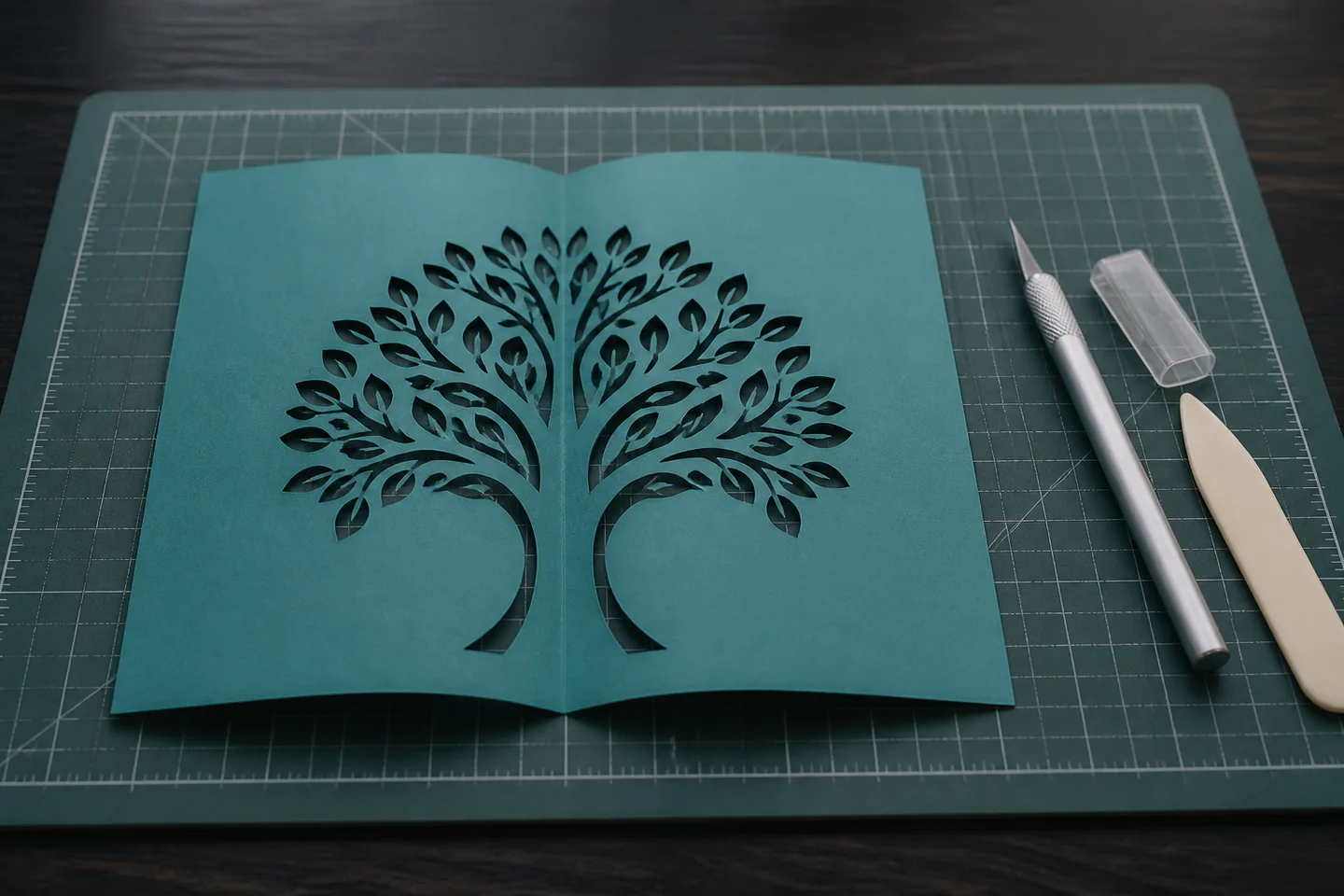
Cut one symmetrical tree card
A single centre fold, repeated branches and broad connecting hinges make blade control easy to inspect.
- 01
Copy the pattern
Use ordinary paper first and mark cuts and fold direction in two different colours. In kirigami, this is worth checking deliberately rather than trying to correct it after the next stage.
- 02
Make the centre fold
Align edges exactly and sharpen the crease with a bone folder or blunt tool. In kirigami, this is worth checking deliberately rather than trying to correct it after the next stage.
- 03
Cut inner openings
Start at the smallest enclosed shapes and use multiple light passes rather than forcing folded layers. In kirigami, this is worth checking deliberately rather than trying to correct it after the next stage.
- 04
Preserve the bridges
Stop each cut at its marked endpoint and inspect from both folded sides before removing waste. In kirigami, this is worth checking deliberately rather than trying to correct it after the next stage.
- 05
Open in reverse
Ease the card apart slowly and support each branch while the centre form reverses. In kirigami, this is worth checking deliberately rather than trying to correct it after the next stage.
- 06
Flatten and assess
Press under clean boards, then inspect fuzz, overcuts and weak hinges before using better card. In kirigami, this is worth checking deliberately rather than trying to correct it after the next stage.
What can wait
What can wait until the first result
Architectural forms and original designs are more enjoyable once cutting, fold notation and paper strength are predictable.
- 01
Complex city skyline
Many narrow bridges and reversed folds compound small cutting errors. In kirigami, this is worth checking deliberately rather than trying to correct it after the next stage.
- 02
Thick board
It requires more force and hides whether the beginner’s blade path is controlled. In kirigami, this is worth checking deliberately rather than trying to correct it after the next stage.
- 03
Original pop-up engineering
Designing fold geometry is a separate skill from executing a tested pattern. In kirigami, this is worth checking deliberately rather than trying to correct it after the next stage.
- 04
Decorative knife set
One comfortable sharp handle is more useful than several unfamiliar blades. In kirigami, this is worth checking deliberately rather than trying to correct it after the next stage.
- 05
Expensive handmade paper
Fibres and grain behave differently; learn the pattern on replaceable stock first. In kirigami, this is worth checking deliberately rather than trying to correct it after the next stage.
Upgrade path
Upgrade the repeated limitation
Add complexity when the current limitation is pattern design or paper behaviour, not a dull blade or rushed fold.
Paper trial
About £5–£15Printed pattern and scissors
Understand cut/fold notation.Precision card
About £15–£40Art knife, mat and suitable card
Control internal detail.Layered display
About £30–£90Several paper weights and mounting
Manage depth and shadows.Original engineered form
About £60–£200+Design tools, scoring board and specialist tuition
Create stable custom mechanisms.Safety & care
The main risk is an exposed precision blade
Kirigami encourages close focus and repeated small cuts. A stable setup, deliberate blade direction and breaks matter more than speed.
- Always cut on a stable mat with the free hand outside the blade’s forward path. Follow the current instructions supplied with the exact material, tool or living specimen.
- Cap or retract the knife whenever the work is being folded, opened or moved. Follow the current instructions supplied with the exact material, tool or living specimen.
- Change blades according to the manufacturer instructions and contain used blades for safe disposal. Follow the current instructions supplied with the exact material, tool or living specimen.
- Use a blunt scoring tool for fold lines unless a pattern explicitly requires a partial cut. Follow the current instructions supplied with the exact material, tool or living specimen.
- Take visual and hand breaks; fatigue makes overcuts and slips more likely. Follow the current instructions supplied with the exact material, tool or living specimen.
Outside help
When outside help earns its place
A well-made tutorial is enough for the first controlled result. In-person help becomes worthwhile when architectural folds or original pop-up mechanisms become the goal.
Use one complete method from start to finish instead of combining several creators’ measurements.
Ask whether materials, preparation, troubleshooting and safe blade handling and a working fold sequence are included.
Representative UK learning options checked 28 August 2026; local prices, access, materials and tutor support vary.
Sources
Where the guidance came from
The method is grounded in specialist and public guidance, then checked against recurring beginner questions and the exact products linked here.
-
01
British Origami Society · resources
UK paper-folding community, terminology and learning resources.
Open source -
02
Smithsonian Libraries · paper engineering
Historical context for movable and engineered paper.
Open source -
03
Victoria and Albert Museum · paper arts
Museum paper collection and material context.
Open source -
04
Origami Resource Center · kirigami
Specialist explanation and beginner pattern references.
Open source -
05
Reddit · r/papercraft
Community evidence on paper, blades, mats and pattern failures.
Open source -
06
Amazon UK · Kirigami: The Art of Cutting and Folding Paper
Exact product catalogue page or ISBN used for the recommendation; current price, seller, specification and availability should be confirmed.
Open source -
07
Amazon UK · OLFA AK-1 Art Knife with 25 Blades
Exact product catalogue page or ISBN used for the recommendation; current price, seller, specification and availability should be confirmed.
Open source -
08
Amazon UK · A3 Self-Healing Cutting Mat
Exact product catalogue page or ISBN used for the recommendation; current price, seller, specification and availability should be confirmed.
Open source
Guide information and links checked 28 August 2026.