Beginner’s guide · Make & create
A playable ten-minute paper prototype with one core decision
Test the decision with scraps before making it beautiful.
Start with index cards, borrowed cubes or tokens and one handwritten rule sheet. A ten-minute paper prototype reveals whether a choice is interesting long before illustrations, manufacturing or crowdfunding.
Quick answer
Build a ten-minute game from one verb and twenty paper pieces
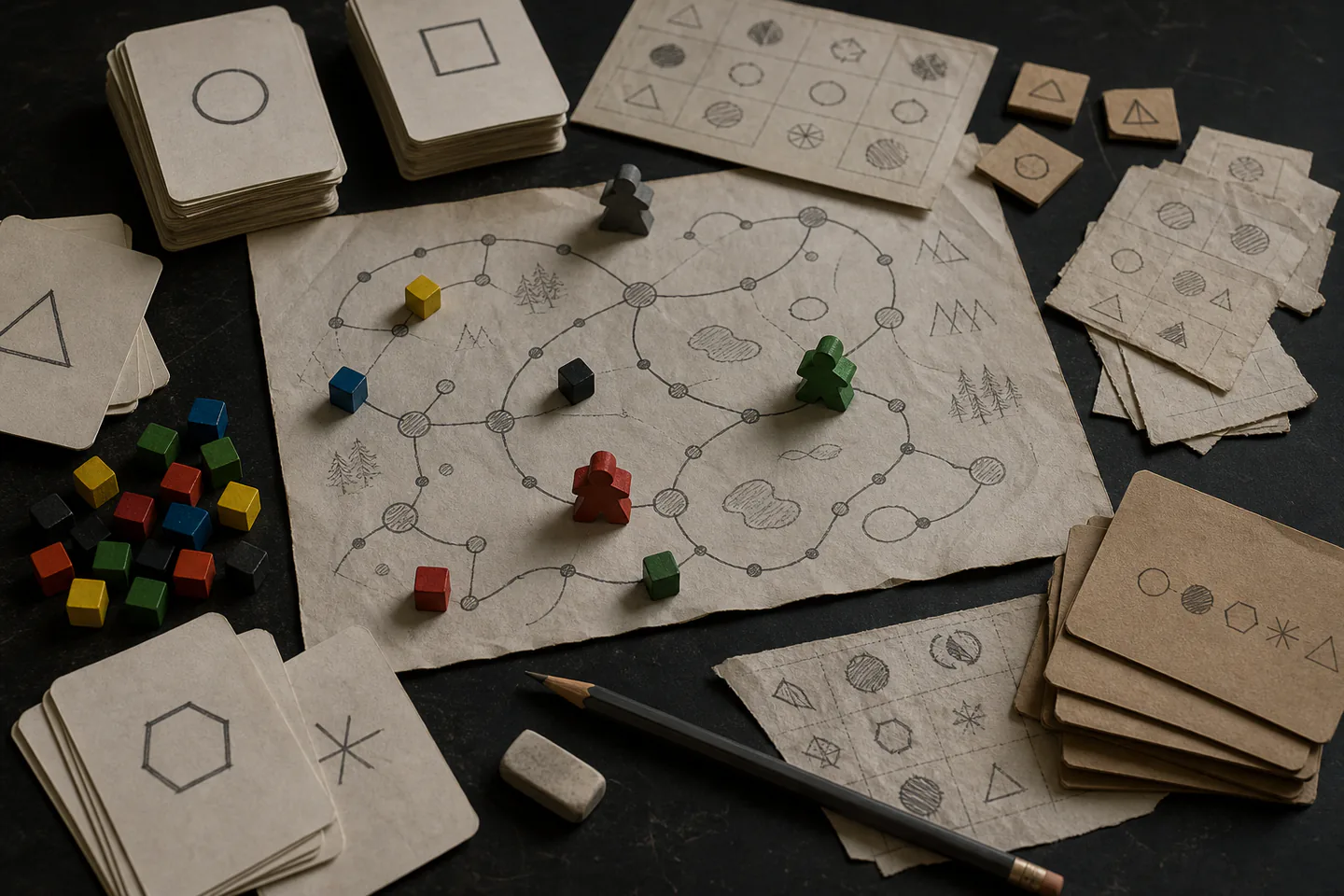
Write one sentence describing what players repeatedly do and why it creates tension—for example, choose a tile, place it and score a connected group. Give the first prototype one end condition, one scoring method and no lore that changes a rule. Use paper slips in card sleeves, coins or borrowed cubes and a hand-drawn track. Play both sides yourself for ten minutes, mark every pause or forgotten rule, change one cause and test again before inviting another person.
- 01
A prototype is a question, not a miniature retail product. Cheap editable components make it easier to discard weak rules.
- 02
Mechanics, theme and presentation interact, but attractive art can make a confusing system harder to criticise honestly.
- 03
Balance is not merely equal numbers. Choices need understandable trade-offs, recoverability and a path to the end.
- 04
A designer watching a test should observe rather than teach every turn; repeated explanations reveal missing rules or interface.
What to expect
What the first board-game design result really teaches
The first design will contain too much. Productive iteration removes bookkeeping and makes one player decision carry more of the experience.
Loop
Name the repeated action, feedback and reason to do it again before writing exceptions.
Goal
Players should know how the game ends and what success means from the first page.
Turn
A short sequence with visible options is easier to test than phases copied from a favourite complex game.
Randomness
Dice and cards create uncertainty; players still need meaningful decisions before and after the result.
Balance
Record turns, scores, dominant choices and confusion across several tests instead of fixing one dramatic loss.
Rules
A blind tester using only the document exposes assumptions that friendly demonstrations hide.
Core method
Build one repeatable board-game design workflow
Define the design question
Write audience, player count, target length, repeated verb and desired tension on one page. State one thing this prototype is testing, such as whether choosing an open resource is interesting. Remove any rule that does not affect that question.
Build with editable components
Cut twenty paper cards, sleeve them with spare playing cards if needed and use cubes, coins or printable tokens for state. Label everything in large readable language and use shapes as well as colour. Keep a component inventory so setup can be repeated.
Solo-test the procedure
Play multiple seats honestly and time setup, turns and ending. Put a mark on the rules whenever memory replaces the written instruction. Record the exact moment a choice becomes automatic, a loop fails or the game cannot end.
Run a small observed playtest
Tell testers the prototype is rough and which question matters. Give them the rules with minimal intervention, take notes and ask about specific decisions rather than whether it was “fun.” Change one cluster of problems, version the files and test again before polishing.
Useful products
Products with a clear job in the setup
Blank cards are the quick editable component, the meeple set supplies reusable state markers and the design-pattern book is a deep later reference. Household paper and borrowed components can replace the first two.
Apostrophe Games Blank Playing Cards, 180 Cards
Cards can be crossed out, replaced or sleeved while the design changes.
Brybelly 100 Wooden Meeples in Assorted Colours
The set supports many prototypes and makes board position clear.
Geoffrey Engelstein and Isaac Shalev Building Blocks of Tabletop Game Design, 2nd Edition
It gives names and relationships to design patterns without prescribing one finished game.
First project
Prototype one ten-minute resource game
A tiny playable loop provides more design evidence than a long theme document.
- 01
Write one repeated verb
Define the action, tension, goal and ending in one paragraph.
- 02
Make twenty paper components
Use large labels, shapes and only necessary information.
- 03
Play every seat yourself
Time turns and mark automatic or impossible choices.
- 04
Revise one cause
Remove or change a rule cluster, not every number at once.
- 05
Observe two players
Give only the written rules and note every intervention.
- 06
Save a new version
Keep test data and state the next question.
What can wait
What can wait until the first result
Commissioned art, manufacturing quotes and crowdfunding belong after strangers can learn and finish the prototype.
- 01
Finished illustration
Beautiful assets create sunk cost and can hide unclear information hierarchy.
- 02
Custom miniatures
Cubes or paper tokens already test position and state.
- 03
A giant rulebook
Prototype the smallest complete loop before documenting future expansions.
- 04
Crowdfunding
Audience building, fulfilment, tax, safety and manufacturing are businesses beyond hobby design.
- 05
Copyrighted characters
Use original or licensed themes and placeholder shapes, not commercial fan art intended for sale.
Upgrade path
Upgrade the repeated limitation
Upgrade only the prototype fidelity needed for the next test: handling, readability, blind rules or public demonstration.
Scrap prototype
Free–£15Paper, coins and borrowed components
Test the core loop.Reusable components
About £20–£55Blank cards, sleeves, cubes and box
Iterate quickly and travel.Print-and-play prototype
About £30–£150Layout software + home/pro print
Test information hierarchy and blind rules.Convention/publisher pitch
About £150–£800+Durable prototype, travel and rights preparation
Demonstrate a proven design professionally.Safety & care
Design inclusively and respect rights and testers
The hobby is physically low risk, but inaccessible components, copied assets, unsafe small parts and exploitative testing can harm people or the project.
- Use symbols, labels and sufficient contrast rather than colour alone and offer readable type and component handling where possible.
- Keep small parts away from children and pets and do not assign an age or safety certification to a handmade prototype without proper assessment.
- Use only owned, licensed or clearly temporary reference art and maintain records of every contributor and licence.
- Ask permission before recording playtests, minimise personal data and make it easy for testers to stop without pressure.
- Store versioned rules and source files in two places and label bags so prototype pieces are not mistaken for food or toys.
Outside help
When outside help earns its place
Free design talks and local playtest groups are enough for early prototypes. A course is useful when it includes repeated critique and blind tests, not merely a polished final pitch.
Share a focused design question and report test evidence.
Check tutor credits, playtest time and feedback structure.
Representative UK product, workshop, lesson and club costs checked 13 August 2026; local prices, access, materials and tutor support vary.
Sources
Where the guidance came from
Designer organisations and publishing specialists define testing and rights; experienced design communities add iteration, component and pitch evidence.
-
01
BoardGameGeek · Board game design
Long-running design, rules and playtesting forum.
Open source -
02
UK Games Expo · Designers
UK convention, playtest and publisher context.
Open source -
03
Tabletop Game Designers Association
Designer education and professional practice.
Open source -
04
The Game Crafter · Design guide
Prototype and manufacturing education.
Open source -
05
Reddit · r/tabletopgamedesign
Community critique on prototypes, balance and testing.
Open source -
06
Amazon UK · Blank playing cards
Exact product page, model or ISBN, observed price and availability checked for this guide.
Open source -
07
Amazon UK · Assorted wooden meeples
Exact product page, model or ISBN, observed price and availability checked for this guide.
Open source -
08
Amazon UK · Building Blocks of Tabletop Game Design
Exact product page, model or ISBN, observed price and availability checked for this guide.
Open source
Guide information and links checked 13 August 2026.