Beginner’s guide · Reflect & explore
Capture, drop and promote,
on one nine-by-nine board.
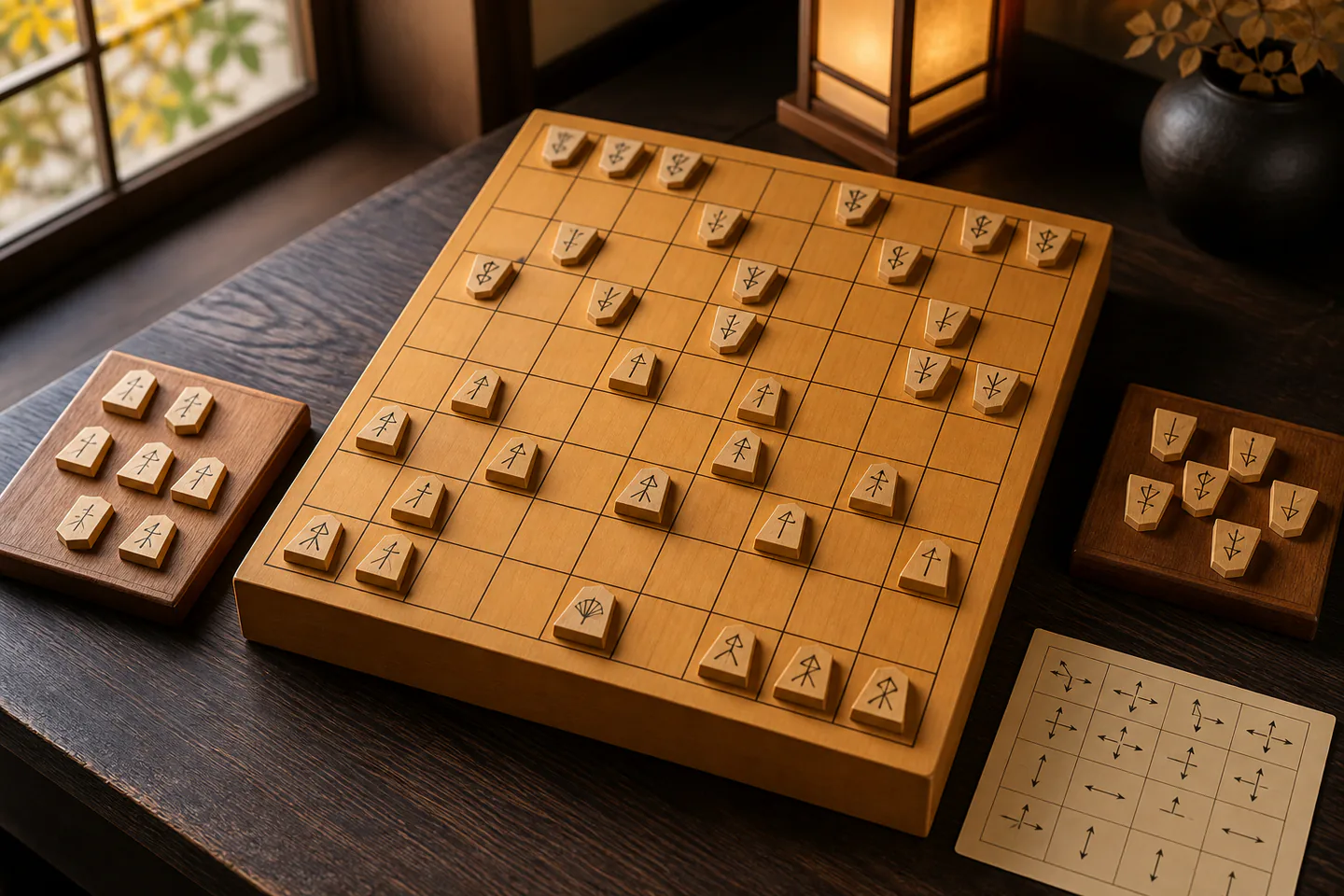
Shogi resembles chess but captured pieces return under the captor’s control. Learn piece movement, drops, promotion and checkmate through short practice positions before full games.
Quick answer
Learn the drop rule through small positions
Use a board with movement guides or an online trainer, learn the eight piece types and promoted sides, then practise capturing and legally dropping pieces before playing a full untimed game with a reference card beside the board.
- 01
Captured pieces change allegiance and can later be dropped on empty squares. Keep the first attempt narrow enough that preparation, the main action and the result can all be reviewed together.
- 02
Most pieces may promote after a move involving the opponent’s promotion zone, with compulsory cases when the unpromoted piece would have no future move. Keep the first attempt narrow enough that preparation, the main action and the result can all be reviewed together.
- 03
A file cannot normally contain two unpromoted pawns for the same player. Keep the first attempt narrow enough that preparation, the main action and the result can all be reviewed together.
- 04
Checkmate with a pawn drop is prohibited, while an ordinary pawn move may deliver mate. Keep the first attempt narrow enough that preparation, the main action and the result can all be reviewed together.
What to expect
Material never really leaves the game
Every capture expands the opponent’s possible drops, so open squares near the king remain tactically important.
Pieces
Traditional kanji are learnable, but movement-marked pieces reduce first-game friction. For shogi, note what actually happened rather than relying on memory; that turns the next attempt into a controlled change instead of another guess.
Drops
A captured piece returns unpromoted and follows restrictions on immobile drops. For shogi, note what actually happened rather than relying on memory; that turns the next attempt into a controlled change instead of another guess.
Promotion
Turning the piece changes its movement and often its tactical role. For shogi, note what actually happened rather than relying on memory; that turns the next attempt into a controlled change instead of another guess.
Notation
Recording a few games makes missed drops and promotion choices reviewable. For shogi, note what actually happened rather than relying on memory; that turns the next attempt into a controlled change instead of another guess.
Core method
Learn movement, drops and king safety together
Orient the pieces
Make every pointed piece face the opponent and keep captured pieces visible. For shogi, note what actually happened rather than relying on memory; that turns the next attempt into a controlled change instead of another guess.
Drill movement
Move each piece to every legal destination from a central square. For shogi, note what actually happened rather than relying on memory; that turns the next attempt into a controlled change instead of another guess.
Practise legal drops
Test pawn-file, dead-rank and pawn-drop mate restrictions. For shogi, note what actually happened rather than relying on memory; that turns the next attempt into a controlled change instead of another guess.
Play and review
Complete an untimed game, then find the first capture whose future drop was overlooked. For shogi, note what actually happened rather than relying on memory; that turns the next attempt into a controlled change instead of another guess.
Useful products
Products with a clear job in the setup
The wooden and magnetic Yellow Mountain sets are alternative physical routes; Fairbairn’s book is a rules and strategy reference rather than required equipment.
Yellow Mountain Imports Wooden Shogi Japanese Chess Game
It is compact and keeps captured pieces visible beside the board.
Yellow Mountain Imports Magnetic Travel Shogi Game Set
Pieces stay aligned on a small board during study.
John Fairbairn Shogi for Beginners
A structured book supports consistent terminology and review.
First project
Play one untimed game with open references
Correct legality and explanation matter more than speed or winning.
- 01
Set the board accurately
Check piece direction and starting ranks. For shogi, note what actually happened rather than relying on memory; that turns the next attempt into a controlled change instead of another guess.
- 02
Name each move
Say the piece and destination before moving. For shogi, note what actually happened rather than relying on memory; that turns the next attempt into a controlled change instead of another guess.
- 03
Keep captures visible
Place pieces on the stand facing the new owner. For shogi, note what actually happened rather than relying on memory; that turns the next attempt into a controlled change instead of another guess.
- 04
Check drop restrictions
Pause before every pawn or dead-rank drop. For shogi, note what actually happened rather than relying on memory; that turns the next attempt into a controlled change instead of another guess.
- 05
Review the first oversight
Find one missed check, drop or promotion choice. For shogi, note what actually happened rather than relying on memory; that turns the next attempt into a controlled change instead of another guess.
What can wait
What can wait until the first result
Extra equipment becomes useful only when the basic method has exposed a specific, repeated limitation.
- 01
A clock
Time pressure hides the rule-learning loop. For shogi, note what actually happened rather than relying on memory; that turns the next attempt into a controlled change instead of another guess.
- 02
Opening memorisation
Patterns make sense only after drops and king safety are visible. For shogi, note what actually happened rather than relying on memory; that turns the next attempt into a controlled change instead of another guess.
- 03
Decorative kanji sets
Readable movement support matters more at first. For shogi, note what actually happened rather than relying on memory; that turns the next attempt into a controlled change instead of another guess.
- 04
Variants
Mini shogi and larger historical games use different pieces and rules. For shogi, note what actually happened rather than relying on memory; that turns the next attempt into a controlled change instead of another guess.
Upgrade path
Upgrade the repeated limitation
Upgrade opponents and analysis before board materials.
Online tutorial
FreeMovement hints and legal-move checks
Learn complete rules.Basic set
£20–£45Board, pieces and reference
Play over a table.Study book and notation
£10–£30Recorded games and problems
Review tactics and errors.Club or server play
Mostly freeVaried opponents and post-game analysis
Build strategic pattern recognition.Safety & care
Keep competition and small pieces sensible
Shogi is low risk, but online conduct, repetitive play and small components still need ordinary care.
- Keep pieces away from young children and pets. Follow current manufacturer, food-safety, access, wildlife or local guidance wherever it applies.
- Take movement and visual breaks during long online or over-board sessions. Follow current manufacturer, food-safety, access, wildlife or local guidance wherever it applies.
- Protect account privacy and use reputable playing servers. Follow current manufacturer, food-safety, access, wildlife or local guidance wherever it applies.
- Agree rule references and time control before competitive games. Follow current manufacturer, food-safety, access, wildlife or local guidance wherever it applies.
- Treat ratings as feedback rather than personal value. Follow current manufacturer, food-safety, access, wildlife or local guidance wherever it applies.
Outside help
When outside help earns its place
An online tutorial can teach legality; a local club becomes useful for notation, etiquette and post-game review.
Use the official movement, drop and promotion explanations.
Ask whether beginner sets and teaching games are available.
Representative UK learning options checked 31 August 2026; local prices, access, materials and tutor support vary.
Sources
Where the guidance came from
Japan Shogi Association material defines the rules; UK and online communities support accessible English-language learning and practice.
-
01
Japan Shogi Association · English pamphlet
Official piece movement, promotion and drop rules.
Open source -
02
Japan Shogi Association · Match rules
Current official rules context.
Open source -
03
Shogi Foundation UK
English-language UK learning and publications.
Open source -
04
81Dojo
Online shogi play and learning platform.
Open source -
05
Reddit · r/shogi
Recurring beginner questions on sets, books and rules.
Open source -
06
Amazon UK · Wooden Shogi Japanese Chess Game
Exact Amazon UK product page or ISBN used for the recommendation; current price, seller, specification and availability should be confirmed.
Open source -
07
Amazon UK · Magnetic Travel Shogi Game Set
Exact Amazon UK product page or ISBN used for the recommendation; current price, seller, specification and availability should be confirmed.
Open source -
08
Amazon UK · Shogi for Beginners
Exact Amazon UK product page or ISBN used for the recommendation; current price, seller, specification and availability should be confirmed.
Open source
Guide information and links checked 31 August 2026.