Beginner’s guide · Cook & bake
Keep butter layered
and the dough cool.
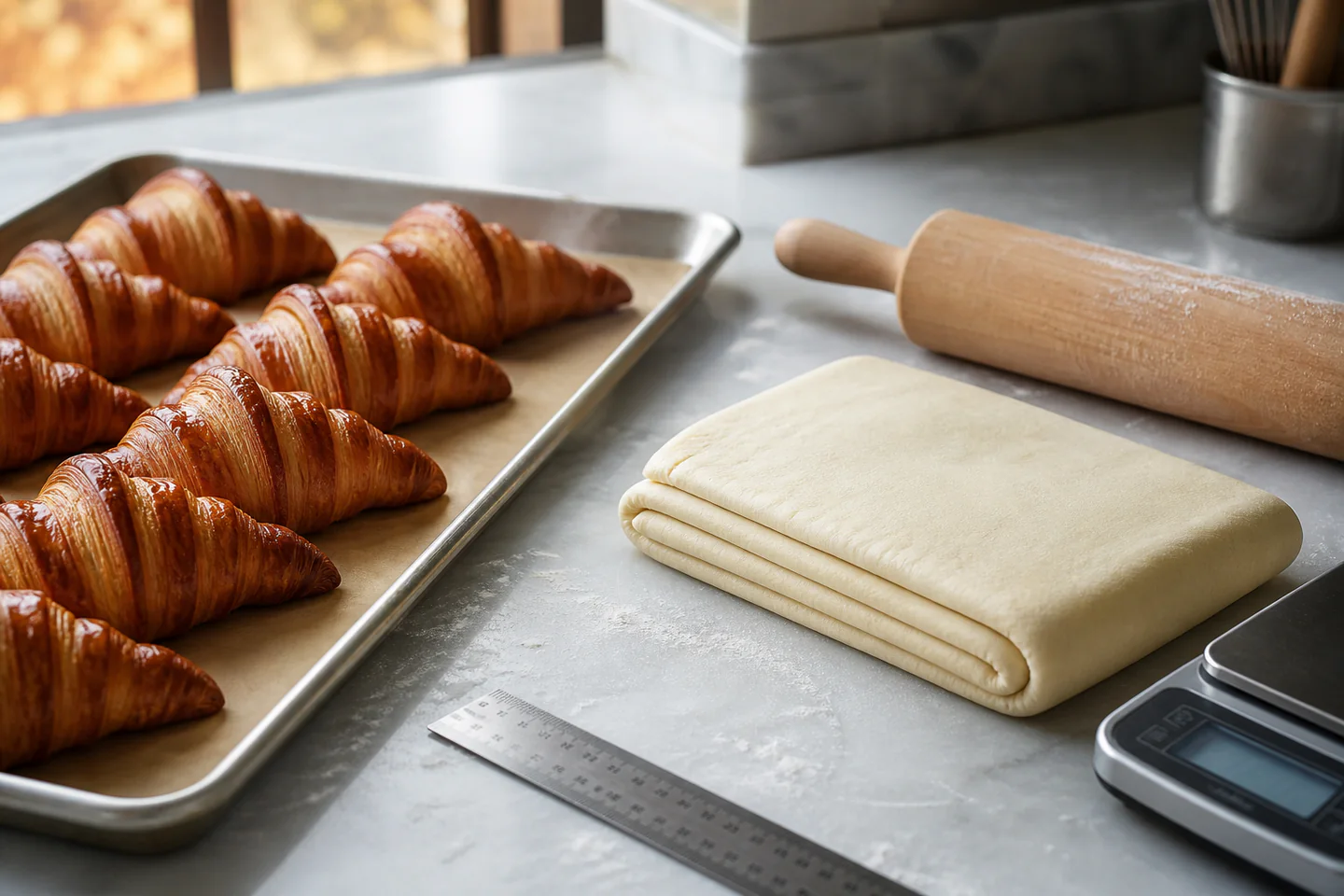
Croissants are a multi-stage lamination project. A half batch, measured rectangle and planned chilling schedule make the first attempt manageable.
Quick answer
Plan the chilling before mixing
Use one tested recipe, make a neat butter block, roll to measured dimensions, complete the stated folds with full chilling and proof shaped croissants until visibly light.
- 01
Clear a cool rolling area and fridge shelf, then mark the target dough dimensions. Keep the first attempt narrow enough that preparation, the main action and the result can all be reviewed together.
- 02
Keep dough and butter at similar workable firmness and return them to the fridge before smearing occurs. Keep the first attempt narrow enough that preparation, the main action and the result can all be reviewed together.
- 03
Visible layers, gentle wobble at proof and a honeycombed crumb show different stages succeeded. Keep the first attempt narrow enough that preparation, the main action and the result can all be reviewed together.
- 04
Do not force cold brittle butter or continue rolling soft greasy dough. Keep the first attempt narrow enough that preparation, the main action and the result can all be reviewed together.
What to expect
The project is mostly temperature management
Mixing is ordinary; maintaining distinct extensible dough and butter layers is the challenge.
The first attempt
Even imperfect croissants teach more when dimensions and fold sequence are recorded. For croissant making, note what actually happened rather than relying on memory; that turns the next attempt into a controlled change instead of another guess.
What changes
Warmer dough rolls easily but risks butter absorption and leaks. For croissant making, note what actually happened rather than relying on memory; that turns the next attempt into a controlled change instead of another guess.
The useful signal
A properly proofed croissant looks expanded and trembles slightly when the tray moves. For croissant making, note what actually happened rather than relying on memory; that turns the next attempt into a controlled change instead of another guess.
The common trap
Under-proofing produces butter pools and dense centres that look like lamination failure. For croissant making, note what actually happened rather than relying on memory; that turns the next attempt into a controlled change instead of another guess.
Core method
Roll, fold, chill and proof on purpose
Prepare deliberately
Clear a cool rolling area and fridge shelf, then mark the target dough dimensions. For croissant making, note what actually happened rather than relying on memory; that turns the next attempt into a controlled change instead of another guess.
Control the central variable
Keep dough and butter at similar workable firmness and return them to the fridge before smearing occurs. For croissant making, note what actually happened rather than relying on memory; that turns the next attempt into a controlled change instead of another guess.
Read the result
Visible layers, gentle wobble at proof and a honeycombed crumb show different stages succeeded. For croissant making, note what actually happened rather than relying on memory; that turns the next attempt into a controlled change instead of another guess.
Reset before repeating
Photograph the cut crumb and note room temperature, rolling resistance and proof time. For croissant making, note what actually happened rather than relying on memory; that turns the next attempt into a controlled change instead of another guess.
Useful products
Products with a clear role
The shortlist covers the first workable route and one realistic improvement. Each exact Amazon UK page or ISBN was checked; confirm the current seller, specification, edition and availability.
Etekcity Digital Kitchen Scale, 0.1 g to 5 kg
Weights expose whether the recipe or technique changed.
Zulay Kitchen Three-Piece Stainless Dough Scraper Set
It reduces added flour and keeps portions consistent.
Generic Thick Silicone Pastry Mat with Measurements, 40 × 50 cm
Guides make repeated dimensions easier to compare.
First project
Make a measured half batch
Fewer pieces preserve fridge space and make careful rolling easier.
- 01
Set up
Clear a cool rolling area and fridge shelf, then mark the target dough dimensions. For croissant making, note what actually happened rather than relying on memory; that turns the next attempt into a controlled change instead of another guess.
- 02
Begin
Use one tested recipe, make a neat butter block, roll to measured dimensions, complete the stated folds with full chilling and proof shaped croissants until visibly light. For croissant making, note what actually happened rather than relying on memory; that turns the next attempt into a controlled change instead of another guess.
- 03
Stay with one method
Keep dough and butter at similar workable firmness and return them to the fridge before smearing occurs. For croissant making, note what actually happened rather than relying on memory; that turns the next attempt into a controlled change instead of another guess.
- 04
Finish and assess
Visible layers, gentle wobble at proof and a honeycombed crumb show different stages succeeded. For croissant making, note what actually happened rather than relying on memory; that turns the next attempt into a controlled change instead of another guess.
- 05
Record the next change
Photograph the cut crumb and note room temperature, rolling resistance and proof time. For croissant making, note what actually happened rather than relying on memory; that turns the next attempt into a controlled change instead of another guess.
What can wait
What can wait until the method works
Buying around an unclear problem adds clutter. These upgrades make more sense after the first result exposes a repeatable limitation.
- 01
More capacity
Larger or multiple batches multiply lamination temperature before the small version is stable. For croissant making, note what actually happened rather than relying on memory; that turns the next attempt into a controlled change instead of another guess.
- 02
Premium equipment
A marble slab or sheeter is unnecessary for home batches. For croissant making, note what actually happened rather than relying on memory; that turns the next attempt into a controlled change instead of another guess.
- 03
Extra varieties
Pain au chocolat and filled shapes can follow plain crescents. For croissant making, note what actually happened rather than relying on memory; that turns the next attempt into a controlled change instead of another guess.
- 04
Public or commercial claims
A dramatic outer flake does not guarantee a fully proofed honeycomb. For croissant making, note what actually happened rather than relying on memory; that turns the next attempt into a controlled change instead of another guess.
Upgrade path
Upgrade the repeated limitation
Upgrade temperature control and rolling accuracy.
Try it
£15–£45Scale, rolling pin, scraper and tested recipe
The fold sequence becomes learnable.Repeat it
£15–£50Large mat and straight ruler
Thickness and dimensions repeat.Improve the bottleneck
£50–£200Better oven thermometer and cold workspace aids
Proof and bake become more predictable.Go deeper
VariablePreferment and flour comparisons
Flavour develops after structure works.Safety & care
Keep raw dough cold and bake fully
Butter, egg wash and flour need normal hygiene alongside safe lifting and oven use.
- Refrigerate butter and dough between stages. Follow current manufacturer, food-safety, access, wildlife or local guidance wherever it applies.
- Avoid raw flour and egg cross-contamination. Follow current manufacturer, food-safety, access, wildlife or local guidance wherever it applies.
- Use oven gloves and stable trays. Follow current manufacturer, food-safety, access, wildlife or local guidance wherever it applies.
- Keep blades and cutters stored safely. Follow current manufacturer, food-safety, access, wildlife or local guidance wherever it applies.
- Cool baked croissants before filling or storing. Follow current manufacturer, food-safety, access, wildlife or local guidance wherever it applies.
Outside help
When outside help earns its place
Lamination benefits unusually well from seeing dough and butter texture in person.
Use one complete lesson that covers preparation, the central technique, common mistakes and finishing. For a first croissant making attempt, one coherent method is easier to diagnose than fragments collected from several creators.
Outside help earns its place when safe setup, access, identification or live correction removes a real obstacle. Ask what equipment, materials, access and follow-up support are included before booking.
Representative UK learning options checked 31 August 2026; local prices, access, materials and tutor support vary.
Sources
Where the guidance came from
The method is grounded in specialist, manufacturer and public guidance, then checked against recurring beginner problems and the exact products linked here.
-
01
Food Standards Agency · Food safety at home
UK hygiene and storage baseline.
Open source -
02
BBC Food · Techniques
Practical cooking technique reference.
Open source -
03
Serious Eats · Techniques
Comparative practical technique context.
Open source -
04
King Arthur Baking · Learn
Tested baking methods and troubleshooting.
Open source -
05
r/AskCulinary
Recurring real-world process questions.
Open source -
06
Amazon UK · Digital Kitchen Scale, 0.1 g to 5 kg
Exact Amazon UK product page or ISBN used for the recommendation; current price, seller, specification and availability should be confirmed.
Open source -
07
Amazon UK · Three-Piece Stainless Dough Scraper Set
Exact Amazon UK product page or ISBN used for the recommendation; current price, seller, specification and availability should be confirmed.
Open source -
08
Amazon UK · Thick Silicone Pastry Mat with Measurements
Exact Amazon UK product page or ISBN used for the recommendation; current price, seller, specification and availability should be confirmed.
Open source
Guide information and links checked 31 August 2026.