Beginner’s guide · Observe & photograph
Arrange it in water,
press only what you may collect.
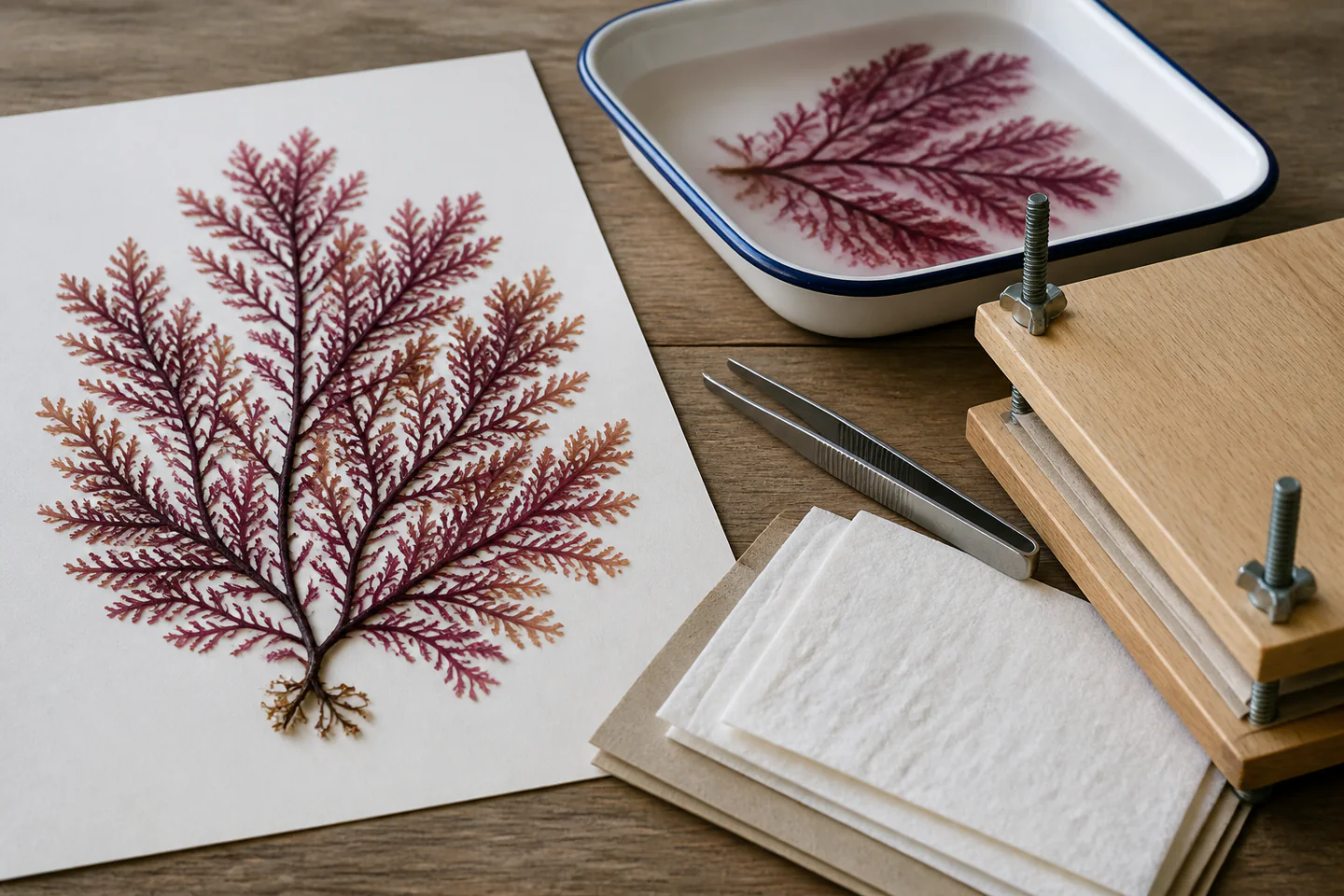
Begin with a small common specimen collected legally and safely from loose drift material. Floating it over paper preserves branching far better than dragging it dry.
Quick answer
Press one loose common specimen from a safe permitted beach
Check tide times, weather, local bylaws, protected-site rules and landowner permission before leaving home. Work with another person on a familiar accessible shore and collect only a small loose specimen where collection is allowed; do not pull a living holdfast from rock. Rinse it in clean seawater, float it in a shallow tray and slide sturdy paper beneath it. Lift slowly while arranging branches with tweezers, cover with a non-stick layer or suitable cloth, add absorbent paper and press while changing damp sheets until dry.
- 01
Safety and permission come before a specimen. Tides, slippery rock, waves and cliffs can make a familiar shore dangerous quickly.
- 02
Many protected sites restrict or prohibit collection. Check the exact place and purpose rather than assuming hand collection is harmless.
- 03
Take the minimum, prefer loose drift material and never strip a patch or remove the holdfast of a living attached seaweed.
- 04
Identify from multiple features and location; red, green and brown colour groups are starting points, not confident species names.
- 05
Record date, broad location, tide zone, substrate and whether the specimen was loose. A beautiful unidentified pressing loses ecological context.
What to expect
The specimen is arranged while floating
Wet seaweed collapses into itself on contact with dry paper. Supporting it in water lets fine branches spread naturally before gravity and absorbent sheets take over.
Shore
The best specimen is not worth approaching a cut-off gully, unstable cliff or wave-washed platform. Use a conservative tide window.
Collection
Drift material can still be ecologically useful and local rules vary. Photograph in place when removal is uncertain.
Rinse
Clean seawater removes sand and small mobile animals while reducing sudden osmotic damage before pressing. Return animals promptly.
Paper
Wet-strength art paper supports lifting and may become the permanent mount. Test absorbency and colour before field use.
Press
Blotters become saturated quickly. Early changes reduce mould, staining and adhesion to unwanted layers.
Colour
Pigments can change dramatically while drying. Preserve the physical form and record a fresh photograph rather than promising original colour.
Core method
Plan a safe return and a wet arranging station
Research the exact shore
Use official tide and weather sources, check site designation and collection rules and obtain permission where needed. Choose a route without scrambling, cliffs or cut-off points and go with someone. Pack footwear with grip, warm layers, phone protection, first aid and a firm leave time.
Observe before taking
Photograph the specimen, surrounding habitat and attachment. Prefer a small loose piece of a common species and avoid reproductive or unusual material. If identification or permission is uncertain, make photographs and notes only. Keep the sample cool in a small amount of clean seawater and do not mix locations.
Float onto the sheet
At home, inspect and return any mobile animal safely where lawful and practical. Place the seaweed in a shallow tray of clean seawater, slide labelled sturdy paper beneath it and use blunt tweezers or a brush to spread branches. Lift one edge slowly so water drains without collapsing the arrangement.
Press and document
Cover the arranged surface with material known not to stick, then add absorbent blotters and boards. Apply even pressure and change wet sheets frequently at first using clean dry hands. Once completely dry, keep the mount flat and label only to the confidence supported by the identification guide and field record.
Useful products
Products with a clear job in the setup
The Rhykoka flower press provides compact even pressure and reusable boards for small specimens. Daler-Rowney watercolour paper has enough wet strength for water-assisted arranging, though an archival project should test paper and long-term storage more strictly. Seaweeds of Britain and Ireland is the strongest identification investment here and is deliberately more prominent than decorative extras.
Rhykoka Wooden Flower Press Kit
A screw press is easier to inspect and retighten than a pile of improvised heavy books.
Daler-Rowney Aquafine Watercolour Pad
Wet strength and a pale surface make branch arrangement and colour changes visible.
Francis Bunker, Juliet Brodie, Christine Maggs and Anne Bunker Seaweeds of Britain and Ireland
The specialist authors and regional scope are more reliable than colour alone or a generic foraging chart.
First project
Press one small branching drift specimen
A common loose piece keeps collection impact low and makes the float-and-lift technique visible without a crowded sheet.
- 01
Check tide and rules
Confirm weather, leave time, site status, permission and a safe companion plan.
- 02
Photograph in place
Record habitat, substrate, fresh colour and whether the piece was attached.
- 03
Take the minimum
Choose a small loose common specimen and leave living holdfasts untouched.
- 04
Float over paper
Spread branches in clean seawater and lift the supporting sheet slowly.
- 05
Change blotters
Replace wet absorbent layers early and keep pressure even.
- 06
Label honestly
Record field data and identify only to the level the evidence supports.
What can wait
What can wait until the first result
A scientific-looking label does not create a valid identification. Better field records and smaller lawful samples come first.
- 01
Rare or unfamiliar specimens
Photograph and seek expert help rather than removing material that may be important.
- 02
Food use
Edibility, contamination, water quality and harvest law are separate high-stakes questions.
- 03
Large kelp pressings
Size, thickness and moisture demand different presses and far more drying capacity.
- 04
Bleach or colour fixatives
They change the specimen and introduce chemical hazards without solving basic arrangement.
- 05
Public-site collecting
Protected or managed shores may prohibit removal even of apparently abundant material.
Upgrade path
Upgrade the repeated limitation
Upgrade documentation and drying capacity before increasing collection size or specimen rarity.
One drift specimen
About £20–£65Small press, paper and field guide
Learn safety, float and blotter changes.Reference set
About £40–£120Better labels, folders and repeat visits
Compare common species and seasons.Large specimens
About £80–£250Larger press and substantial blotter stock
Handle thicker branching material.Scientific contribution
About £150–£500+Expert verification and archival standards
Create records useful beyond decoration.Safety & care
The shore can close the route faster than the project suggests
Never work with your back to changing water, enter a cave or cross a flooding gully for a specimen. Leave early and return with photographs rather than taking risks or protected material.
- Check official tide times, weather and local warnings, go with another person and choose a firm leave time well before access is threatened.
- Wear grippy footwear and suitable layers, stay away from cliffs, unstable rocks, breaking waves and deep pools and keep communications protected.
- Follow site, wildlife, landowner and collection rules and remove only a minimal common loose specimen where explicitly allowed.
- Do not eat pressed or collected material; contamination and edible identification require separate expert guidance.
- Wash hands, clean salt from tools, handle mouldy material cautiously and keep wet specimens and small tools away from children and pets.
Outside help
When outside help earns its place
The Natural History Museum survey and one safe shore are enough for observation. A guided rockpool or seaweed-identification walk is valuable for habitat recognition and collection-free identification.
Use the survey method and photograph records without needing to collect.
Ask about tide planning, site permissions, accessibility and a no-foraging option.
Representative UK learning options checked 18 August 2026; local prices, access, materials and tutor support vary.
Sources
Where the guidance came from
The Natural History Museum and specialist field guides anchor identification and recording. Official site rules and shore-safety guidance define whether and how the practical pressing project can proceed.
-
01
Natural History Museum · Big Seaweed Search
UK seaweed recording, identification and responsible survey method.
Open source -
02
Marine Conservation Society · Seashore safety
UK coastal visit and beach-safety context.
Open source -
03
RNLI · Beach safety
Tides, waves, emergencies and safer shore visits.
Open source -
04
NHBS · Seaweeds of Britain and Ireland
Specialist guide scope, authorship and identification context.
Open source -
05
Reddit · r/Seaweed
Community evidence on identification, pressing and regional variation.
Open source -
06
Amazon UK · Wooden Flower Press Kit
Exact product catalogue page or ISBN used for the recommendation; current price, seller, specification and availability should be confirmed.
Open source -
07
Amazon UK · Aquafine Watercolour Pad
Exact product catalogue page or ISBN used for the recommendation; current price, seller, specification and availability should be confirmed.
Open source -
08
Amazon UK · Seaweeds of Britain and Ireland
Exact product catalogue page or ISBN used for the recommendation; current price, seller, specification and availability should be confirmed.
Open source
Guide information and links checked 18 August 2026.