Beginner’s guide · Photograph & film
Turn one page of script
into six purposeful shots.
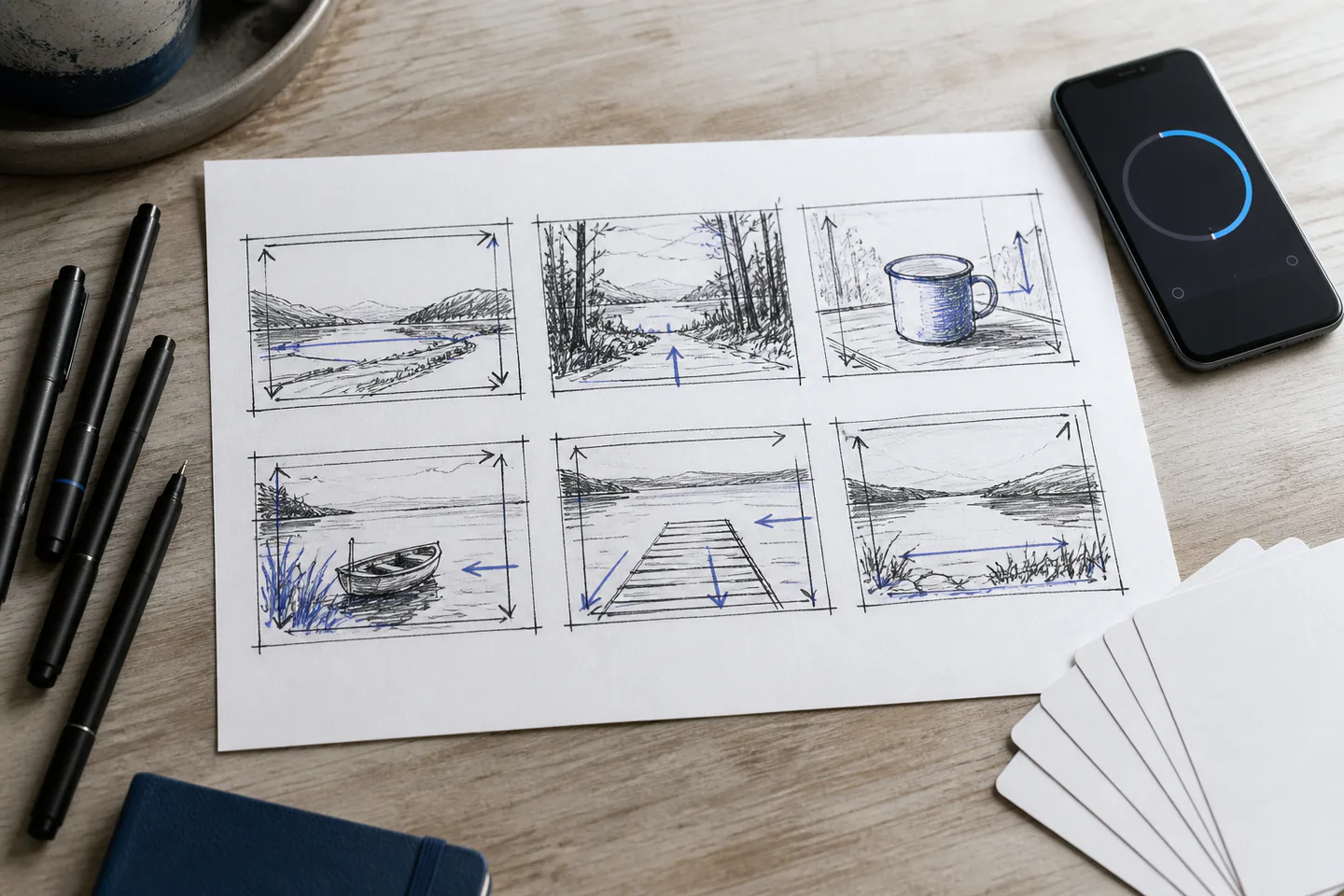
Rough readable panels beat polished illustrations. Translate each change in framing, camera angle or important action into a new panel, then time the sequence as an animatic.
Quick answer
Draw for decisions, not display
Choose one short scene, write its story beat in a sentence, draw a new rough panel whenever framing, angle or significant action changes, label movement and sound, then photograph the panels into a timed sequence.
- 01
A storyboard communicates staging, framing and continuity; drawing polish is secondary. Keep the first attempt narrow enough that preparation, the main action and the result can all be reviewed together.
- 02
Use a new panel when the shot changes, not for every tiny movement. Keep the first attempt narrow enough that preparation, the main action and the result can all be reviewed together.
- 03
Arrows must distinguish camera movement from subject movement. Keep the first attempt narrow enough that preparation, the main action and the result can all be reviewed together.
- 04
An animatic reveals whether the number and duration of shots support the scene. Keep the first attempt narrow enough that preparation, the main action and the result can all be reviewed together.
What to expect
Every panel is a production choice
A missing eyeline or impossible screen direction becomes expensive only after cameras, sets or animators are working.
Shot size
Wide, medium and close framing change information and emotional distance. For storyboarding, note what actually happened rather than relying on memory; that turns the next attempt into a controlled change instead of another guess.
Angle
High, low and level viewpoints imply different relationships and practical setups. For storyboarding, note what actually happened rather than relying on memory; that turns the next attempt into a controlled change instead of another guess.
Continuity
Screen direction and eyelines should remain intelligible across cuts. For storyboarding, note what actually happened rather than relying on memory; that turns the next attempt into a controlled change instead of another guess.
Timing
A panel has no duration until notes or an animatic give it one. For storyboarding, note what actually happened rather than relying on memory; that turns the next attempt into a controlled change instead of another guess.
Core method
Move from story beat to shootable sequence
Name the beat
State what changes emotionally or practically during the scene. For storyboarding, note what actually happened rather than relying on memory; that turns the next attempt into a controlled change instead of another guess.
Block the geography
Draw a simple overhead map so entrances, looks and screen direction agree. For storyboarding, note what actually happened rather than relying on memory; that turns the next attempt into a controlled change instead of another guess.
Thumbnail alternatives
Try two or three shot orders before committing to a neat grid. For storyboarding, note what actually happened rather than relying on memory; that turns the next attempt into a controlled change instead of another guess.
Build the animatic
Photograph panels, add rough timing and revise confusing or redundant cuts. For storyboarding, note what actually happened rather than relying on memory; that turns the next attempt into a controlled change instead of another guess.
Useful products
Products with a clear job in the setup
Fineliners make readable panels, flash cards keep beats movable and the sketchbook stores alternate sequences; ordinary pencil and paper remain a complete route.
Sakura Pigma Micron Fineliner Pens, Set of 6
Different widths separate rough construction, final contour and notes.
Oxford A6 Ruled Flash Cards, Pack of 80
One beat per card exposes pacing and missing transitions.
Stillman & Birn Zeta Hardcover Sketchbook
Smooth paper supports pencil, ink and measured observation.
First project
Storyboard a five-shot exchange
Use one entrance, one object handover and one reaction to test geography and emphasis.
- 01
Write the beat
State who wants what and what changes. For storyboarding, note what actually happened rather than relying on memory; that turns the next attempt into a controlled change instead of another guess.
- 02
Map the room
Place doors, object and characters from above. For storyboarding, note what actually happened rather than relying on memory; that turns the next attempt into a controlled change instead of another guess.
- 03
Choose five shots
Include only the coverage needed to read the action. For storyboarding, note what actually happened rather than relying on memory; that turns the next attempt into a controlled change instead of another guess.
- 04
Add arrows and notes
Mark movement, sound and transitions without prose overload. For storyboarding, note what actually happened rather than relying on memory; that turns the next attempt into a controlled change instead of another guess.
- 05
Time an animatic
Hold each panel long enough to test rhythm. For storyboarding, note what actually happened rather than relying on memory; that turns the next attempt into a controlled change instead of another guess.
What can wait
What can wait until the first result
Extra equipment becomes useful only when the basic method has exposed a specific, repeated limitation.
- 01
Finished character art
Model sheets and polish can hide weak shot logic. For storyboarding, note what actually happened rather than relying on memory; that turns the next attempt into a controlled change instead of another guess.
- 02
Every possible angle
Coverage without intention creates editing work rather than clarity. For storyboarding, note what actually happened rather than relying on memory; that turns the next attempt into a controlled change instead of another guess.
- 03
Complex software
A phone slideshow already exposes timing. For storyboarding, note what actually happened rather than relying on memory; that turns the next attempt into a controlled change instead of another guess.
- 04
Dialogue detail
Use only the words or sound cue needed to identify the moment. For storyboarding, note what actually happened rather than relying on memory; that turns the next attempt into a controlled change instead of another guess.
Upgrade path
Upgrade the repeated limitation
Improve revision speed and collaboration, not illustration gloss.
Paper thumbnails
FreePencil and six boxes
Test the shot logic.Card sequence
£5–£20Index cards and fineliner
Reorder beats physically.Digital boards
Free–£40 monthlyTablet or storyboard software
Duplicate panels and share revisions.Animatic workflow
VariableAudio, editing and version control
Test pacing before production.Safety & care
Respect scripts, images and production safety
Boards can expose copyrighted material, private scripts and unsafe proposed setups.
- Use only scripts, stills and reference images you have permission to reproduce. Follow current manufacturer, food-safety, access, wildlife or local guidance wherever it applies.
- Label borrowed visual reference rather than presenting it as original art. Follow current manufacturer, food-safety, access, wildlife or local guidance wherever it applies.
- Do not let a dramatic angle imply an unsafe real camera position without a production plan. Follow current manufacturer, food-safety, access, wildlife or local guidance wherever it applies.
- Protect confidential scripts and unreleased project files. Follow current manufacturer, food-safety, access, wildlife or local guidance wherever it applies.
- Keep long drawing sessions ergonomically varied and take visual breaks. Follow current manufacturer, food-safety, access, wildlife or local guidance wherever it applies.
Outside help
When outside help earns its place
A film course or peer table-read becomes useful when another person must understand the boards without explanation.
Draw, time and revise one short action without polishing.
Look for shot critique, continuity and animatic feedback rather than only drawing technique.
Representative UK learning options checked 31 August 2026; local prices, access, materials and tutor support vary.
Sources
Where the guidance came from
Film-education and production sources agree that storyboards communicate shot changes, geography and timing rather than finished illustration.
-
01
Adobe · Storyboarding for animation
Panels, shots, scenes and animatic context.
Open source -
02
L.A. Film School · Storyboarding 101
Shot, angle, movement and production communication.
Open source -
03
FutureLearn · Storyboarding your five-shot film
Bounded five-shot beginner exercise.
Open source -
04
Storyboard Express · How to create a storyboard
Practical rule for new panels and movement arrows.
Open source -
05
BBC Writersroom · Script library
Produced-script examples for legal study and shot analysis.
Open source -
06
Amazon UK · Pigma Micron Fineliner Pens, Set of 6
Exact Amazon UK product page or ISBN used for the recommendation; current price, seller, specification and availability should be confirmed.
Open source -
07
Amazon UK · A6 Ruled Flash Cards, Pack of 80
Exact Amazon UK product page or ISBN used for the recommendation; current price, seller, specification and availability should be confirmed.
Open source -
08
Amazon UK · Zeta Hardcover Sketchbook
Exact Amazon UK product page or ISBN used for the recommendation; current price, seller, specification and availability should be confirmed.
Open source
Guide information and links checked 31 August 2026.