Beginner’s guide · Reflect & explore
Use the image,
then write your own question.
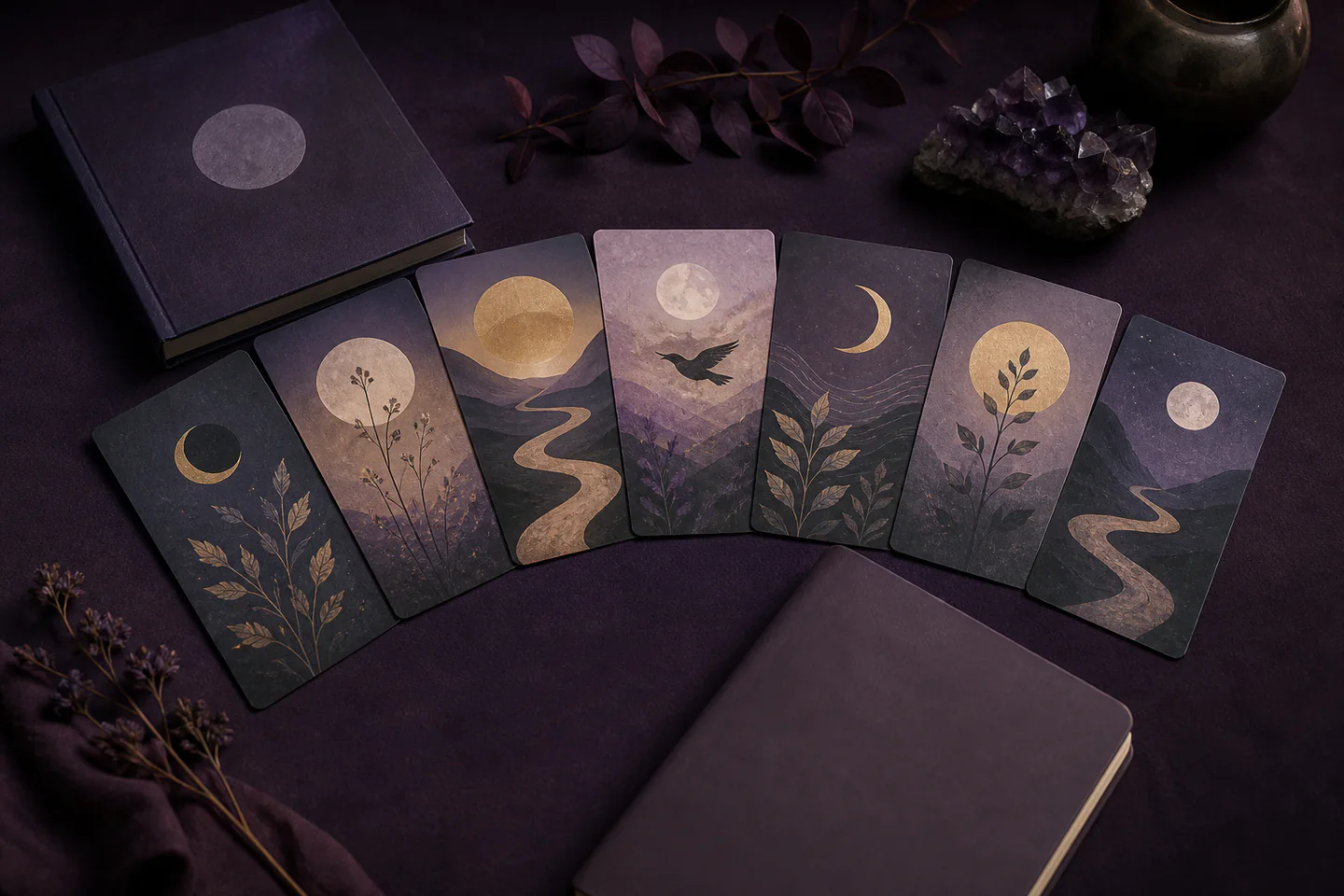
Oracle decks have no universal structure, so the best beginning is one clearly illustrated deck with a useful guidebook and a short reflective journal practice. The cards can prompt thought; they do not prove a fixed future.
Quick answer
Use one card to explore an open practical question
Choose a deck whose artwork, card size, guidebook sample and stated cultural framework are comfortable and understandable. Ask an open question such as “What deserves my attention in this situation?” Draw one card, describe only what is visibly present before reading the title or guide, then write three possible interpretations and one small reversible action. Read the creator’s guide, note where it changes the interpretation and close by naming what remains uncertain. Repeat with the same deck for five entries.
- 01
Unlike tarot, oracle decks have no standard number of cards, suits or shared sequence. Learn the creator’s own system before comparing decks.
- 02
Treat the reading as reflection, imagination or storytelling—not evidence of supernatural certainty or a replacement for qualified medical, legal, financial or mental-health help.
- 03
Open questions produce more useful reflection than repeated yes/no demands about an uncontrollable future.
- 04
A guidebook is part of the deck’s authorship. Image, keyword and explanation should be read together before making claims about intent.
- 05
Consent and privacy apply when reading for someone else. They can decline, keep questions private or stop at any time.
What to expect
The freedom of oracle cards is also their main difficulty
With no common grammar, any interpretation can sound plausible. A written distinction between observation, association, guidebook and action keeps the practice honest.
Observation
Name colours, figures, direction, objects and expression without assigning meaning yet.
Association
Personal memories may be relevant to the reader but are not universal facts about the card.
Guidebook
The creator’s stated theme provides context and may reveal culture, symbolism or a prompt missed in the image.
Question
A good question leaves agency with the person. It does not ask the card to diagnose, accuse or guarantee.
Pattern
Repeated cards can reflect shuffle, deck size or attention. Do not turn coincidence into escalating certainty.
Closure
End with one proportionate action or a decision to seek real information, then put the deck away.
Core method
Keep four columns: image, association, source and action
Choose the deck by usability
Preview several cards and a guidebook page. Check dimensions, cardstock, representation, religious or cultural framing and whether the deck promises certainty that conflicts with the intended reflective approach. Buy one authentic edition from a traceable publisher and inspect printing and booklet on arrival.
Set a bounded question
Use an issue the reader can influence and avoid diagnosing another person’s motives. Write the question before shuffling. If the topic involves health, safety, abuse, debt, law or severe distress, pause the cards and use appropriate professional or emergency support.
Describe before interpreting
Draw one card and spend a minute listing only visible evidence. Add personal associations in a second column and the creator’s guidebook meaning in a third. Look for overlap and disagreement. Generate at least two plausible readings so the first emotionally satisfying answer does not become destiny.
Close with an accountable action
Write one small action that is safe, reversible and connected to the question: ask for information, schedule time, draft options or rest before deciding. Note what evidence would change the interpretation. Do not redraw until a preferred answer appears. Date the entry and review five readings for usefulness rather than prediction accuracy.
Useful products
Products with a clear job in the setup
Moonology is a popular mass-market deck with an included guidebook and clear written prompts. Magic Oracle Cards is a visually and thematically different alternative, not a necessary second purchase. The Leuchtturm notebook supports the four-column method without tying the practice to another deck. Choose one deck plus any notebook already owned.
Yasmin Boland / Hay House Moonology Oracle Cards: A 44-Card Deck and Guidebook
The guidebook and visible messages reduce the need to invent a structure from nothing.
Semra Haksever / Hardie Grant Magic Oracle Cards: 36-Card Deck and Guidebook
A publisher-listed ISBN and included guidebook make the system and authorship identifiable.
Leuchtturm1917 A5 Dotted Hardcover Notebook, Forest Green
Numbered pages make it easy to revisit patterns without repeatedly drawing for the same issue.
First project
Complete five one-card reflective entries
Five readings with one deck reveal its visual language and whether the practice supports clearer action.
- 01
Write an open question
Keep it within personal agency and away from diagnosis or certainty.
- 02
Draw once
Use a simple shuffle and accept the selected card without hunting for a better answer.
- 03
Describe the visible image
List concrete elements before meanings.
- 04
Add two interpretations
Separate personal association from the creator’s guidebook.
- 05
Choose one grounded action
Make it safe, small, reversible and connected to real information.
- 06
Review all five
Judge clarity and usefulness, not whether events obeyed the cards.
What can wait
What can wait until the first result
More decks create novelty before the first deck’s language and the reader’s boundaries are understood.
- 01
A large deck collection
One guidebook and five dated entries reveal more than comparing packaging.
- 02
Repeated yes/no draws
Redrawing until relief appears reinforces the desired answer rather than reflection.
- 03
Reading health or crisis outcomes
Use qualified care, safeguarding and emergency support instead of symbolic cards.
- 04
Reading another person without consent
Privacy and agency apply even when the reading is not shared with them.
- 05
Expensive crystals and cloths
They are optional aesthetics and do not improve reasoning or ethical boundaries.
Upgrade path
Upgrade the repeated limitation
Upgrade only when a distinct visual system or shared practice has a clear purpose.
One-card journal
About £15–£45One deck + existing notebook
Learn observation and boundaries.Three-card structure
No extra spendSame deck + defined positions
Explore context, choice and next step.Different art system
About £15–£35One deliberately contrasting deck
Compare how images shape association.Facilitated creative practice
About £30–£150Ethics-led workshop or art journalling group
Use cards for writing and discussion with consent.Safety & care
Cards can prompt reflection but cannot establish facts
Keep decisions proportionate, preserve consent and step out of the symbolic frame whenever safety, evidence or professional expertise is required.
- Do not use oracle cards to diagnose illness, determine medication, predict legal or financial outcomes, identify abusers or replace emergency and safeguarding support.
- When reading for others, obtain explicit consent, explain the reflective framing, protect privacy and allow any question or card to be declined.
- Avoid deterministic statements, fear-based upselling and claims that a person caused misfortune through thoughts, energy or insufficient belief.
- Pause if readings become compulsive, increase anxiety or repeatedly delay decisions; use grounded support and qualified mental-health care where appropriate.
- Respect the deck creator’s copyright and cultural context and do not reproduce full card art, guidebooks or paid spreads without permission.
Outside help
When outside help earns its place
No class is needed. An ethical creative-writing or art-journalling session can add perspectives, while any course promising guaranteed prediction or costly spiritual dependency should be avoided.
Use the exact deck’s system and compare it with personal observation.
Ask how consent, health claims, privacy and facilitator boundaries are handled.
Representative UK learning options checked 17 August 2026; local prices, access, materials and tutor support vary.
Sources
Where the guidance came from
Publishers establish deck authorship and structure; ethical tarot/oracle educators and experienced communities provide question, consent and compulsive-use context.
-
01
Hay House · Moonology Oracle Cards
Publisher deck structure, creator and guidebook information.
Open source -
02
Penguin · Magic Oracle Cards
Publisher edition, contents and ISBN information.
Open source -
03
Biddy Tarot · Tarot ethics
Established reader guidance on consent, scope and responsible language applicable to oracle practice.
Open source -
04
Labyrinthos · Asking tarot questions
Open-question and agency framing applicable to reflective card use.
Open source -
05
Reddit · r/oraclecards
Community evidence on beginner decks, guidebooks, journalling and reading boundaries.
Open source -
06
Amazon UK · Moonology Oracle Cards: A 44-Card Deck and Guidebook
Exact product catalogue page or ISBN used for the recommendation; current price, seller and availability should be confirmed.
Open source -
07
Amazon UK · Magic Oracle Cards: 36-Card Deck and Guidebook
Exact product catalogue page or ISBN used for the recommendation; current price, seller and availability should be confirmed.
Open source -
08
Amazon UK · A5 Dotted Hardcover Notebook, Forest Green
Exact product catalogue page or ISBN used for the recommendation; current price, seller and availability should be confirmed.
Open source
Guide information and links checked 17 August 2026.