Beginner’s guide · Cook & bake
Proof the dough.
Control the oil.
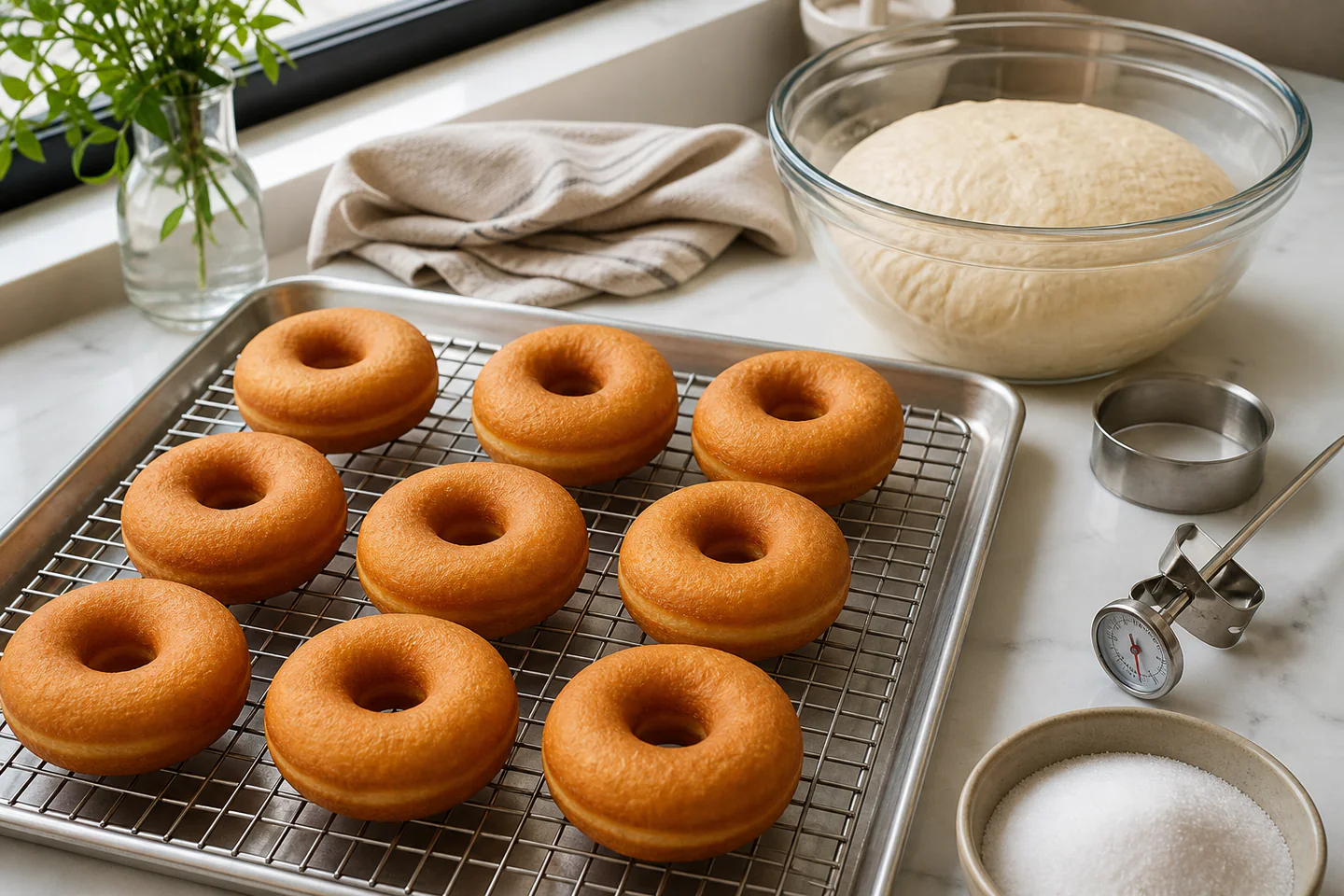
Yeasted doughnuts need light dough, full proofing and a stable frying temperature. Start with rings so the centre cooks before the outside darkens.
Quick answer
Start with rings and a thermometer
Make one soft enriched dough, proof until genuinely airy, cut simple rings and fry a few at a time in deep oil held at the recipe temperature.
- 01
Clear the hob, fit a thermometer and rack, and keep a lid nearby before heating oil. Keep the first attempt narrow enough that preparation, the main action and the result can all be reviewed together.
- 02
Keep dough thickness, proof and oil temperature steady rather than crowding the pan. Keep the first attempt narrow enough that preparation, the main action and the result can all be reviewed together.
- 03
A pale grease-heavy doughnut means different correction from a dark raw-centred one. Keep the first attempt narrow enough that preparation, the main action and the result can all be reviewed together.
- 04
Never add wet food to hot oil or leave the pan unattended. Keep the first attempt narrow enough that preparation, the main action and the result can all be reviewed together.
What to expect
Frying exposes proofing mistakes quickly
The dough must hold gas before it enters oil, while oil must recover between batches.
The first attempt
Rings cook more evenly than filled rounds. For doughnut making, note what actually happened rather than relying on memory; that turns the next attempt into a controlled change instead of another guess.
What changes
Cold oil increases grease absorption; excessive heat colours before the centre cooks. For doughnut making, note what actually happened rather than relying on memory; that turns the next attempt into a controlled change instead of another guess.
The useful signal
A light ring expands, floats and colours gradually on both sides. For doughnut making, note what actually happened rather than relying on memory; that turns the next attempt into a controlled change instead of another guess.
The common trap
Adding flour until dough is easy to handle can make it dense. For doughnut making, note what actually happened rather than relying on memory; that turns the next attempt into a controlled change instead of another guess.
Core method
Coordinate dough readiness with oil heat
Prepare deliberately
Clear the hob, fit a thermometer and rack, and keep a lid nearby before heating oil. For doughnut making, note what actually happened rather than relying on memory; that turns the next attempt into a controlled change instead of another guess.
Control the central variable
Keep dough thickness, proof and oil temperature steady rather than crowding the pan. For doughnut making, note what actually happened rather than relying on memory; that turns the next attempt into a controlled change instead of another guess.
Read the result
A pale grease-heavy doughnut means different correction from a dark raw-centred one. For doughnut making, note what actually happened rather than relying on memory; that turns the next attempt into a controlled change instead of another guess.
Reset before repeating
Record proof time, oil recovery and interior texture before changing the dough. For doughnut making, note what actually happened rather than relying on memory; that turns the next attempt into a controlled change instead of another guess.
Useful products
Products with a clear role
The shortlist covers the first workable route and one realistic improvement. Each exact Amazon UK page or ISBN was checked; confirm the current seller, specification, edition and availability.
Etekcity Digital Kitchen Scale, 0.1 g to 5 kg
Weights expose whether the recipe or technique changed.
ThermoPro TP19 Instant-Read Food Thermometer
Temperature explains many inconsistent food results.
Zulay Kitchen Three-Piece Stainless Dough Scraper Set
It reduces added flour and keeps portions consistent.
First project
Fry one batch of sugar rings
Leave fillings and elaborate glazes until the crumb is light and fully cooked.
- 01
Set up
Clear the hob, fit a thermometer and rack, and keep a lid nearby before heating oil. For doughnut making, note what actually happened rather than relying on memory; that turns the next attempt into a controlled change instead of another guess.
- 02
Begin
Make one soft enriched dough, proof until genuinely airy, cut simple rings and fry a few at a time in deep oil held at the recipe temperature. For doughnut making, note what actually happened rather than relying on memory; that turns the next attempt into a controlled change instead of another guess.
- 03
Stay with one method
Keep dough thickness, proof and oil temperature steady rather than crowding the pan. For doughnut making, note what actually happened rather than relying on memory; that turns the next attempt into a controlled change instead of another guess.
- 04
Finish and assess
A pale grease-heavy doughnut means different correction from a dark raw-centred one. For doughnut making, note what actually happened rather than relying on memory; that turns the next attempt into a controlled change instead of another guess.
- 05
Record the next change
Record proof time, oil recovery and interior texture before changing the dough. For doughnut making, note what actually happened rather than relying on memory; that turns the next attempt into a controlled change instead of another guess.
What can wait
What can wait until the method works
Buying around an unclear problem adds clutter. These upgrades make more sense after the first result exposes a repeatable limitation.
- 01
More capacity
Larger or multiple batches multiply proofing and oil temperature before the small version is stable. For doughnut making, note what actually happened rather than relying on memory; that turns the next attempt into a controlled change instead of another guess.
- 02
Premium equipment
A deep-fat fryer manages heat, but only earns space for regular batches. For doughnut making, note what actually happened rather than relying on memory; that turns the next attempt into a controlled change instead of another guess.
- 03
Extra varieties
Cake doughnuts and filled doughnuts use different methods. For doughnut making, note what actually happened rather than relying on memory; that turns the next attempt into a controlled change instead of another guess.
- 04
Public or commercial claims
Appearance does not prove the centre reached a safe cooked state. For doughnut making, note what actually happened rather than relying on memory; that turns the next attempt into a controlled change instead of another guess.
Upgrade path
Upgrade the repeated limitation
Improve temperature recovery and shaping consistency.
Try it
£15–£45Saucepan, thermometer and ring cutter
Oil behaviour becomes visible.Repeat it
£20–£70Heavy pan and spider strainer
Batch recovery and draining improve.Improve the bottleneck
£60–£180Thermostatic fryer
Temperature is easier to hold.Go deeper
VariablePiping, fillings and overnight fermentation
Texture and flavour broaden.Safety & care
Treat hot oil as the main hazard
Frying needs a clear, dry, supervised work area.
- Never leave hot oil unattended. Follow current manufacturer, food-safety, access, wildlife or local guidance wherever it applies.
- Keep water, children and pets away from the hob. Follow current manufacturer, food-safety, access, wildlife or local guidance wherever it applies.
- Do not fill a pan more than recommended. Follow current manufacturer, food-safety, access, wildlife or local guidance wherever it applies.
- Use a lid to smother fire and never use water. Follow current manufacturer, food-safety, access, wildlife or local guidance wherever it applies.
- Cool oil completely before moving or filtering it. Follow current manufacturer, food-safety, access, wildlife or local guidance wherever it applies.
Outside help
When outside help earns its place
A baking class helps with handling soft enriched dough and reading proof.
Use one complete lesson that covers preparation, the central technique, common mistakes and finishing. For a first doughnut making attempt, one coherent method is easier to diagnose than fragments collected from several creators.
Outside help earns its place when safe setup, access, identification or live correction removes a real obstacle. Ask what equipment, materials, access and follow-up support are included before booking.
Representative UK learning options checked 31 August 2026; local prices, access, materials and tutor support vary.
Sources
Where the guidance came from
The method is grounded in specialist, manufacturer and public guidance, then checked against recurring beginner problems and the exact products linked here.
-
01
Food Standards Agency · Food safety at home
UK hygiene and storage baseline.
Open source -
02
BBC Food · Techniques
Practical cooking technique reference.
Open source -
03
Serious Eats · Techniques
Comparative practical technique context.
Open source -
04
King Arthur Baking · Learn
Tested baking methods and troubleshooting.
Open source -
05
r/AskCulinary
Recurring real-world process questions.
Open source -
06
Amazon UK · Digital Kitchen Scale, 0.1 g to 5 kg
Exact Amazon UK product page or ISBN used for the recommendation; current price, seller, specification and availability should be confirmed.
Open source -
07
Amazon UK · TP19 Instant-Read Food Thermometer
Exact Amazon UK product page or ISBN used for the recommendation; current price, seller, specification and availability should be confirmed.
Open source -
08
Amazon UK · Three-Piece Stainless Dough Scraper Set
Exact Amazon UK product page or ISBN used for the recommendation; current price, seller, specification and availability should be confirmed.
Open source
Guide information and links checked 31 August 2026.