Beginner’s guide · Write & create
Prepare a problem, not a plot.
Let the players create the route.
Write one session around a strong hook, a small location, active opposition and clues that support several choices. Preparation should make improvisation easier, not decide the ending.
Quick answer
Create a pressured situation with more than one answer
Choose the game system and expected characters first. Write a hook that demands a decision, three connected locations, an opposing force with a goal, several clues that can be found in different ways and a consequence if nobody acts. Prepare names, sensory details and likely rules, then stop before scripting the players’ route or ending.
- 01
An adventure is material for play, not a short story whose scenes must occur in order.
- 02
Clues needed for progress should not depend on one successful roll or one guessed interaction.
- 03
Rules, tone and character capabilities differ by system; write for the actual table rather than generic fantasy.
- 04
Safety tools and a clear content conversation are part of preparation, especially with horror, violence or personal themes.
What to expect
Players use the material differently from its author
They may trust the villain, ignore the locked door or ask an unnamed bystander for help. Useful notes make consequences easier to improvise.
Hook
It must matter to the characters and support a choice; a forced mission can create resistance before play begins.
Locations
Each place needs a purpose, sensory identity and something that can change, not a paragraph of decorative lore.
Opposition
Give factions goals and methods so they can respond when the players choose an unexpected approach.
Clues
Repeat essential information through people, objects and events rather than hiding the session behind one roll.
Rules
Prepare only likely stat blocks, hazards and reference pages and make provisional rulings openly when needed.
Timing
Table discussion, combat and jokes consume more time than prose suggests. Include optional scenes that can be cut.
Core method
Prepare an active situation and usable table notes
Define the table contract
Record system, character level or competence, session length, player count and agreed tone. Ask about lines, veils and accessibility needs and choose a safety tool the group understands. Write a two-sentence premise that can be accepted, declined or reframed without tricking the players.
Build nodes rather than a corridor
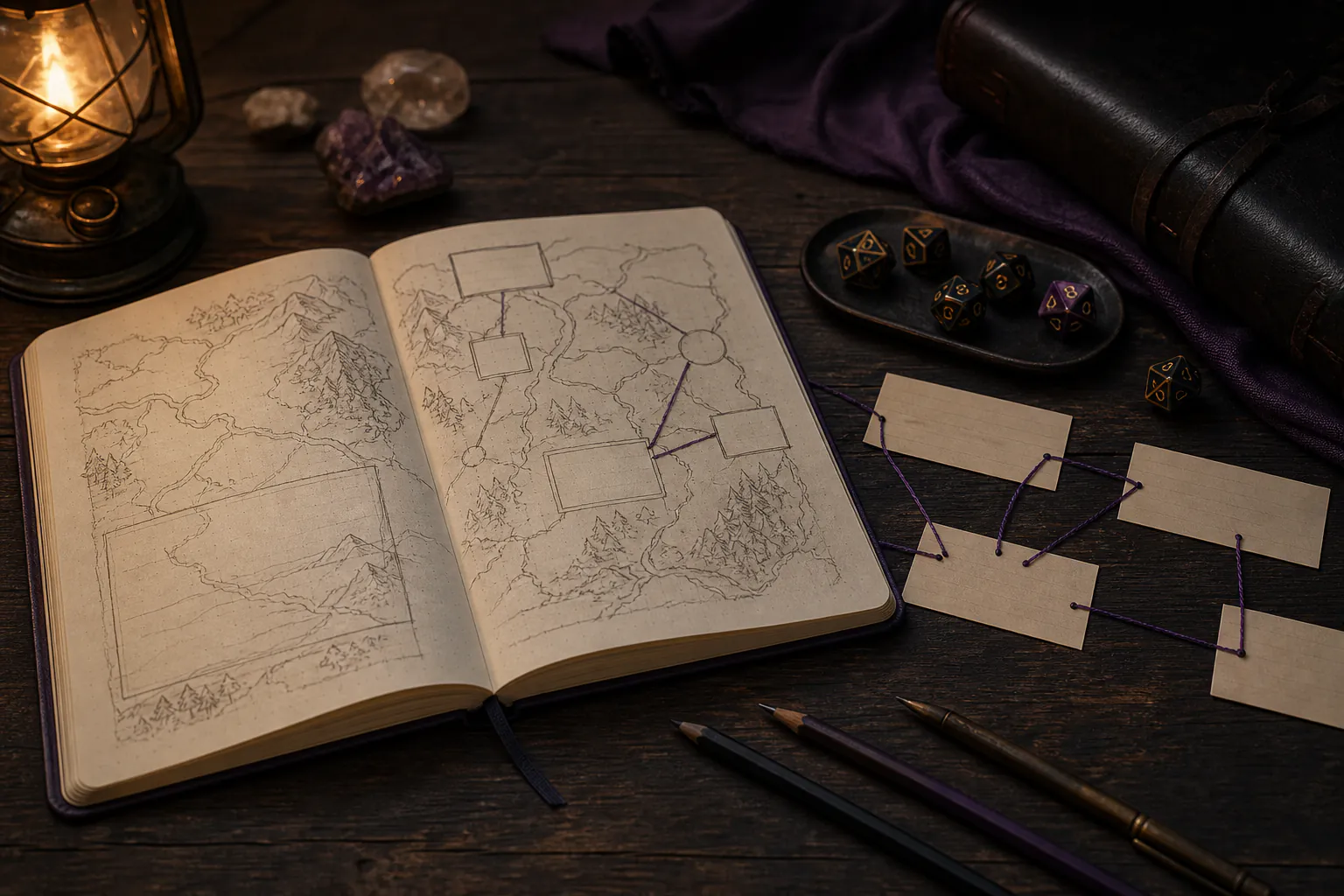
Create three locations or scenes connected by more than one route. Give each a clear entrance question, sensory cue, person or force and piece of useful information. The players can move between them in different orders, while the opposition advances a visible plan.
Place redundant clues and choices
For each conclusion needed to act, prepare at least three discoverable clues across different methods: conversation, physical evidence and consequence. Do not require a particular skill roll to continue. A roll can change cost, speed or clarity while the core situation remains playable.
Write for scanning under pressure
Use one-page summaries, bold names, bullet-point goals and short stat references. Keep a list of flexible names and details. During play, note player decisions and changes rather than protecting unused preparation. Afterward, record which material generated choices and which explanation was missing.
Useful products
One light rules framework and two practical note systems
Index Card RPG is a compact game and adventure-design framework, not mandatory for people already using another ruleset. The mixed-grid journal supports maps and notes; the campaign journal is a more structured alternative. Choose the note style that will be scanned easily at the table.
Runehammer Games Index Card RPG Core, Second Edition
It can supply both system and practical GM structure for a beginner without an existing game.
TTRPG Accessories RPG Journal with Ruled, Graph and Hex Pages
Its mixed pages support a small scenario without forcing a complex digital campaign tool.
The Dungeon Journal Campaign Journal for Game Masters
It can prevent forgotten names and consequences as a one-shot grows into a short arc.
First project
Write a three-location missing-person scenario
A familiar premise keeps attention on playable structure. Give the missing person their own goal and the opposition a clock.
- 01
Set the contract
Name system, characters, duration, tone and any excluded content.
- 02
Write the urgent hook
Offer a reason to act and one clear initial lead without removing refusal.
- 03
Create three locations
Give each a purpose, sensory cue, obstacle, person and change.
- 04
Build active opposition
State what it wants, what it does next and what signs reveal progress.
- 05
Distribute clues
Place important conclusions in at least three discoverable forms.
- 06
Run and revise
Cut optional material for time, record choices and rewrite notes for scanning.
What can wait
What can wait until the first result
Write the smallest complete session before designing a campaign world.
- 01
A predetermined ending
Prepare consequences and motives; let play determine who succeeds and at what cost.
- 02
Twenty pages of lore
Put only actionable facts in the session and save optional background separately.
- 03
Every possible rule
Bookmark likely mechanics and agree how provisional rulings will work.
- 04
Custom software
Paper or a plain document is enough to learn useful note shape.
- 05
A campaign commitment
A one-shot shows table fit and gives everyone a natural stopping point.
Upgrade path
Upgrade the repeated limitation
Increase continuity and variety only after a one-session structure survives play.
Three-node one-shot
FreeOwned rules + five pages or less
Learn hook, clues and consequences.Reusable toolkit
About £8–£25Names, maps, encounter templates and reference book
Improvise without inventing every format.Short arc
Mostly timeThree linked situations + decision log
Make consequences persist across sessions.Original setting or system material
VariablePlaytests, editing and rights review
Publish only after repeated table evidence.Safety & care
Design for consent, access and shared authorship
The game belongs to everyone at the table. Surprise should occur inside agreed boundaries, not through hidden personal risk.
- Discuss tone, content boundaries and safety tools before play and make stopping or revising available without argument.
- Do not use a player’s trauma, identity or private disclosure as adventure material without explicit informed permission.
- Provide accessible handouts, breaks, captions or remote tools according to participant needs.
- Respect the licences and trademarks of the chosen game and verify publication rights before distributing material.
- Separate character conflict from player hostility and pause when disagreement or distress leaves the fictional space.
Outside help
When outside help earns its place
Playing and running one short session gives better evidence than another theory course. A workshop helps when it includes live facilitation and feedback.
Use practical situation, clue and session-prep articles beside the first draft.
Choose one covering safety, pacing and actual play rather than only lore creation.
Representative UK prices and free learning routes checked 3 August 2026; local availability, materials and tutor support vary.
Sources
Where the guidance came from
Experienced game-master resources support situation-first preparation, node design and redundant clues; system rules remain the authority for mechanics.
-
01
Sly Flourish · Lazy GM resource document
Practical preparation steps designed for flexibility at the table.
Open source -
02
Sly Flourish · Prepping a dungeon
Usable location, encounter and session-note preparation.
Open source -
03
The Alexandrian · Node-based scenario design
Flexible scenario structure beyond a forced scene sequence.
Open source -
04
The Alexandrian · The Three Clue Rule
Redundant clue design to prevent brittle progress.
Open source -
05
Amazon UK · Index Card RPG Core second edition
Exact product page, model or ISBN, observed price and availability checked for this guide.
Open source -
06
Amazon UK · Mixed ruled graph and hex RPG journal
Exact product page, model or ISBN, observed price and availability checked for this guide.
Open source -
07
Amazon UK · Game Master campaign journal
Exact product page, model or ISBN, observed price and availability checked for this guide.
Open source
Guide information and links checked 3 August 2026.