Beginner’s guide · Write & create
Bind the useful scraps,
give them a second story.
Junk journalling combines reused papers, pockets, notes and small found materials. Start with one slim hand-bound signature rather than buying a roomful of ephemera.
Quick answer
Build the book from papers you already have
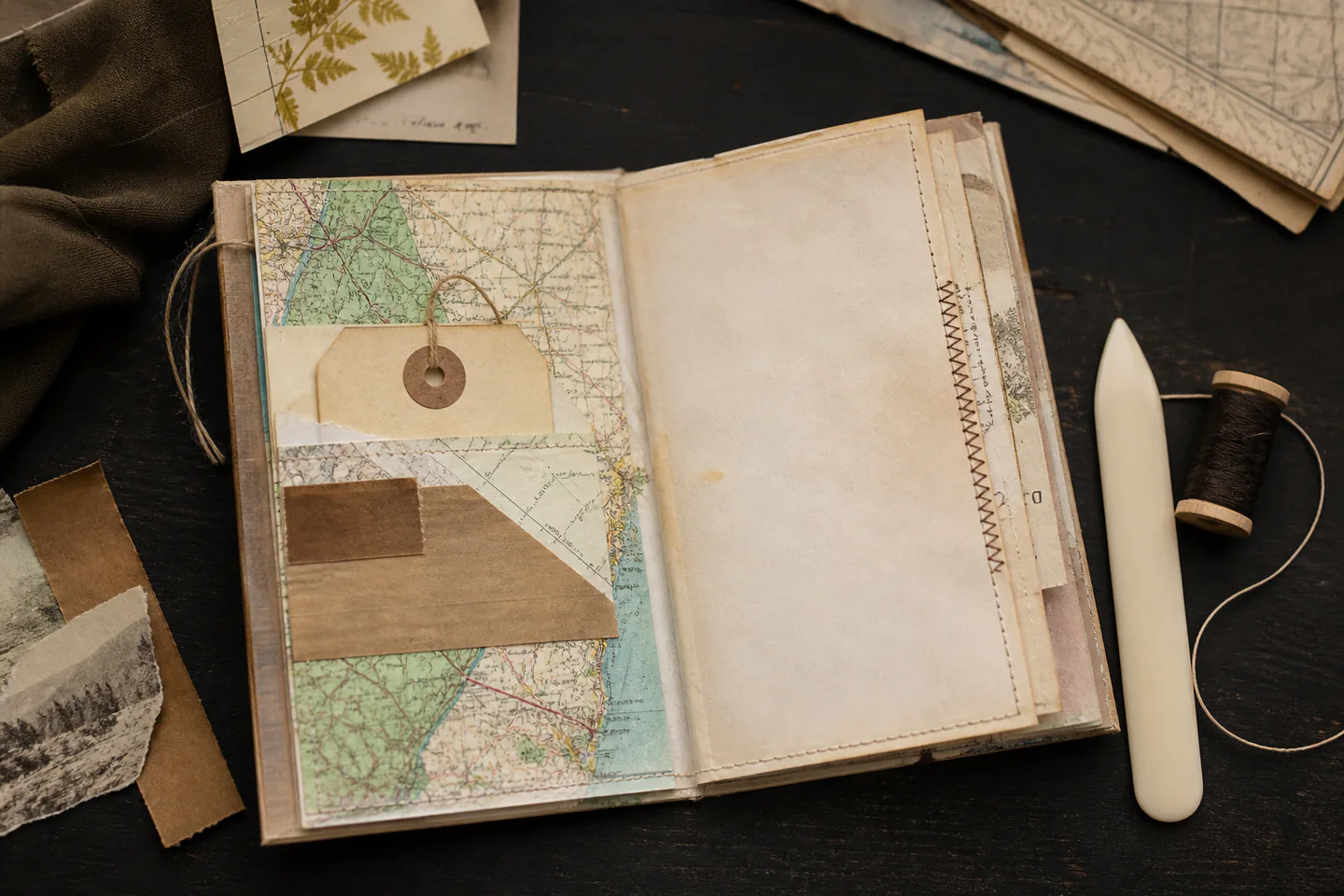
Gather a small, clean group of envelopes, packaging, maps, plain writing paper and permitted printed scraps around one loose theme. Trim them to a shared folded size, nest eight to twelve sheets into one signature and punch a simple three-hole pamphlet stitch. Add one flat pocket and a few restrained collage elements, keeping the spine fold and page edges clear so the finished journal opens normally.
- 01
Choose clean reused papers and one slim signature for the first result and resist substituting several unfamiliar materials at once. Record what you used on the first attempt so the result can be repeated or changed for a reason.
- 02
Make page bulk and a sound pamphlet stitch visible with a small test before committing the full project. Record what you used on the first attempt so the result can be repeated or changed for a reason.
- 03
Change one variable between attempts and keep the preparation otherwise consistent. Record what you used on the first attempt so the result can be repeated or changed for a reason.
- 04
Inspect the work at each reversible stage instead of waiting until flat pockets and restrained decoration. Record what you used on the first attempt so the result can be repeated or changed for a reason.
- 05
Finish one modest result and note the actual time, material use and recurring difficulty. Record what you used on the first attempt so the result can be repeated or changed for a reason.
What to expect
The journal must work as a book before it works as a collage
Large supply hauls are easy; making an object whose pages turn, spine closes and contents remain lawful and stable is the real craft.
Paper
Mixing weights adds character, but brittle, greasy, mouldy or heavily coated scraps do not belong in the book. In junk journalling, this is worth checking deliberately rather than trying to correct it after the next stage.
Bulk
Every folded pocket doubles thickness near one point. Distribute layers and test the closed fore-edge. In junk journalling, this is worth checking deliberately rather than trying to correct it after the next stage.
Rights
Found does not mean free to reproduce or sell. Use personal materials, public-domain imagery or licensed ephemera. In junk journalling, this is worth checking deliberately rather than trying to correct it after the next stage.
Adhesive
Too much wet glue buckles thin pages. Apply a thin even layer to stable surfaces. In junk journalling, this is worth checking deliberately rather than trying to correct it after the next stage.
Storage
Unsorted scraps expand indefinitely. Keep a project palette and recycle what has no clear use. In junk journalling, this is worth checking deliberately rather than trying to correct it after the next stage.
Core method
Make a usable signature before decorating it
Curate a small palette
Choose clean compatible papers, remove private information and keep enough plain area for writing. In junk journalling, this is worth checking deliberately rather than trying to correct it after the next stage.
Fold and order pages
Set one finished size, alternate weights and check that pockets will not collide. In junk journalling, this is worth checking deliberately rather than trying to correct it after the next stage.
Sew one signature
Punch three aligned holes with an awl into a cradle or support and complete a controlled pamphlet stitch. In junk journalling, this is worth checking deliberately rather than trying to correct it after the next stage.
Add flat interaction
Glue one pocket at its edges, insert a removable tag and close the journal under light weight. In junk journalling, this is worth checking deliberately rather than trying to correct it after the next stage.
Useful products
Products with a clear job in the setup
The ephemera pack supplies a bounded visual palette. Lineco PVA is a later controlled adhesive, while the bookbinding kit contains reusable folding, punching and sewing tools. Reused paper remains the main material.
Generic Time Traveller Vintage Scrapbook Ephemera Pack
A fixed selection is easier to use coherently than a large random assortment.
Lineco Neutral pH Adhesive 8 oz
A controlled brush application bonds paper without tape ridges.
Jodsen Traditional Bookbinding Tool Kit
The tools address book function rather than encouraging more decorative stock.
First project
Bind an eight-sheet pocket journal
One signature is enough to test page order, stitch tension, adhesive restraint and whether the chosen scraps are pleasant to use.
- 01
Choose a folded size
Use the smallest paper as the practical limit and make a card template. In junk journalling, this is worth checking deliberately rather than trying to correct it after the next stage.
- 02
Select eight to twelve sheets
Mix plain and found paper without concentrating every thick sheet together. In junk journalling, this is worth checking deliberately rather than trying to correct it after the next stage.
- 03
Fold and nest
Crease individually, arrange the sequence and trim only with safe supported tools. In junk journalling, this is worth checking deliberately rather than trying to correct it after the next stage.
- 04
Punch and sew
Use three aligned stations and a pamphlet stitch whose knot sits around the centre thread. In junk journalling, this is worth checking deliberately rather than trying to correct it after the next stage.
- 05
Add one pocket
Glue only two or three edges and keep it away from the spine fold. In junk journalling, this is worth checking deliberately rather than trying to correct it after the next stage.
- 06
Press and use
Close under boards, let adhesive dry and write on several pages before adding more layers. In junk journalling, this is worth checking deliberately rather than trying to correct it after the next stage.
What can wait
What can wait until the first result
The first journal should prove the binding and page experience, not justify a large shopping haul.
- 01
Large ephemera bundles
They create sorting work and weaken a coherent first palette. In junk journalling, this is worth checking deliberately rather than trying to correct it after the next stage.
- 02
Multiple signatures
A thicker spine needs a different cover and sewing plan. In junk journalling, this is worth checking deliberately rather than trying to correct it after the next stage.
- 03
Bulky charms
They obstruct writing, strain the attachment and prevent the book closing. In junk journalling, this is worth checking deliberately rather than trying to correct it after the next stage.
- 04
Old unknown documents
Private, culturally sensitive, contaminated or valuable material needs assessment, not automatic cutting. In junk journalling, this is worth checking deliberately rather than trying to correct it after the next stage.
- 05
Digital image resale
Copyright and licensing must be checked before reproducing designs commercially. In junk journalling, this is worth checking deliberately rather than trying to correct it after the next stage.
Upgrade path
Upgrade the repeated limitation
Add structure or materials when a completed journal reveals a clear limitation.
One signature
About £5–£20Saved papers, needle and thread
Learn page order and sewing.Pocket journal
About £15–£40Book tools and controlled adhesive
Add useful interaction.Multi-signature book
About £30–£90Board cover and planned spine
Manage bulk and opening.Original journal series
About £80–£300+Repeatable templates and licensed imagery
Build consistent books.Safety & care
Treat old materials and sharp tools carefully
Reusing paper is valuable only when the material is clean, lawfully available and safe to handle.
- Reject mouldy, pest-damaged, greasy or strongly odorous papers instead of sealing them into a book. Follow the current instructions supplied with the exact material, tool or living specimen.
- Remove addresses, account details, barcodes and personal information from reused mail. Follow the current instructions supplied with the exact material, tool or living specimen.
- Push an awl into a proper cradle or sacrificial support with the other hand clear. Follow the current instructions supplied with the exact material, tool or living specimen.
- Use knives on a cutting mat with a metal ruler and controlled passes. Follow the current instructions supplied with the exact material, tool or living specimen.
- Follow adhesive ventilation and skin-contact instructions and dry pages before closing the journal. Follow the current instructions supplied with the exact material, tool or living specimen.
Outside help
When outside help earns its place
A complete beginner tutorial is enough for the first controlled attempt. A class becomes useful when multi-signature binding or lawful image reproduction becomes the obstacle.
Follow one method using clean reused papers and one slim signature, including preparation and finishing rather than only the photogenic middle stage.
Check whether materials, troubleshooting, flat pockets and restrained decoration and a finished take-home result are included.
Representative UK learning options checked 28 August 2026; local prices, access, materials and tutor support vary.
Sources
Where the guidance came from
The method is grounded in specialist and public guidance, then checked against recurring beginner questions and the exact products linked here.
-
01
British Library · book arts
Book and binding material context.
Open source -
02
Library of Congress · care of paper
Paper handling and storage guidance.
Open source -
03
Tate · art terms collage
Museum context for assembled paper artwork.
Open source -
04
JetPens · paper and pen guides
Specialist notebook, paper and writing-tool comparisons.
Open source -
05
Reddit · r/Journaling
Community evidence on useful formats, materials and sustainable routines.
Open source -
06
Amazon UK · Time Traveller Vintage Scrapbook Ephemera Pack
Exact product catalogue page or ISBN used for the recommendation; current price, seller, specification and availability should be confirmed.
Open source -
07
Amazon UK · Neutral pH Adhesive 8 oz
Exact product catalogue page or ISBN used for the recommendation; current price, seller, specification and availability should be confirmed.
Open source -
08
Amazon UK · Traditional Bookbinding Tool Kit
Exact product catalogue page or ISBN used for the recommendation; current price, seller, specification and availability should be confirmed.
Open source
Guide information and links checked 28 August 2026.