Beginner’s guide · Reflect & explore
Walk a familiar loop slowly.
Notice without turning it into a test.
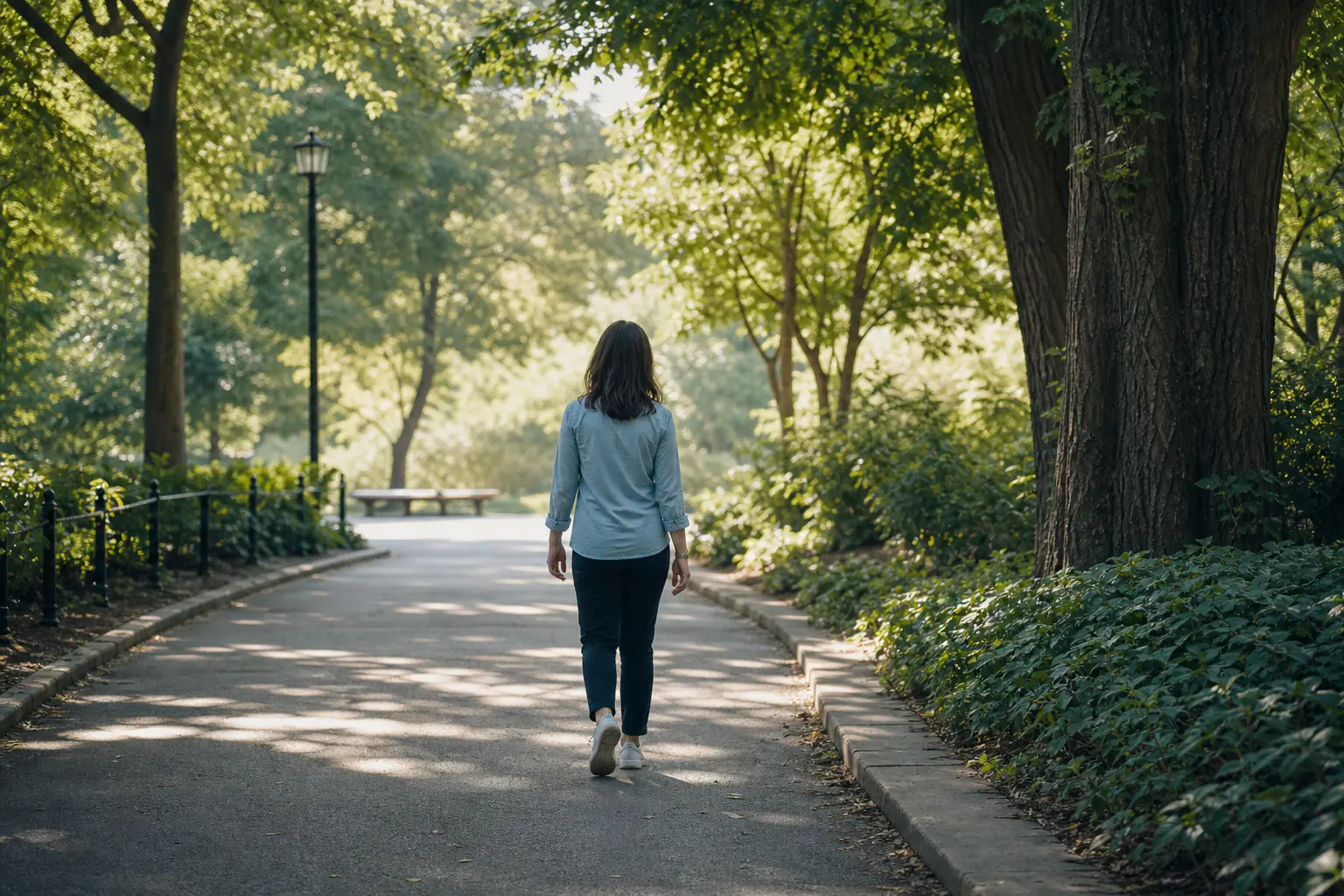
Choose a safe ten-minute route you already know, put the phone away and move attention between feet, sound, light and breath. Mindful walking is an attention practice inside an ordinary walk—not a promise to empty the mind or cure a health condition.
Quick answer
Keep the route easy enough to notice it
Pick a familiar daylight loop with a pavement or straightforward path, check the weather and tell someone if the route warrants it. Walk at a natural safe pace. For one minute notice contact under each foot, then sounds, then colours and light, then breathing. When thought carries attention away, acknowledge it and return to the next step without stopping awareness of traffic, surfaces or other people.
- 01
Safety awareness remains primary. Mindfulness should widen attention, not encourage closed eyes, headphones or absorption near hazards.
- 02
Slow is optional. Use the pace, mobility aid, route and duration that are stable and comfortable for your body.
- 03
The practice does not require a beautiful landscape. A street, garden path or indoor corridor can provide changing sensation.
- 04
Calm may happen, but the task is noticing present experience. Restlessness, noise and an ordinary mood do not make the walk fail.
What to expect
Attention moves; the route keeps moving too
A walking practice combines an active environment with an active mind. The skill is returning without losing practical judgement.
Feet
Pressure, roll and balance provide a portable anchor, but pain is information to adapt or stop—not something to observe through.
Sound
Notice near and far sounds without needing to name all of them. Keep enough orientation to hear vehicles, cyclists and warnings.
Sight
Use a soft forward gaze and notice colour, shadow and movement while continuing to scan the path.
Thought
Planning and memory will appear. A brief “thinking” label can prevent a walk from becoming an argument with the mind.
Weather
Cold, heat, wind and rain change physical risk. Shorten, relocate or cancel rather than using discomfort as proof of discipline.
Routine
Repeating one route reveals seasonal and daily change. Novelty is not required for attention.
How to practise
Alternate a narrow anchor with wide awareness
Prepare an ordinary safe route
For the first practice, choose a path already known, with clear footing and an easy way home. Check daylight and weather, wear suitable footwear and carry necessary medication or mobility support. Put the phone on silent but keep it accessible for navigation or emergency use. Mindful walking does not justify entering private land, ignoring closures or choosing an isolated route beyond current skill.
Begin by orienting
Stand or sit at the start and look around. Notice the route, other users, traffic and the body’s present condition. Begin at a comfortable pace. Feel three or four complete steps: heel or contact point, transfer of weight and lift. There is no need to synchronise breathing or make the gait unnaturally slow.
Move through the senses
Spend roughly a minute with foot contact, a minute with sound, a minute with colour and light and a minute with breathing or whole-body movement. Then allow a wider awareness that includes several senses and the path ahead. When attention becomes lost in thought, return to the next physical step without criticism.
Close before the route ends
In the last minute, notice the whole body moving through the environment and name one concrete change since the start: temperature, tension, sound or pace. Finish the route normally and record one factual sentence if helpful. Do not score calmness, step count or productivity; choose one practical adjustment for the next walk.
Useful products
Two different walking guides and one optional pause seat
Walking in the Woods focuses on forest-bathing research and sensory attention; 52 Ways to Walk offers varied prompts that also work in ordinary places. The Therm-a-Rest Z Seat is a compact insulated pad for someone who already wants a dry pause outdoors. None is required for a ten-minute neighbourhood loop.
Yoshifumi Miyazaki Walking in the Woods
The short guide gives concrete sensory invitations and context for a named practice.
Annabel Streets 52 Ways to Walk
The collection can refresh attention without requiring a new hobby system or expensive kit.
Therm-a-Rest Z Seat Insulated Sitting Pad
The folding foam creates a small insulated place for an already planned stationary part of a walk.
First walk
Complete a ten-minute four-anchor loop
Use the same familiar route on the first two attempts so navigation does not consume the attention you are trying to practise.
- 01
Check the route
Confirm surface, daylight, weather, accessibility and an uncomplicated return point.
- 02
Orient at the start
Notice hazards, other users and how the body feels before beginning.
- 03
Feel the feet
Spend one minute with contact, weight transfer and lift while keeping eyes safely forward.
- 04
Open to sound
Notice near and distant sound without headphones or losing awareness of warnings.
- 05
Notice light and colour
Use a soft gaze to observe changes while still scanning the path surface.
- 06
Include breathing
Feel breath within walking without forcing rhythm or depth.
- 07
Return from thought
Acknowledge distraction briefly and reconnect with the next safe step.
- 08
Close factually
At the end, record one observed change and one route or comfort adjustment.
What can wait
What can wait until the short walk is useful
The practice should remain easy to begin. Equipment and remote routes can create more planning than attention.
- 01
A destination walk
A spectacular location adds travel, navigation and expectations. Learn the practice on a route that requires little management.
- 02
The checked sit mat
Useful for a dry insulated pause when that is already part of the route; irrelevant when walking continuously near home.
- 03
Silent headphones
Audio guidance can obscure environmental cues. Learn the four anchors without blocking traffic, people or wildlife sounds.
- 04
Long sessions
Extending duration also extends weather and fatigue exposure. Ten attentive minutes can remain the whole practice.
- 05
A wellness subscription
A timer or memorised sequence is enough. Pay only when a particular teacher or accessible programme adds value.
Upgrade path
Add terrain or duration only with matching skills
A practice can deepen through repetition without becoming a hike. If the route expands, walking safety expands with it.
Familiar ten-minute loop
FreeSuitable clothing + four attention anchors
Learn returning while staying oriented.Repeated seasonal route
FreeSame route at safe varied times
Notice change without seeking novelty.Local park pause
Free to about £25Longer route + optional insulated seat
Include a stable seated listening or viewing period.Countryside walk
VariableRoute plan, navigation, weather kit and skills
Practise attention in a richer environment with materially greater safety demands.Safety & access
Attention never outranks route safety
Adapt the practice to health, mobility, place and current conditions. It is not treatment and it is not an invitation to ignore warning signs.
- Keep eyes open and awareness available around traffic, water, drops, animals, other path users and uneven surfaces.
- Check weather, route, daylight and accessibility; carry an offline map and share plans for unfamiliar or remote walks.
- Follow rights of way, signs and the Countryside Code, leave gates and wildlife as directed and take litter home.
- Stop or seek appropriate help for pain, dizziness, breathlessness, panic, dissociation or other concerning symptoms.
- Use a seated, indoor, mobility-aid or companion version when that is safer; there is no spiritually superior walking pace or terrain.
Outside help
When a group or teacher adds value
A class is optional. It may help with route confidence, accessible adaptations or supported practice after difficult experiences.
Combine a safe ordinary loop with a short attention sequence before booking anything.
Check distance, terrain, pace, toilets, weather policy, leader competence and accessibility.
Free resources and representative UK guided-walk pricing checked 2 August 2026; access, equipment and provider training vary.
Sources
Where the guidance came from
NHS mindfulness material supports attention practice; Ramblers and government guidance establish route planning, pedestrian and countryside boundaries.
-
01
NHS · Mindfulness
Accessible mindfulness principles, limits and routes to further support.
Open source -
02
Ramblers · Practical tips for walking alone safely
Route planning, offline maps, sharing plans and choosing familiar paths.
Open source -
03
GOV.UK · Countryside Code for visitors
Rights of way, signs, respect, environmental protection and visitor responsibilities.
Open source -
04
GOV.UK · Highway Code rules for pedestrians
Pedestrian safety around roads, crossings, poor light and shared routes.
Open source -
05
Amazon UK · Yoshifumi Miyazaki Walking in the Woods
Exact product page, model or ISBN, observed price and availability checked for this guide.
Open source -
06
Amazon UK · Annabel Streets 52 Ways to Walk
Exact product page, model or ISBN, observed price and availability checked for this guide.
Open source -
07
Amazon UK · Therm-a-Rest Z Seat sitting pad
Exact product page, model or ISBN, observed price and availability checked for this guide.
Open source
Guide information and links checked 2 August 2026.