Beginner’s guide · Make & create
Follow one outside curve,
then thread an inside cut.
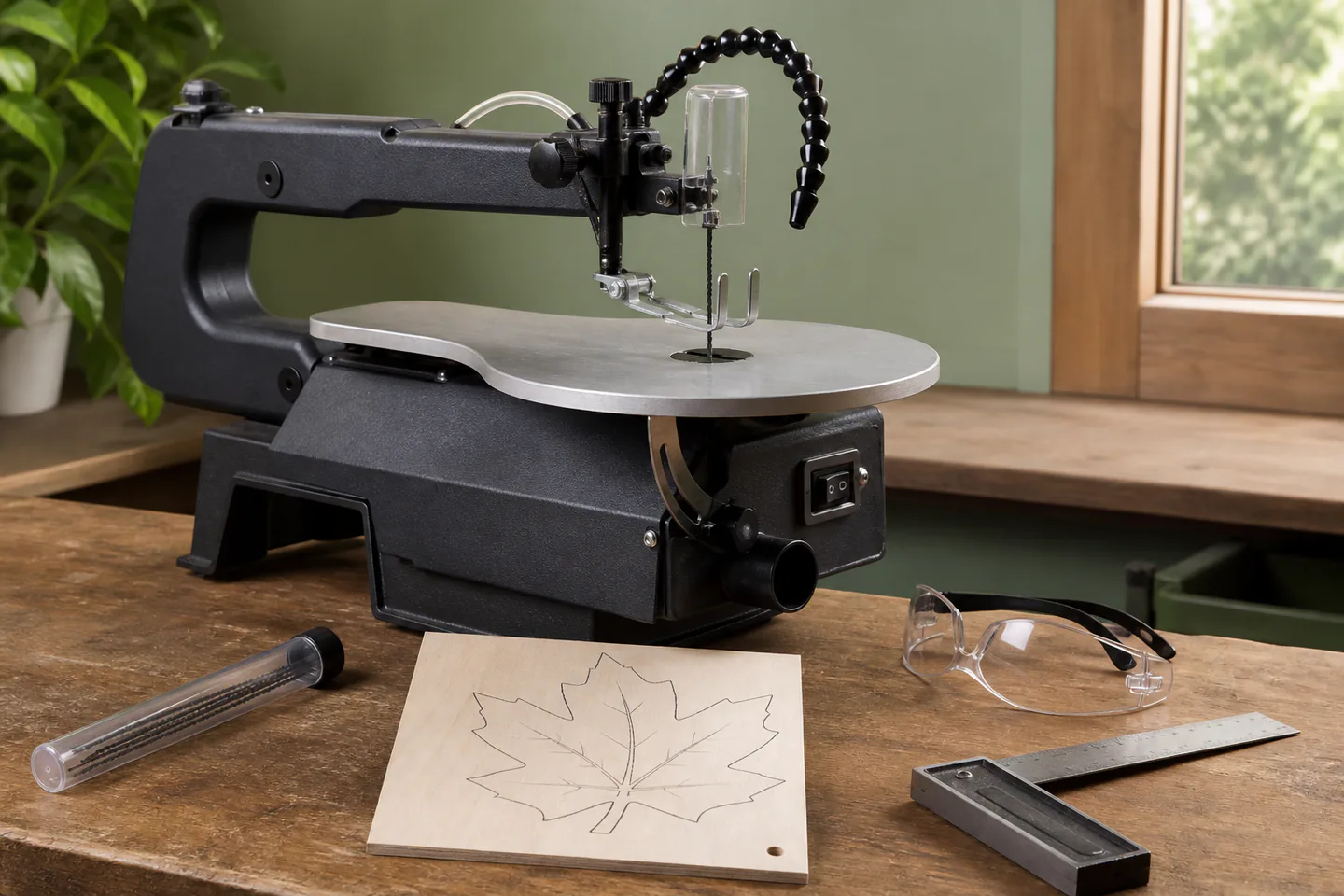
A correctly tensioned fine blade, square table and simple plywood pattern are enough for a first scroll-saw piece. Keep hands clear and let the blade cut without side pressure.
Quick answer
Calibrate the saw on scrap before the pattern
Bolt or clamp the saw to a stable bench, fit the correct blade with teeth facing forward and down where the blade type requires, set tension and table square, connect dust control, then practise straight lines and broad curves in thin plywood before threading one inside cut.
- 01
A loose blade wanders and flexes; excessive tension can break blades or stress clamps. Keep the first attempt narrow enough that preparation, the main action and the result can all be reviewed together.
- 02
Feed pressure should be light and forward, never a sideways attempt to steer the blade. Keep the first attempt narrow enough that preparation, the main action and the result can all be reviewed together.
- 03
Blade choice depends on material thickness, radius, finish and whether pinless changes are practical. Keep the first attempt narrow enough that preparation, the main action and the result can all be reviewed together.
- 04
Inside cuts start through a drilled entry hole with the machine isolated for blade threading. Keep the first attempt narrow enough that preparation, the main action and the result can all be reviewed together.
What to expect
The blade cuts only in one narrow direction
Trying to rotate the work too late pushes the blade sideways, bows the cut and often snaps it.
Tension
The blade must be secure and consistent before accuracy can be judged. For scroll-saw woodworking, note what actually happened rather than relying on memory; that turns the next attempt into a controlled change instead of another guess.
Table
A tilted table creates edges that are not square even when the pattern line is followed. For scroll-saw woodworking, note what actually happened rather than relying on memory; that turns the next attempt into a controlled change instead of another guess.
Speed
Thin brittle material and tight curves may need different feed and stroke rates. For scroll-saw woodworking, note what actually happened rather than relying on memory; that turns the next attempt into a controlled change instead of another guess.
Dust
The blower clears the line but does not capture fine airborne dust. For scroll-saw woodworking, note what actually happened rather than relying on memory; that turns the next attempt into a controlled change instead of another guess.
Core method
Set the machine before steering the work
Read and isolate
Use the actual saw manual for blade changes, guarding and bench fixing. For scroll-saw woodworking, note what actually happened rather than relying on memory; that turns the next attempt into a controlled change instead of another guess.
Square and test
Check the table against the blade and cut scrap to verify the kerf. For scroll-saw woodworking, note what actually happened rather than relying on memory; that turns the next attempt into a controlled change instead of another guess.
Follow broad practice lines
Keep both hands to the sides, look ahead of the teeth and rotate smoothly. For scroll-saw woodworking, note what actually happened rather than relying on memory; that turns the next attempt into a controlled change instead of another guess.
Thread an inside opening
Drill in waste, isolate power, install and tension the blade, then cut the waste before re-isolating. For scroll-saw woodworking, note what actually happened rather than relying on memory; that turns the next attempt into a controlled change instead of another guess.
Useful products
Products with a clear job in the setup
The Sealey saw is a current UK machine example, the 3M glasses cover baseline eye protection and John Nelson’s workbook supplies progressive practice patterns.
Sealey SM1302 Variable Speed Scroll Saw
Variable speed and inside-cut access suit skill-building patterns.
3M SecureFit 200 Safety Glasses
They are easy to keep at the bench and wear for every cut or chemical setup.
John A. Nelson Scroll Saw Workbook, 3rd Edition
It moves from calibration cuts to controlled projects.
First project
Cut a leaf with one internal vein
The silhouette teaches curve planning and the vein teaches blade entry and re-tensioning.
- 01
Prepare the pattern
Use thin sound plywood and place the entry hole in waste. For scroll-saw woodworking, note what actually happened rather than relying on memory; that turns the next attempt into a controlled change instead of another guess.
- 02
Run calibration cuts
Verify square, tension and feed on offcut material. For scroll-saw woodworking, note what actually happened rather than relying on memory; that turns the next attempt into a controlled change instead of another guess.
- 03
Cut the outside
Follow broad curves and leave the narrow stem until late. For scroll-saw woodworking, note what actually happened rather than relying on memory; that turns the next attempt into a controlled change instead of another guess.
- 04
Thread the inside
Isolate power before releasing or refitting the blade. For scroll-saw woodworking, note what actually happened rather than relying on memory; that turns the next attempt into a controlled change instead of another guess.
- 05
Sand and inspect
Control dust and check the edge for bevel, burn and wandering. For scroll-saw woodworking, note what actually happened rather than relying on memory; that turns the next attempt into a controlled change instead of another guess.
What can wait
What can wait until the first result
Extra equipment becomes useful only when the basic method has exposed a specific, repeated limitation.
- 01
Stack cutting
Multiple blanks hide blade deflection and multiply consequences. For scroll-saw woodworking, note what actually happened rather than relying on memory; that turns the next attempt into a controlled change instead of another guess.
- 02
Spiral blades
They cut in all directions but change steering and surface quality. For scroll-saw woodworking, note what actually happened rather than relying on memory; that turns the next attempt into a controlled change instead of another guess.
- 03
Very fine fretwork
Tiny bridges break while basic blade control is still developing. For scroll-saw woodworking, note what actually happened rather than relying on memory; that turns the next attempt into a controlled change instead of another guess.
- 04
Thick hardwood
It increases heat, wander and blade stress. For scroll-saw woodworking, note what actually happened rather than relying on memory; that turns the next attempt into a controlled change instead of another guess.
Upgrade path
Upgrade the repeated limitation
Improve blade change, vibration and extraction before decorative complexity.
Scrap calibration
£10–£30Blades, plywood and PPE
Learn tension and turning.Entry scroll saw
£100–£180Stable machine and extraction connection
Complete simple patterns.Better blade system
£150–£400Tool-free pinless changes and lower vibration
Make inside cuts efficiently.Fine fretwork setup
£400+Precision saw, lighting and dust control
Sustain delicate repeated work.Safety & care
A small blade is still a moving machine tool
Broken blades, exposed teeth, dust and workpiece kick remain credible hazards.
- Follow the exact saw manual, guarding and isolation procedure. Follow current manufacturer, food-safety, access, wildlife or local guidance wherever it applies.
- Wear suitable eye protection and keep hands a safe distance from the blade. Follow current manufacturer, food-safety, access, wildlife or local guidance wherever it applies.
- Tie back hair, remove loose clothing and jewellery and never wear gloves near the moving blade. Follow current manufacturer, food-safety, access, wildlife or local guidance wherever it applies.
- Connect effective dust extraction and use additional respiratory protection where the assessment requires it. Follow current manufacturer, food-safety, access, wildlife or local guidance wherever it applies.
- Stop when tired, when the blade dulls or when extra force is needed to keep cutting. Follow current manufacturer, food-safety, access, wildlife or local guidance wherever it applies.
Outside help
When outside help earns its place
A machine induction is useful for blade changes, tension and inside cuts; progressive scrap practice remains essential afterwards.
Verify every control and blade change before the pattern.
Look for guarding, extraction, blade fitting and supervised inside cuts.
Representative UK learning options checked 31 August 2026; local prices, access, materials and tutor support vary.
Sources
Where the guidance came from
Machine manuals and specialist scroll-saw instruction support calibration, light feed, inside-cut isolation and dust control.
-
01
Scroll Saw Woodworking & Crafts · Scroll saw basics
Blade tension, entry holes and safety tips.
Open source -
02
Scroll Saw Woodworking & Crafts · Basics PDF
Square-table tests, blade entry and beginner technique.
Open source -
03
Sealey · SM1302 manual
Machine-specific safe-use and setup guidance.
Open source -
04
HSE · Woodworking
UK machinery and dust safety context.
Open source -
05
Reddit · r/Scrollsaw
Recurring beginner discussion of saws, blades and patterns.
Open source -
06
Amazon UK · SM1302 Variable Speed Scroll Saw
Exact Amazon UK product page or ISBN used for the recommendation; current price, seller, specification and availability should be confirmed.
Open source -
07
Amazon UK · SecureFit 200 Safety Glasses
Exact Amazon UK product page or ISBN used for the recommendation; current price, seller, specification and availability should be confirmed.
Open source -
08
Amazon UK · Scroll Saw Workbook, 3rd Edition
Exact Amazon UK product page or ISBN used for the recommendation; current price, seller, specification and availability should be confirmed.
Open source
Guide information and links checked 31 August 2026.