Beginner’s guide · Make & create
Observe one leaf closely,
then draw what is actually there.
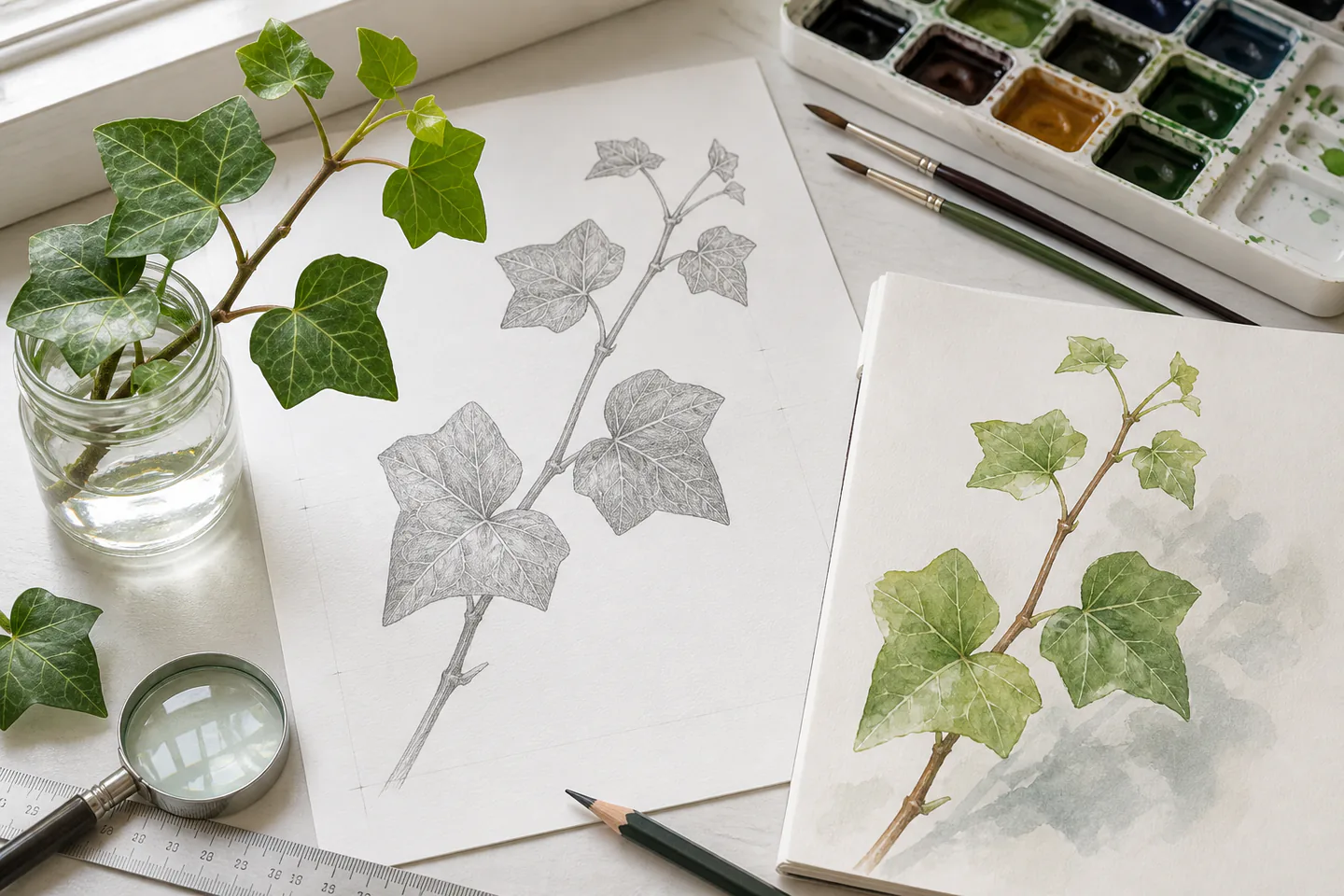
Begin with a fresh common plant, measured pencil study and tonal drawing before adding watercolour. Botanical accuracy comes from structure, not decorative greenness.
Quick answer
Draw one leaf from life at actual size
Choose a common legally obtained garden leaf, record its front, back, edge and attachment, measure length and width, draw the main axis and vein pattern in graphite at life size, then add a small colour chart before one transparent watercolour layer.
- 01
Botanical illustration explains diagnostic structure as well as appearance. Keep the first attempt narrow enough that preparation, the main action and the result can all be reviewed together.
- 02
A plant study should be identified or labelled honestly when identity is uncertain. Keep the first attempt narrow enough that preparation, the main action and the result can all be reviewed together.
- 03
Measurements and multiple views correct the generic leaf symbol stored in memory. Keep the first attempt narrow enough that preparation, the main action and the result can all be reviewed together.
- 04
Colour is built from observed hue, value and surface, not one tube labelled green. Keep the first attempt narrow enough that preparation, the main action and the result can all be reviewed together.
What to expect
Accuracy begins before the first contour
Leaves twist, veins branch asymmetrically and colour changes across surface, age and light.
Specimen
A cut plant changes as it wilts, so photographs and notes preserve early shape and colour. For botanical illustration, note what actually happened rather than relying on memory; that turns the next attempt into a controlled change instead of another guess.
Measurement
Proportion errors accumulate when each feature is guessed independently. For botanical illustration, note what actually happened rather than relying on memory; that turns the next attempt into a controlled change instead of another guess.
Graphite
A clear tonal drawing can communicate form before paint introduces another variable. For botanical illustration, note what actually happened rather than relying on memory; that turns the next attempt into a controlled change instead of another guess.
Watercolour
Transparent layers need drying time and a planned reserved highlight. For botanical illustration, note what actually happened rather than relying on memory; that turns the next attempt into a controlled change instead of another guess.
Core method
Observe, measure, construct and annotate
Document the specimen
Record source, date, identity confidence, dimensions and photographs from several views. For botanical illustration, note what actually happened rather than relying on memory; that turns the next attempt into a controlled change instead of another guess.
Build the drawing
Place the main axis, widest point and attachment before drawing the edge. For botanical illustration, note what actually happened rather than relying on memory; that turns the next attempt into a controlled change instead of another guess.
Map structure and tone
Add primary and secondary veins, overlap and a simple light direction. For botanical illustration, note what actually happened rather than relying on memory; that turns the next attempt into a controlled change instead of another guess.
Mix and layer colour
Make labelled swatches, use a pale first wash and add detail only after drying. For botanical illustration, note what actually happened rather than relying on memory; that turns the next attempt into a controlled change instead of another guess.
Useful products
Products with a clear job in the setup
The sketchbook supports measured pencil and ink studies; the Cotman palette and Foundation brushes form a modest colour route after the drawing works.
Stillman & Birn Zeta Hardcover Sketchbook
Smooth paper supports pencil, ink and measured observation.
Winsor & Newton Cotman Sketchers Pocket Set, 12 Half Pans
A small known palette teaches mixing without a distracting number of pigments.
Winsor & Newton Foundation Water Colour Short Handle Brushes, Six Pack
The set supports a first leaf study without buying sable brushes.
First project
Make a one-page ivy or pelargonium study
Show front, back, edge and attachment with a small measurement and colour strip.
- 01
Record provenance
Use a common garden specimen with permission. For botanical illustration, note what actually happened rather than relying on memory; that turns the next attempt into a controlled change instead of another guess.
- 02
Measure and place
Mark axis, overall box and attachment point. For botanical illustration, note what actually happened rather than relying on memory; that turns the next attempt into a controlled change instead of another guess.
- 03
Draw three views
Include face, reverse and side or folded view. For botanical illustration, note what actually happened rather than relying on memory; that turns the next attempt into a controlled change instead of another guess.
- 04
Add vein hierarchy
Separate primary structure from surface texture. For botanical illustration, note what actually happened rather than relying on memory; that turns the next attempt into a controlled change instead of another guess.
- 05
Paint one controlled wash
Use swatches and preserve the paper for highlights. For botanical illustration, note what actually happened rather than relying on memory; that turns the next attempt into a controlled change instead of another guess.
What can wait
What can wait until the first result
Extra equipment becomes useful only when the basic method has exposed a specific, repeated limitation.
- 01
A bouquet composition
Many species wilt and overlap before basic observation is stable. For botanical illustration, note what actually happened rather than relying on memory; that turns the next attempt into a controlled change instead of another guess.
- 02
Rare wild specimens
Picking may be illegal or damaging. For botanical illustration, note what actually happened rather than relying on memory; that turns the next attempt into a controlled change instead of another guess.
- 03
A huge paint set
A limited palette teaches botanical colour mixing. For botanical illustration, note what actually happened rather than relying on memory; that turns the next attempt into a controlled change instead of another guess.
- 04
Microscopic sections
Scientific dissection and microscopy need additional knowledge and tools. For botanical illustration, note what actually happened rather than relying on memory; that turns the next attempt into a controlled change instead of another guess.
Upgrade path
Upgrade the repeated limitation
Improve reference quality and observation before pigment quantity.
Graphite leaf
£10–£30Pencils, paper and ruler
Learn measured structure.Watercolour study
£25–£70Small palette and brushes
Add transparent colour.Whole plant plate
£40–£120Larger paper, magnifier and specimen support
Show habit and diagnostic details.Formal course
£500+Botany, critique and portfolio work
Build scientific and artistic discipline.Safety & care
Collect plants legally and handle materials sensibly
A beautiful specimen is not permission to pick it, and some plants or pigments can irritate or poison.
- Use garden or abundant material with landowner permission and do not pick protected or rare wild plants. Follow current manufacturer, food-safety, access, wildlife or local guidance wherever it applies.
- Identify toxic, irritant or allergenic plants before handling and wash hands afterwards. Follow current manufacturer, food-safety, access, wildlife or local guidance wherever it applies.
- Keep paint water and brushes separate from food and never point brushes with the mouth. Follow current manufacturer, food-safety, access, wildlife or local guidance wherever it applies.
- Use sharp blades for dissection only with appropriate training and a controlled cutting surface. Follow current manufacturer, food-safety, access, wildlife or local guidance wherever it applies.
- Do not publish precise locations for sensitive plants without recorder or land-manager guidance. Follow current manufacturer, food-safety, access, wildlife or local guidance wherever it applies.
Outside help
When outside help earns its place
A botanic-garden course earns its place by combining drawing feedback with plant structure and identification.
Repeat the same species at different ages and angles.
Look for drawing fundamentals, botany, colour mixing and individual critique.
Representative UK learning options checked 31 August 2026; local prices, access, materials and tutor support vary.
Sources
Where the guidance came from
Botanic-garden curricula join drawing fundamentals with plant structure, while field-botany guidance sets responsible specimen limits.
-
01
Royal Botanic Garden Edinburgh · Certificate in Botanical Illustration
Course scope spanning drawing, colour, technique and botany.
Open source -
02
RBGE · Botanical illustration handbook
Drawing and botanical-study curriculum.
Open source -
03
Kew · Botanical illustration materials list
Realistic starter materials from a botanic-garden course.
Open source -
04
BSBI · Code of conduct
Responsible botanical fieldwork and recording.
Open source -
05
Reddit · r/BotanicalIllustration
Recurring learner discussion of drawing, paint and resources.
Open source -
06
Amazon UK · Zeta Hardcover Sketchbook
Exact Amazon UK product page or ISBN used for the recommendation; current price, seller, specification and availability should be confirmed.
Open source -
07
Amazon UK · Cotman Sketchers Pocket Set, 12 Half Pans
Exact Amazon UK product page or ISBN used for the recommendation; current price, seller, specification and availability should be confirmed.
Open source -
08
Amazon UK · Foundation Water Colour Short Handle Brushes, Six Pack
Exact Amazon UK product page or ISBN used for the recommendation; current price, seller, specification and availability should be confirmed.
Open source
Guide information and links checked 31 August 2026.