Beginner’s guide · Grow & care
Cycle water without fish
before stocking the system.
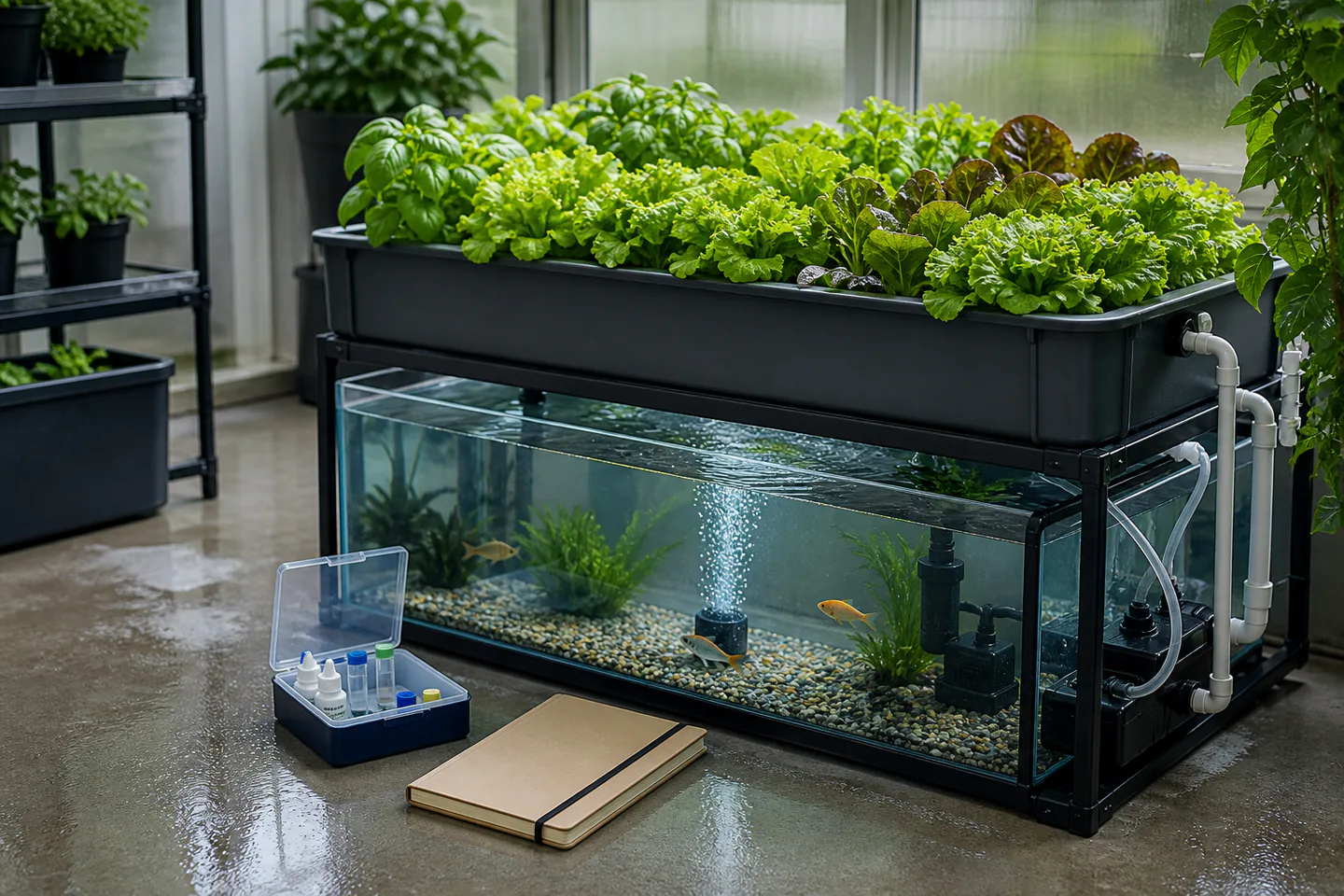
A small aquaponics system links fish welfare, biological filtration and plant uptake, so cycling, water testing and conservative stocking come first.
Quick answer
Stabilise one small living system first
Build or buy a modest supported system, leak-test it, establish mechanical and biological filtration and complete a documented fishless cycle. Add only suitable plants first and stock fish conservatively after stable ammonia and nitrite readings.
- 01
Calculate water volume, load-bearing, splash control, pump head, aeration, filtration, access and emergency power response before filling the system. Keep the first attempt narrow enough that preparation, the main action and the result can all be reviewed together.
- 02
Test temperature, pH, ammonia, nitrite and nitrate on a consistent schedule while changing feed, stocking or plant load slowly. Keep the first attempt narrow enough that preparation, the main action and the result can all be reviewed together.
- 03
Fish behaviour, dissolved oxygen, flow, root condition and repeated water tests matter more than rapid plant growth alone. Keep the first attempt narrow enough that preparation, the main action and the result can all be reviewed together.
- 04
Record readings and interventions, remove settled waste without destroying biofilter media and keep a prepared response for power or pump failure. Keep the first attempt narrow enough that preparation, the main action and the result can all be reviewed together.
What to expect
Water quality and routine matter more than a busy installation
A small observed system exposes imbalances sooner and is easier to correct than an ambitious first build.
The first attempt
A fishless cycled system with leafy plants is a meaningful first milestone and prevents livestock from carrying the startup experiment. For aquaponics, note what actually happened rather than relying on memory; that turns the next attempt into a controlled change instead of another guess.
The control point
Test temperature, pH, ammonia, nitrite and nitrate on a consistent schedule while changing feed, stocking or plant load slowly. For aquaponics, note what actually happened rather than relying on memory; that turns the next attempt into a controlled change instead of another guess.
The useful signal
Fish behaviour, dissolved oxygen, flow, root condition and repeated water tests matter more than rapid plant growth alone. For aquaponics, note what actually happened rather than relying on memory; that turns the next attempt into a controlled change instead of another guess.
The common trap
Overstocking, overfeeding and chasing pH with unrecorded additives destabilise both fish and plants. For aquaponics, note what actually happened rather than relying on memory; that turns the next attempt into a controlled change instead of another guess.
Core method
Cycle, measure, adjust slowly and keep records
Prepare deliberately
Calculate water volume, load-bearing, splash control, pump head, aeration, filtration, access and emergency power response before filling the system. For aquaponics, note what actually happened rather than relying on memory; that turns the next attempt into a controlled change instead of another guess.
Control the central variable
Test temperature, pH, ammonia, nitrite and nitrate on a consistent schedule while changing feed, stocking or plant load slowly. For aquaponics, note what actually happened rather than relying on memory; that turns the next attempt into a controlled change instead of another guess.
Read the result
Fish behaviour, dissolved oxygen, flow, root condition and repeated water tests matter more than rapid plant growth alone. For aquaponics, note what actually happened rather than relying on memory; that turns the next attempt into a controlled change instead of another guess.
Reset before repeating
Record readings and interventions, remove settled waste without destroying biofilter media and keep a prepared response for power or pump failure. For aquaponics, note what actually happened rather than relying on memory; that turns the next attempt into a controlled change instead of another guess.
Useful products
Products with a clear job in the setup
A liquid freshwater test kit measures the central nitrogen-cycle compounds, a complete hydroponic unit is a plant-only comparison rather than an aquaponics system, and a pH meter needs calibration discipline.
API Freshwater Master Test Kit
Repeated liquid tests make startup and stocking decisions visible.
Apera Instruments PH20 Waterproof Pocket pH Tester Kit
A maintained meter reduces guesswork when plant and fish ranges overlap narrowly.
iDOO ID-IG301 12-Pod Hydroponics Growing System
It can teach flow and plant routines before animal welfare is added.
First project
Cycle and document a small system before stocking
Stable water and a tested emergency plan are the first harvest.
- 01
Set up
Calculate water volume, load-bearing, splash control, pump head, aeration, filtration, access and emergency power response before filling the system. For aquaponics, note what actually happened rather than relying on memory; that turns the next attempt into a controlled change instead of another guess.
- 02
Begin the first attempt
A fishless cycled system with leafy plants is a meaningful first milestone and prevents livestock from carrying the startup experiment. For aquaponics, note what actually happened rather than relying on memory; that turns the next attempt into a controlled change instead of another guess.
- 03
Hold one variable steady
Test temperature, pH, ammonia, nitrite and nitrate on a consistent schedule while changing feed, stocking or plant load slowly. For aquaponics, note what actually happened rather than relying on memory; that turns the next attempt into a controlled change instead of another guess.
- 04
Inspect the result
Fish behaviour, dissolved oxygen, flow, root condition and repeated water tests matter more than rapid plant growth alone. For aquaponics, note what actually happened rather than relying on memory; that turns the next attempt into a controlled change instead of another guess.
- 05
Reset and record
Record readings and interventions, remove settled waste without destroying biofilter media and keep a prepared response for power or pump failure. For aquaponics, note what actually happened rather than relying on memory; that turns the next attempt into a controlled change instead of another guess.
What can wait
What can wait until the first result
Delay extra capacity and livestock until the small system remains stable.
- 01
A large first setup
Scale multiplies Overstocking, overfeeding and chasing pH with unrecorded additives destabilise both fish and plants. before the basic routine is known. For aquaponics, note what actually happened rather than relying on memory; that turns the next attempt into a controlled change instead of another guess.
- 02
Premium specialist equipment
It should solve a limitation you can describe after several aquaponics sessions. For aquaponics, note what actually happened rather than relying on memory; that turns the next attempt into a controlled change instead of another guess.
- 03
Several methods at once
Changing materials and technique together makes the cause of a result hard to see. For aquaponics, note what actually happened rather than relying on memory; that turns the next attempt into a controlled change instead of another guess.
- 04
Buying for a future version
Finish and review the small route before equipping an imagined advanced practice. For aquaponics, note what actually happened rather than relying on memory; that turns the next attempt into a controlled change instead of another guess.
Upgrade path
Upgrade the repeated limitation
Increase capacity only after maintenance is predictable.
Try it
About £250–£700 before fishFishless cycle in a supported system
Complete one meaningful result and learn the whole sequence.Repeat it
About £250–£700 before fishTest kit, aeration and maintenance log
Reduce setup friction and compare several attempts.Improve the bottleneck
£400–£1,200+Conservative fish stocking and backup air
Address Overstocking, overfeeding and chasing pH with unrecorded additives destabilise both fish and plants. with a targeted change.Go deeper
VariableLarger balanced system with quarantine plan
Add scale, precision or public participation with evidence from practice.Safety & care
Fish welfare makes every equipment failure urgent
Pumps, oxygen and water quality can fail faster than visible plants show distress.
- Complete a fishless cycle and seek current fish-welfare guidance before stocking. Follow current manufacturer, food-safety, access, wildlife or local guidance wherever it applies.
- Use RCD-protected power, drip loops and equipment rated for wet environments. Follow current manufacturer, food-safety, access, wildlife or local guidance wherever it applies.
- Provide aeration and a tested response for pump or power failure. Follow current manufacturer, food-safety, access, wildlife or local guidance wherever it applies.
- Quarantine livestock where appropriate and never release fish, plants or water into the wild. Follow current manufacturer, food-safety, access, wildlife or local guidance wherever it applies.
- Keep chemicals, fertilisers and treatments out unless confirmed safe for the exact fish-and-plant system. Follow current manufacturer, food-safety, access, wildlife or local guidance wherever it applies.
Outside help
When outside help earns its place
An established aquaponics course or experienced fishkeeper earns its place before livestock is added, especially for cycling, oxygen and disease response.
Use one complete lesson that covers preparation, the central technique, common mistakes and finishing. For a first aquaponics attempt, one coherent method is easier to diagnose than fragments collected from several creators.
Outside help earns its place when safe setup, access, identification or live correction removes a real obstacle. Ask what equipment, materials, access and follow-up support are included before booking.
Representative UK learning options checked 31 August 2026; local prices, access, materials and tutor support vary.
Sources
Where the guidance came from
The method is grounded in specialist, manufacturer and public guidance, then checked against recurring beginner problems and the exact products linked here.
-
01
FAO · Small-scale aquaponic food production
Comprehensive system, cycling, water and stocking guidance.
Open source -
02
RSPCA · Fish care
Fish welfare and aquarium-care principles.
Open source -
03
RHS · Hydroponics
UK soilless growing context.
Open source -
04
GOV.UK · Keeping fish
UK fish-health and movement context.
Open source -
05
Reddit · r/aquaponics
Community evidence on cycling, pumps, stocking and plant balance.
Open source -
06
Amazon UK · Freshwater Master Test Kit
Exact Amazon UK product page or ISBN used for the recommendation; current price, seller, specification and availability should be confirmed.
Open source -
07
Amazon UK · PH20 Waterproof Pocket pH Tester Kit
Exact Amazon UK product page or ISBN used for the recommendation; current price, seller, specification and availability should be confirmed.
Open source -
08
Amazon UK · ID-IG301 12-Pod Hydroponics Growing System
Exact Amazon UK product page or ISBN used for the recommendation; current price, seller, specification and availability should be confirmed.
Open source
Guide information and links checked 31 August 2026.