Beginner’s guide · Cook & bake
Soften the peel first,
then chase the set.
Citrus peel, pectin, acid and sugar need a sequence: extract and soften, dissolve, boil rapidly, test the set and hot-fill clean jars.
Quick answer
Complete one small batch before expanding the setup
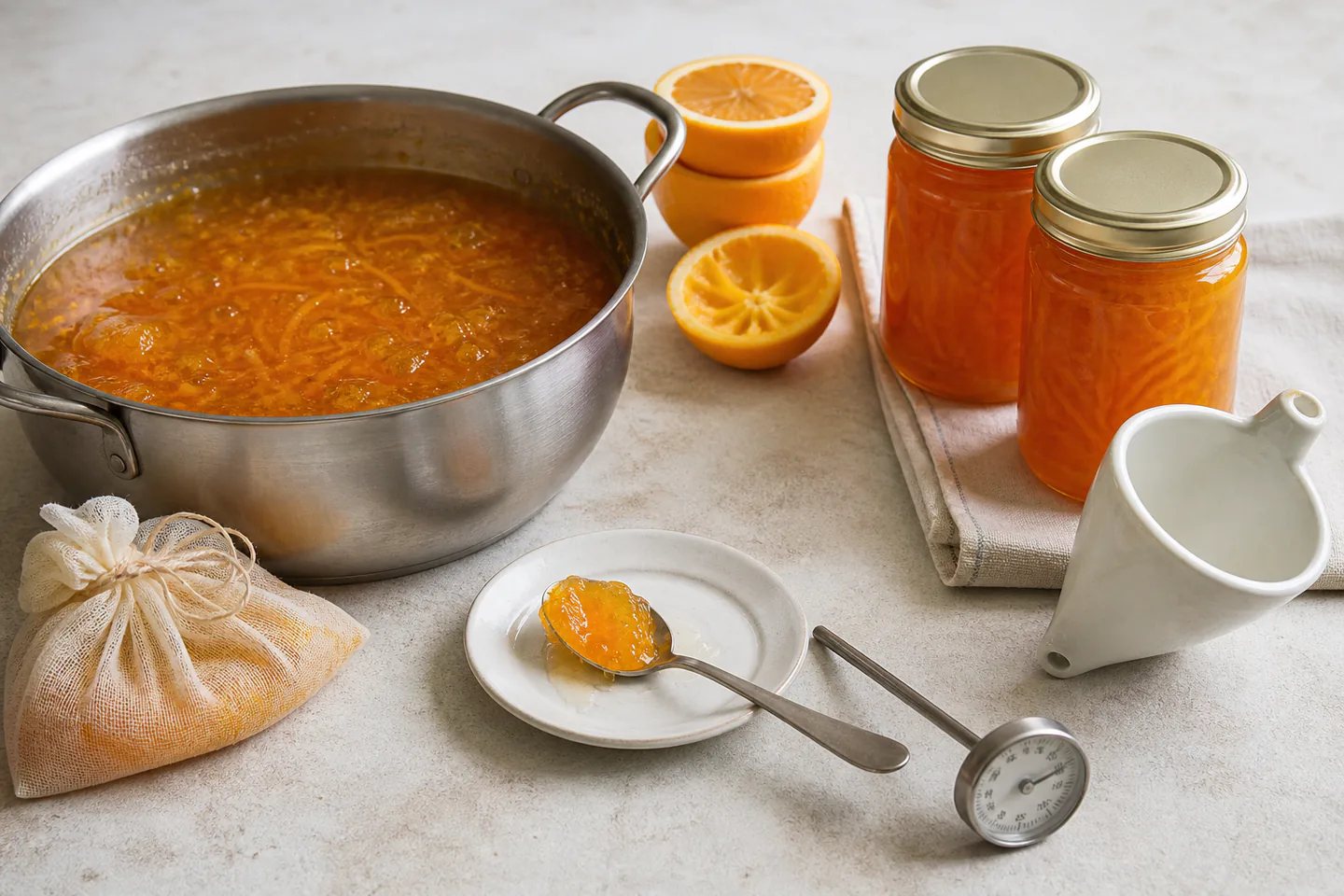
Use a tested whole-citrus recipe. Slice peel consistently, simmer it with the prescribed water and pips or pith until completely tender, then add the measured sugar and stir until dissolved. Boil rapidly, test early with temperature plus a cold-saucer wrinkle or flake test, rest briefly to distribute peel and hot-fill clean prepared jars as directed.
- 01
Sugar added before peel is tender can firm it and prevent a pleasant final texture. Record what happened during marmalade making so the next attempt changes one known variable instead of several guesses.
- 02
Pectin, acid, sugar concentration and temperature interact; one number does not guarantee a set. Record what happened during marmalade making so the next attempt changes one known variable instead of several guesses.
- 03
A wide pan needs headroom because marmalade rises strongly at a rolling boil. Record what happened during marmalade making so the next attempt changes one known variable instead of several guesses.
- 04
Over-boiling darkens flavour and can produce a rubbery set that cannot be fixed by more heat. Record what happened during marmalade making so the next attempt changes one known variable instead of several guesses.
What to expect
What marmalade making is really like at the start
The useful beginner controls are preparation, one bounded task and a record of the result; specialist equipment matters only when it solves a repeated limitation.
Citrus
Fruit variety, ripeness and pith change natural pectin and bitterness. Record what happened during marmalade making so the next attempt changes one known variable instead of several guesses.
Peel
Uniform thickness helps strips soften together. Record what happened during marmalade making so the next attempt changes one known variable instead of several guesses.
Set
The mixture may pass from loose to over-set quickly near the endpoint. Record what happened during marmalade making so the next attempt changes one known variable instead of several guesses.
Jar
Peel can float if the marmalade is filled immediately without the recipe’s brief rest. Record what happened during marmalade making so the next attempt changes one known variable instead of several guesses.
Core method
The core marmalade making method
Prepare fruit and pectin
Capture pips and pith as the recipe directs and keep peel thickness consistent. Record what happened during marmalade making so the next attempt changes one known variable instead of several guesses.
Cook until tender
Simmer before sugar until a strip crushes easily and no tough bite remains. Record what happened during marmalade making so the next attempt changes one known variable instead of several guesses.
Dissolve then boil
Warm the sugar if directed, dissolve every crystal and only then bring the pan to a full boil. Record what happened during marmalade making so the next attempt changes one known variable instead of several guesses.
Test and fill
Use more than one set cue, stop early enough to avoid overcooking and follow the hot-fill method. Record what happened during marmalade making so the next attempt changes one known variable instead of several guesses.
Useful products
Products with a clear job in the route
The scale controls fruit, water and sugar, the jam thermometer tracks concentration and the clear jar makes peel distribution and seal condition visible.
Salter 1036 Digital Kitchen Scale
It makes a first batch easier to repeat and diagnose.
Tala Jam and Confectionery Thermometer
It supplements wrinkle and flake tests with a repeatable temperature reading.
Kilner One-Litre Clip-Top Glass Jar
The clear body makes cleanliness, headspace and condition easy to inspect.
First project
Make one small Seville-style orange batch
Use a tested recipe and one peel thickness so tenderness and set can be reviewed independently.
- 01
Prepare the peel
Slice evenly and retain pips or pith in the recipe’s muslin bag. Record what happened during marmalade making so the next attempt changes one known variable instead of several guesses.
- 02
Simmer to tenderness
Do not proceed until the peel can be crushed easily. Record what happened during marmalade making so the next attempt changes one known variable instead of several guesses.
- 03
Add and dissolve sugar
Keep the heat controlled until no crystals remain. Record what happened during marmalade making so the next attempt changes one known variable instead of several guesses.
- 04
Boil and test early
Use temperature, flake and cold-saucer cues before the marmalade becomes dark. Record what happened during marmalade making so the next attempt changes one known variable instead of several guesses.
- 05
Rest, fill and label
Allow the stated settling time, hot-fill and record fruit, recipe, batch and date. Record what happened during marmalade making so the next attempt changes one known variable instead of several guesses.
What can wait
What can wait until the first result
Delay anything that adds cost, risk or another variable before the basic workflow has produced something you can review.
- 01
Low-sugar improvisation
It changes both set and preservation and needs a purpose-designed recipe. Record what happened during marmalade making so the next attempt changes one known variable instead of several guesses.
- 02
Doubling the batch
A domestic pan may not evaporate or boil safely at the same rate. Record what happened during marmalade making so the next attempt changes one known variable instead of several guesses.
- 03
Repeated reboiling
It can harden peel and degrade flavour while chasing an uncertain set. Record what happened during marmalade making so the next attempt changes one known variable instead of several guesses.
- 04
Selling the first batch
Composition, labelling, registration and shelf-life duties need separate attention. Record what happened during marmalade making so the next attempt changes one known variable instead of several guesses.
Upgrade path
Add the capability you can now name
Each stage should remove a demonstrated constraint rather than make the setup look more advanced.
Use what you own
£0–£20Existing equipment and one written plan
Use a tested recipe, cold saucers and prepared jars.Repeat the first route
About £15–£45 plus citrus and sugarA complete repeatable starter setup
Repeat the same fruit and batch size until peel and set are predictable.Add one capability
Often £50–£250One selected tool, service or learning resource
Add a wide pan, funnel or refractometer only for a defined repeatability problem.Build specialist depth
Club, course or specialist dependentA documented specialist workflow
Develop reduced-sugar or mixed-citrus recipes with validated food-safety and compositional guidance.Safety & care
Treat hot sugar and shelf stability seriously
Marmalade is acidic and high in sugar, but safe storage still depends on a tested recipe, clean containers and sound seals.
- Use a current tested recipe and do not casually reduce sugar, acid, water or cooking.
- Leave generous pan headroom and protect skin from rising foam and sticky splashes.
- Use clean disinfected undamaged jars and recipe-compatible lids on a dry stable surface.
- Label the batch and follow the recipe’s unopened and opened storage instructions.
- Discard a jar with mould, leakage, bulging, gas, an uncertain seal or an unexpected smell without tasting.
Outside help
When outside help earns its place
A preserving session helps when side-by-side peel and set tests can be felt and seen at the correct moment.
Choose teaching that covers validated recipes, clean hot filling and storage, not only flavour combinations.
Use outside help after the first marmalade making attempt can reveal the exact technique, access or safety problem that needs live correction.
Representative UK learning and access routes checked 1 September 2026; local prices, permissions, equipment and tutor support vary.
Sources
Where the guidance came from
Authoritative and specialist guidance supports the method and safety boundaries; community discussion contributes recurring beginner problems rather than unsupported claims.
-
01
Dover District Council · Jams and marmalades
UK local-authority hygiene, jar, temperature and storage guidance for preserves.
Open source -
02
GOV.UK · Jams and marmalades composition
Reserved descriptions, fruit and sugar composition and labelling context.
Open source -
03
BBC Good Food · Seville orange marmalade
Tested UK recipe sequence for peel, pectin, sugar and set.
Open source -
04
BBC Good Food · Sterilise jars
Practical preparation of jars for hot preserves.
Open source -
05
Preserves by Pam Corbin · River Cottage
Specialist small-batch citrus preparation and setting cues.
Open source -
06
Reddit · r/Canning
Community evidence on set, seals, storage and unsafe recipe changes.
Open source -
07
Amazon UK · 1036 Digital Kitchen Scale
Exact Amazon UK product page or ISBN used for this recommendation; current price, seller, specification and availability should be confirmed.
Open source -
08
Amazon UK · Jam and Confectionery Thermometer
Exact Amazon UK product page or ISBN used for this recommendation; current price, seller, specification and availability should be confirmed.
Open source -
09
Amazon UK · One-Litre Clip-Top Glass Jar
Exact Amazon UK product page or ISBN used for this recommendation; current price, seller, specification and availability should be confirmed.
Open source
Guide information and links checked 1 September 2026.