Beginner’s guide · Research & collect
Start with one known person,
then prove every link.
A family tree is an evidence map, not a collection of copied hints. Begin with living memory, civil certificates and census records, and attach each claim to a source.
Quick answer
Complete one sourced branch before expanding the setup
Choose one deceased grandparent or great-grandparent with a known place and date range. Interview relatives for leads, record the uncertainty, then verify one relationship at a time with civil registration indexes, certificates, census returns and parish or archive records. Save a citation and image reference before adding each fact to the tree.
- 01
A name match is not identity; place, age, occupation, relatives and original context must agree. Record what happened during genealogy & family history so the next attempt changes one known variable instead of several guesses.
- 02
Online public trees are clues unless their attached records independently support the relationship. Record what happened during genealogy & family history so the next attempt changes one known variable instead of several guesses.
- 03
Record negative searches and alternate spellings so the same dead end is not repeated. Record what happened during genealogy & family history so the next attempt changes one known variable instead of several guesses.
- 04
Living people’s dates, addresses, family circumstances and DNA information require strong privacy controls. Record what happened during genealogy & family history so the next attempt changes one known variable instead of several guesses.
What to expect
What genealogy & family history is really like at the start
The useful beginner controls are preparation, one bounded task and a record of the result; specialist equipment matters only when it solves a repeated limitation.
Names
Spelling, nicknames, transcription and changing surnames produce plausible false matches. Record what happened during genealogy & family history so the next attempt changes one known variable instead of several guesses.
Dates
Ages and birthplaces can vary between records, especially when supplied from memory. Record what happened during genealogy & family history so the next attempt changes one known variable instead of several guesses.
Records
An index points to a record but rarely contains all the evidence in the original image or certificate. Record what happened during genealogy & family history so the next attempt changes one known variable instead of several guesses.
Tree
A small sourced tree is more useful than hundreds of copied names with no proof. Record what happened during genealogy & family history so the next attempt changes one known variable instead of several guesses.
Core method
The core genealogy & family history method
Work backwards
Begin with what is documented now and move one generation at a time rather than searching for a famous surname. Record what happened during genealogy & family history so the next attempt changes one known variable instead of several guesses.
Form an identity case
Compare name, time, place, occupation, household and informant before deciding two records describe one person. Record what happened during genealogy & family history so the next attempt changes one known variable instead of several guesses.
Cite as you go
Store repository, collection, reference, image, access date and the claim each record supports. Record what happened during genealogy & family history so the next attempt changes one known variable instead of several guesses.
Preserve and review
Keep originals safe, make working copies and mark hypotheses clearly until another source confirms them. Record what happened during genealogy & family history so the next attempt changes one known variable instead of several guesses.
Useful products
Products with a clear job in the route
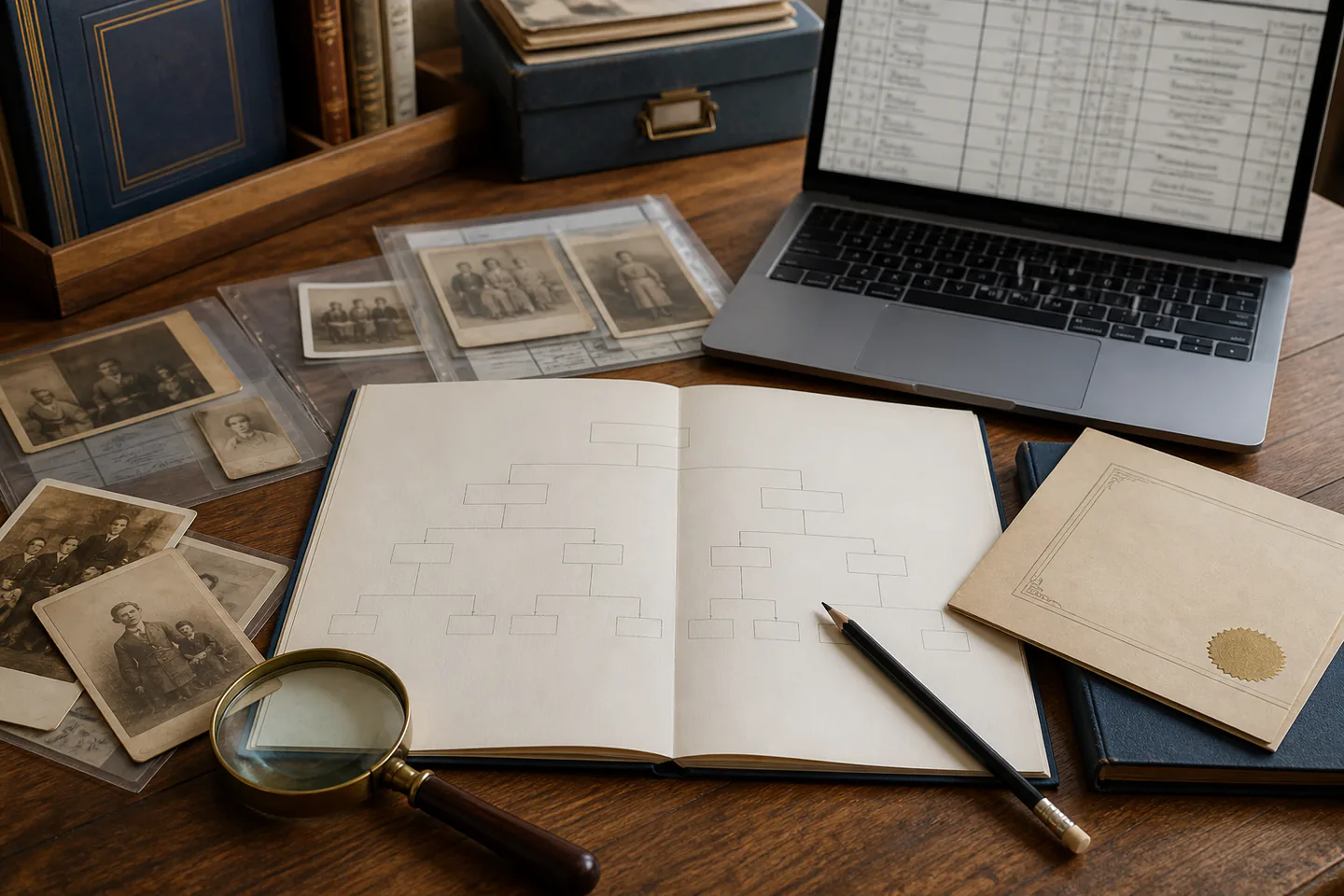
The magnifier supports close inspection, the album demonstrates protected page organisation and the notebook keeps a search log; specialist archival enclosures should be chosen to suit the originals.
Carson LL-10 10× LumiLoupe Stand Magnifier
A stand leaves delicate paper, specimens or small finds undisturbed.
Lanpn 12 × 12 Archival Top-Load Album
It helps establish an orderly page system before specialist archival enclosures are chosen.
Silvine A5 Executive Dotted Hardback Notebook
A durable small notebook is quicker to annotate than rebuilding events from memory.
First project
Prove one parent-child relationship
Use at least two independent record types and write a short conclusion that acknowledges any conflict.
- 01
Write the known facts
Separate firsthand knowledge, family story and documentary evidence. Record what happened during genealogy & family history so the next attempt changes one known variable instead of several guesses.
- 02
Search a broad index
Use date ranges, places, relatives and spelling variants rather than one exact name. Record what happened during genealogy & family history so the next attempt changes one known variable instead of several guesses.
- 03
Open the underlying record
Read the full household, image, certificate or archive description. Record what happened during genealogy & family history so the next attempt changes one known variable instead of several guesses.
- 04
Compare identities
List agreements and conflicts before attaching the record. Record what happened during genealogy & family history so the next attempt changes one known variable instead of several guesses.
- 05
Cite and back up
Save the citation, a lawful working copy and a note explaining the relationship. Record what happened during genealogy & family history so the next attempt changes one known variable instead of several guesses.
What can wait
What can wait until the first result
Delay anything that adds cost, risk or another variable before the basic workflow has produced something you can review.
- 01
A large subscription bundle
Free indexes, library access and one research question can reveal which service is actually needed. Record what happened during genealogy & family history so the next attempt changes one known variable instead of several guesses.
- 02
DNA testing
It introduces privacy, unexpected relationship and interpretation issues beyond a first paper trail. Record what happened during genealogy & family history so the next attempt changes one known variable instead of several guesses.
- 03
Merging public trees
A merge imports other people’s errors faster than it resolves evidence. Record what happened during genealogy & family history so the next attempt changes one known variable instead of several guesses.
- 04
Scanning every family box
Stabilise, identify and prioritise the material before bulk digitisation. Record what happened during genealogy & family history so the next attempt changes one known variable instead of several guesses.
Upgrade path
Add the capability you can now name
Each stage should remove a demonstrated constraint rather than make the setup look more advanced.
Use what you own
£0–£20Existing equipment and one written plan
Use family papers, free indexes and a research log.Repeat the first route
Free to about £60 for certificates and accessA complete repeatable starter setup
Buy only the certificate or record access that answers the current question.Add one capability
Often £50–£250One selected tool, service or learning resource
Add archive visits, parish registers or specialist databases for a documented gap.Build specialist depth
Club, course or specialist dependentA documented specialist workflow
Develop proof arguments, DNA methods and preservation with society or archive guidance.Safety & care
Protect living people and original records
Family history combines fragile material, sensitive personal information and conclusions that can affect real relationships.
- Do not publish living people’s full dates, addresses, certificates, private messages or family circumstances without informed permission.
- Treat DNA matches and unexpected parentage as sensitive evidence, not material for public speculation.
- Use clean dry hands, support bound volumes and follow archive handling rules.
- Respect database licences, copyright, archive photography rules and certificate-use restrictions.
- Keep encrypted or access-controlled backups and separate private research from any public tree.
Outside help
When outside help earns its place
A local family-history society or archive orientation session is valuable when record systems, jurisdictions and catalogue references become the obstacle.
Bring one precise identity question and ask which indexes, original series and access routes apply.
Use outside help after the first genealogy & family history attempt can reveal the exact technique, access or safety problem that needs live correction.
Representative UK learning and access routes checked 1 September 2026; local prices, permissions, equipment and tutor support vary.
Sources
Where the guidance came from
Authoritative and specialist guidance supports the method and safety boundaries; community discussion contributes recurring beginner problems rather than unsupported claims.
-
01
The National Archives · Census records
UK census coverage, access routes and limitations.
Open source -
02
GOV.UK · Order birth, death or marriage certificates
Official General Register Office certificate-ordering route.
Open source -
03
General Register Office · Research your family history
Official civil registration and family-history starting points.
Open source -
04
Society of Genealogists
UK specialist library, education and research support.
Open source -
05
FamilySearch · Genealogy research process
Structured question, search, analysis and citation workflow.
Open source -
06
Reddit · r/Genealogy
Community evidence on false matches, copied trees, certificates and research logs.
Open source -
07
Amazon UK · LL-10 10× LumiLoupe Stand Magnifier
Exact Amazon UK product page or ISBN used for this recommendation; current price, seller, specification and availability should be confirmed.
Open source -
08
Amazon UK · 12 × 12 Archival Top-Load Album
Exact Amazon UK product page or ISBN used for this recommendation; current price, seller, specification and availability should be confirmed.
Open source -
09
Amazon UK · A5 Executive Dotted Hardback Notebook
Exact Amazon UK product page or ISBN used for this recommendation; current price, seller, specification and availability should be confirmed.
Open source
Guide information and links checked 1 September 2026.