Beginner’s guide · Play & perform
Leave room to twist,
expect a few pops.
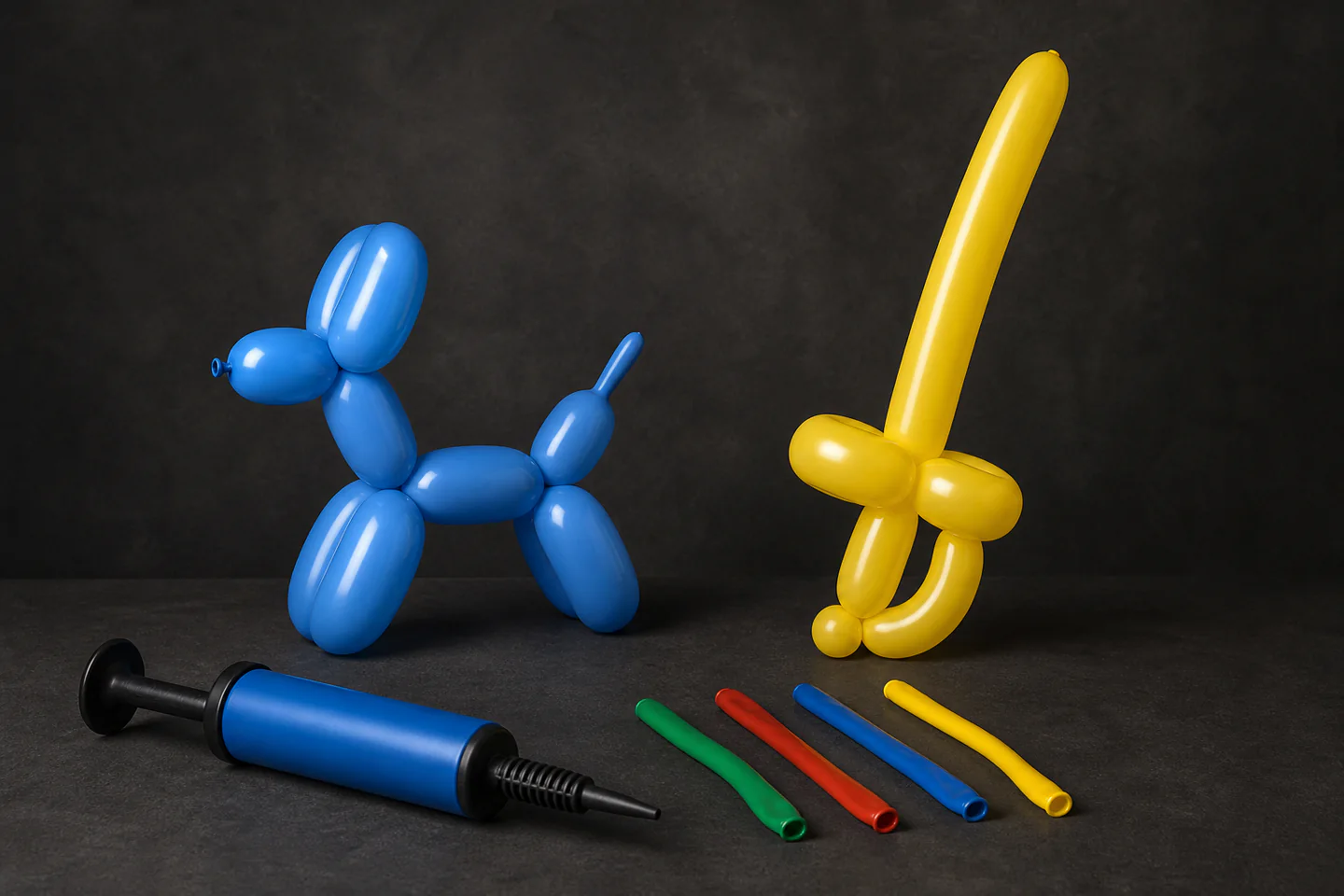
Begin with quality 260 balloons, a hand pump and one dog pattern. Consistent bubbles and deliberate uninflated tail matter more than speed or a huge colour range.
Quick answer
Make one 260 dog with a hand pump
Use fresh professional 260 modelling balloons and a two-way hand pump rather than mouth inflation. Stretch only if the maker recommends it, inflate slowly and leave the uninflated tail shown in the dog instructions so displaced air has somewhere to move. Release a small amount of pressure before tying, then make pairs of equal bubbles and lock-twist them together. Work away from faces, stop if latex becomes thin or sticky and collect every fragment immediately when a balloon pops.
- 01
The name 260 describes an approximate inflated size—about two inches wide and sixty inches long—not the amount that should be filled for every model.
- 02
Twists push air towards the far end. The uninflated tail is working space, and more complex figures need more of it.
- 03
Quality and freshness affect stretch and consistency. Old, heat-damaged or cheap balloons can pop before technique can be judged.
- 04
Use a pump. Mouth inflation adds hygiene and physical risks and is needlessly difficult with narrow modelling balloons.
- 05
Latex fragments are serious choking hazards and allergies can be severe. Keep balloons away from young children, pets and anyone with latex sensitivity.
What to expect
Air management is the hidden drawing
The final animal looks like a sequence of shapes, but every bubble moves pressure through one sealed tube. The sculpture succeeds because the first inflation anticipated the last twist.
Balloon
A fresh 260 from a professional brand stretches and twists more consistently than decorative long balloons of uncertain size.
Pump
A suitable narrow nozzle and two-way action fill 260s efficiently without overheating an electric party pump.
Tail
Too little uninflated length makes the last bubbles tight and fragile; too much leaves an unfinished tail.
Bubbles
Pinch the exact endpoints and compare pairs before locking them. Unequal ears and legs are mostly measurement errors.
Twist
Several turns create a stable bubble; lock twists hold paired structures. Always twist repeated bubbles in the same direction.
Pops
They are normal feedback, but fragments must be controlled. Move away from faces and discard any balloon with weak patches.
Core method
Learn pressure, bubble size and one locking twist
Prepare a safe batch
Buy one fresh assorted pack from a traceable seller and let cold balloons reach normal room temperature. Remove jewellery, clear sharp furniture and create a lidded bin for fragments. Check for latex allergy and ensure the audience is old enough for the activity.
Inflate with working space
Seat the balloon fully on the hand-pump nozzle, point it away from faces and inflate steadily to the pattern’s stated length, leaving the tail. Let a little air escape so the tube is firm but not drum-tight, then tie a secure knot without overstretching the neck.
Make matched bubbles
Measure the first bubble against fingers or a simple gauge, pinch both endpoints and twist several times. Hold completed twists so they cannot unwind. Make the matching bubble beside it, compare lengths and use a lock twist exactly as the tutorial shows.
Finish and evaluate
Complete one dog without rushing. Check whether the tail was sufficient, paired bubbles match and joints stay locked when set down. Photograph it from the side, then make a second dog immediately using the notes. Dispose of failed balloons and every fragment before leaving the room.
Useful products
Products with a clear job in the setup
The Qualatex 260Q assortment is a historically standard modelling balloon and useful when genuinely fresh stock is available; current marketplace supply should be checked because old stock becomes unreliable. A basic two-way hand pump is the correct beginner inflator. Jeremy Telford’s Balloonology provides sequenced projects after the one-balloon dog.
Qualatex 260Q Tropical Assortment Modelling Balloons, 100 Pack
The 260Q has long been a reference balloon for learning bubble sizes and standard patterns.
Generic Two-Way Handheld Balloon Pump
Manual control makes it easier to stop at the required tail length and avoids unnecessary electrical equipment.
Jeremy Telford Balloonology: 32 Fun Projects to Take You from Beginner to Expert
The projects create a progression from basic bubbles to more complex sculptures without random pattern hunting.
First project
Make two one-balloon dogs
The second dog, made immediately from notes, is where inflation and matched bubbles begin to become a repeatable skill.
- 01
Prepare and inspect
Clear sharp objects, check allergy risk and reject damaged or sticky balloons.
- 02
Inflate with a tail
Use the pump and leave the pattern’s working length uninflated.
- 03
Soften the pressure
Release a small amount before tying so the tube can accept twists.
- 04
Make equal head bubbles
Measure, twist consistently and lock the ears without letting go.
- 05
Repeat the legs
Compare each pair before the lock twist and preserve tail space.
- 06
Collect every fragment
Photograph the result, record tail length and clean the whole area.
What can wait
What can wait until the first result
A reliable dog, sword and flower establish nearly every basic motion. Speed and complexity can follow without wasting fragile material.
- 01
Multi-balloon characters
They require sizing across several balloons and more opportunities for pressure errors.
- 02
An electric inflator
Manual control is quieter, portable and sufficient for learning; many party pumps are not designed for 260 pressure.
- 03
Hundreds of colours
Freshness and reliable size matter more than shade range.
- 04
Public performance
Queue control, hygiene, allergy communication and child safeguarding go beyond making a good dog.
- 05
Mouth inflation
It is unnecessary and adds avoidable hygiene and physical risk.
Upgrade path
Upgrade the repeated limitation
Upgrade when hand fatigue, event volume or a specific sculpture—not enthusiasm alone—creates a repeated limit.
One-balloon figures
About £15–£45Fresh 260s + hand pump
Learn inflation, bubbles and locks.Small repertoire
About £30–£80Several sizes and reference book
Add flowers, hats and multi-part shapes.Frequent practice
About £70–£180Professional pump and organised stock
Improve speed and reduce hand fatigue.Paid performance
About £150–£600+Reliable inventory, bags and event systems
Deliver safely and consistently for an audience.Safety & care
Pops are expected; loose latex is not
A broken balloon can become a choking hazard in seconds, and latex allergy can be serious. Safe modelling includes the room, audience and cleanup—not only hand technique.
- Never allow babies or young children to handle uninflated balloons or fragments; supervise older children and remove broken pieces immediately.
- Check for latex allergy before the activity and stop at any sign of reaction; use professional medical guidance for known allergy risk.
- Inflate with a suitable pump pointed away from faces, wear eye protection if appropriate and never deliberately overinflate to test a balloon.
- Keep balloons away from pets, food, candles, heaters, sharp objects and outdoor wildlife; never release balloons into the environment.
- Public or paid work needs risk assessment, hygiene, safeguarding, queue boundaries and suitable liability arrangements in addition to twisting skill.
Outside help
When outside help earns its place
A reliable dog tutorial is enough to begin. A jam or club becomes useful when another twister can correct hand position, pressure and efficient sequences without turning practice into a performance.
Use standard 260 terminology and clear tail-length guidance.
Ask whether balloons, pumps, allergy practice and take-home patterns are included.
Representative UK learning options checked 18 August 2026; local prices, access, materials and tutor support vary.
Sources
Where the guidance came from
Manufacturers and established twisters define balloon sizes and foundational techniques. Active professional communities add current evidence about brand supply, pumps, pressure, performance and recurring beginner failures.
-
01
Qualatex · Balloon basics
Manufacturer terminology, inflation and balloon-handling basics.
Open source -
02
Qualatex · 260Q manual
Illustrated foundational one-balloon models and twist sequence.
Open source -
03
Balloon Artists Guild
Professional education and community context.
Open source -
04
Balloon Twisting · Instructables guide
Accessible illustrated basic twists and figures.
Open source -
05
Reddit · r/BalloonTwisting
Current community evidence on brands, pumps, tail length and troubleshooting.
Open source -
06
Amazon UK · 260Q Tropical Assortment Modelling Balloons, 100 Pack
Exact product catalogue page or ISBN used for the recommendation; current price, seller, specification and availability should be confirmed.
Open source -
07
Amazon UK · Two-Way Handheld Balloon Pump
Exact product catalogue page or ISBN used for the recommendation; current price, seller, specification and availability should be confirmed.
Open source -
08
Amazon UK · Balloonology: 32 Fun Projects to Take You from Beginner to Expert
Exact product catalogue page or ISBN used for the recommendation; current price, seller, specification and availability should be confirmed.
Open source
Guide information and links checked 18 August 2026.