Beginner’s guide · Reflect & explore
Read the cards together,
not as thirty-six tiny tarots.
A standard 36-card Petit Lenormand deck and a notebook are enough. Learn one practical keyword per card, then read pairs and short lines as a sentence.
Quick answer
Learn combinations before large spreads
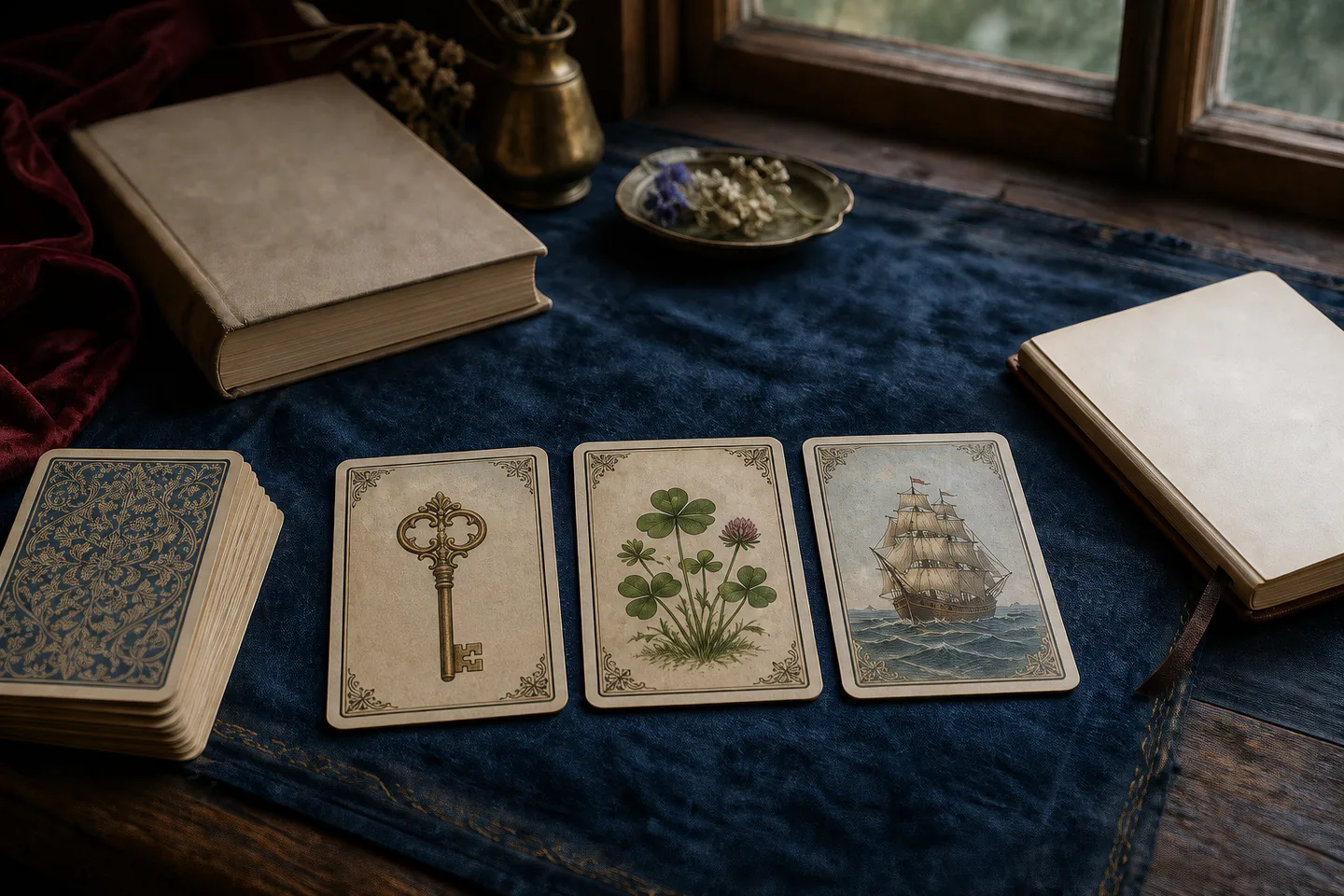
Choose a standard 36-card Petit Lenormand deck, assign one concise keyword to each card, ask a concrete low-stakes question, draw three cards and read them left to right as a phrase before checking a guidebook.
- 01
Lenormand normally uses 36 fixed images and reads cards in combinations. Keep the first attempt narrow enough that preparation, the main action and the result can all be reviewed together.
- 02
Traditional practice does not depend on tarot reversals or major and minor arcana. Keep the first attempt narrow enough that preparation, the main action and the result can all be reviewed together.
- 03
A short line keeps grammar and card order visible. Keep the first attempt narrow enough that preparation, the main action and the result can all be reviewed together.
- 04
Divination can support reflection but should not replace professional medical, legal, financial or safeguarding advice. Keep the first attempt narrow enough that preparation, the main action and the result can all be reviewed together.
What to expect
The meaning lives between cards
Memorising isolated keywords feels productive, but useful readings depend on how one card modifies the next.
Deck
Traditional symbols make books and teachers easier to compare. For lenormand card reading, note what actually happened rather than relying on memory; that turns the next attempt into a controlled change instead of another guess.
Question
Concrete wording gives combinations a clearer context. For lenormand card reading, note what actually happened rather than relying on memory; that turns the next attempt into a controlled change instead of another guess.
Order
Readers use different grammatical conventions, so one consistent method matters. For lenormand card reading, note what actually happened rather than relying on memory; that turns the next attempt into a controlled change instead of another guess.
Journal
Recording the question and later outcome reveals hindsight and overconfident interpretation. For lenormand card reading, note what actually happened rather than relying on memory; that turns the next attempt into a controlled change instead of another guess.
Core method
Build a small working vocabulary
Map the deck
Write one plain noun or action for each of the 36 cards. For lenormand card reading, note what actually happened rather than relying on memory; that turns the next attempt into a controlled change instead of another guess.
Practise pairs
Combine two cards in both orders and notice how emphasis changes. For lenormand card reading, note what actually happened rather than relying on memory; that turns the next attempt into a controlled change instead of another guess.
Read a three-card line
Use the centre as the focus and outer cards as context in one chosen method. For lenormand card reading, note what actually happened rather than relying on memory; that turns the next attempt into a controlled change instead of another guess.
Review without rewriting history
Date the interpretation before the outcome and keep uncertainty visible. For lenormand card reading, note what actually happened rather than relying on memory; that turns the next attempt into a controlled change instead of another guess.
Useful products
Products with a clear job in the setup
The Blue Owl and Gilded Reverie are alternative 36-card decks, not a compulsory pair. Rana George’s book is a structured reference after hands-on combination practice.
AGM-Urania Mlle Lenormand Blue Owl Deck
Its familiar images make combination references easier to follow.
Ciro Marchetti Gilded Reverie Lenormand
It keeps the standard system while using richer artwork.
Rana George The Essential Lenormand
One author’s consistent approach is easier to test than scattered keyword lists.
First project
Write one three-card sentence
Use an everyday question whose outcome can be reviewed without serious consequences.
- 01
State the question
Keep it concrete, time-bounded and low stakes. For lenormand card reading, note what actually happened rather than relying on memory; that turns the next attempt into a controlled change instead of another guess.
- 02
Draw three cards
Keep orientation and order fixed. For lenormand card reading, note what actually happened rather than relying on memory; that turns the next attempt into a controlled change instead of another guess.
- 03
Name the centre
Write its plainest practical meaning first. For lenormand card reading, note what actually happened rather than relying on memory; that turns the next attempt into a controlled change instead of another guess.
- 04
Combine the neighbours
Turn the line into one sentence rather than three speeches. For lenormand card reading, note what actually happened rather than relying on memory; that turns the next attempt into a controlled change instead of another guess.
- 05
Date and revisit
Compare the record with events without forcing a match. For lenormand card reading, note what actually happened rather than relying on memory; that turns the next attempt into a controlled change instead of another guess.
What can wait
What can wait until the first result
Extra equipment becomes useful only when the basic method has exposed a specific, repeated limitation.
- 01
The Grand Tableau
Thirty-six interacting positions hide weak basic combinations. For lenormand card reading, note what actually happened rather than relying on memory; that turns the next attempt into a controlled change instead of another guess.
- 02
Several decks at once
Changing imagery interrupts vocabulary building. For lenormand card reading, note what actually happened rather than relying on memory; that turns the next attempt into a controlled change instead of another guess.
- 03
Reversed meanings
They belong to some tarot practices, not the usual Lenormand structure. For lenormand card reading, note what actually happened rather than relying on memory; that turns the next attempt into a controlled change instead of another guess.
- 04
High-stakes readings for others
Consent, boundaries and the risk of harmful certainty increase. For lenormand card reading, note what actually happened rather than relying on memory; that turns the next attempt into a controlled change instead of another guess.
Upgrade path
Upgrade the repeated limitation
Deepen combination grammar before adding spread size.
Three-card line
£12–£25One standard deck and notebook
Learn order and combination.Five-card line
No extra costSame deck and consistent method
Add context and emphasis.Nine-card box
No extra costRows, columns and centre focus
Read several relationships.Grand Tableau
Time rather than kitAll 36 cards and recorded method
Study a complete system only after fluency.Safety & care
Keep symbolic practice proportionate
Direct language can feel authoritative, so ethical boundaries matter more than dramatic certainty.
- Do not use card readings as a substitute for qualified medical, legal, financial or mental-health advice. Follow current manufacturer, food-safety, access, wildlife or local guidance wherever it applies.
- Avoid deterministic claims about death, illness, pregnancy, crime or another person’s private thoughts. Follow current manufacturer, food-safety, access, wildlife or local guidance wherever it applies.
- Obtain consent before reading for someone and respect a request to stop. Follow current manufacturer, food-safety, access, wildlife or local guidance wherever it applies.
- Keep identifiable journal entries and other people’s questions private. Follow current manufacturer, food-safety, access, wildlife or local guidance wherever it applies.
- Pause if repeated readings are increasing distress or driving consequential decisions. Follow current manufacturer, food-safety, access, wildlife or local guidance wherever it applies.
Outside help
When outside help earns its place
A coherent book or teacher can clarify one reading grammar; avoid courses that promise certainty or pressure repeated purchases.
Practise one pair or three-card line daily and review the record.
Check whether it teaches combinations, ethics and a standard 36-card system.
Representative UK learning options checked 31 August 2026; local prices, access, materials and tutor support vary.
Sources
Where the guidance came from
Specialist Lenormand resources consistently distinguish the 36-card combination system from tarot and favour short practice lines before the Grand Tableau.
-
01
Lenormand.io · What is Lenormand?
History, 36-card structure and distinction from tarot.
Open source -
02
Lenormand.io · Lenormand for beginners
Beginner deck, keywords and practice route.
Open source -
03
Lenormand.io · Card combinations
Combination grammar and short-line method.
Open source -
04
Reddit · r/Lenormand
Recurring practitioner discussion of decks, combinations and spreads.
Open source -
05
Open Library · Shaped history of cartomancy references
Bibliographic context for card-reading literature.
Open source -
06
Amazon UK · Mlle Lenormand Blue Owl Deck
Exact Amazon UK product page or ISBN used for the recommendation; current price, seller, specification and availability should be confirmed.
Open source -
07
Amazon UK · Gilded Reverie Lenormand
Exact Amazon UK product page or ISBN used for the recommendation; current price, seller, specification and availability should be confirmed.
Open source -
08
Amazon UK · The Essential Lenormand
Exact Amazon UK product page or ISBN used for the recommendation; current price, seller, specification and availability should be confirmed.
Open source
Guide information and links checked 31 August 2026.