Beginner’s guide · Write & create
Record what matters,
leave the system light.
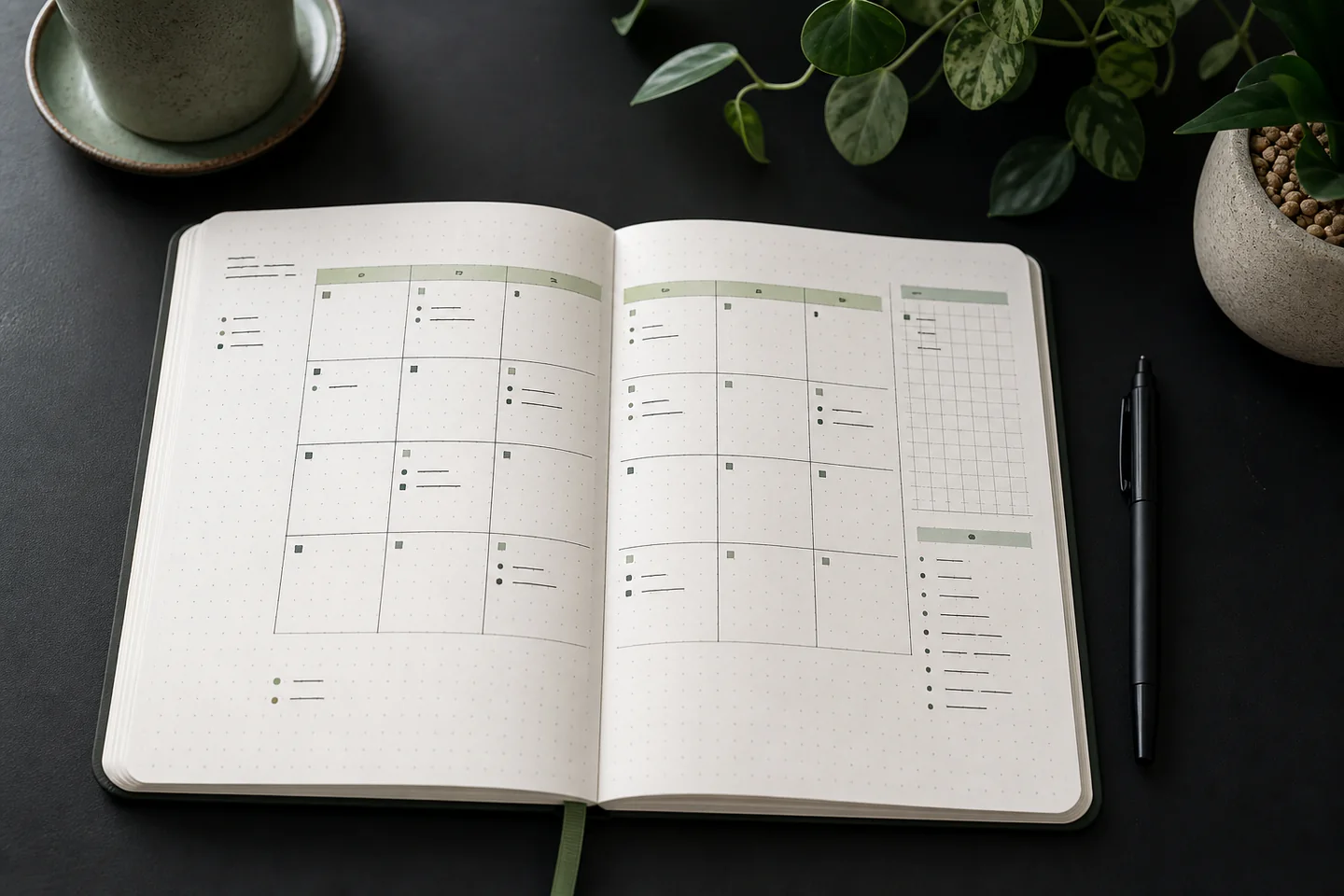
Bullet journalling can begin with a dotted notebook, one pen and a short index. The useful test is whether rapid logging reduces friction, not how decorative the spreads look.
Quick answer
Build the minimum system and use it for two weeks
Number the pages of a dotted notebook if they are not already numbered, reserve two pages for an index and create a simple future log. On the next spread, list this month’s dates and only the tasks or events that need tracking. Use concise bullets for daily notes, mark completed work, migrate only genuinely useful unfinished items and review the notebook at a fixed short interval.
- 01
Choose one durable dotted notebook and comfortable pen for the first result and resist substituting several unfamiliar materials at once. Record what you used on the first attempt so the result can be repeated or changed for a reason.
- 02
Make rapid logging and selective migration visible with a small test before committing the full project. Record what you used on the first attempt so the result can be repeated or changed for a reason.
- 03
Change one variable between attempts and keep the preparation otherwise consistent. Record what you used on the first attempt so the result can be repeated or changed for a reason.
- 04
Inspect the work at each reversible stage instead of waiting until a brief repeatable review. Record what you used on the first attempt so the result can be repeated or changed for a reason.
- 05
Finish one modest result and note the actual time, material use and recurring difficulty. Record what you used on the first attempt so the result can be repeated or changed for a reason.
What to expect
The value appears through use, not setup decoration
A beautiful unused tracker is less useful than plain pages that capture tasks, events and notes consistently.
Capture
The notebook must be available quickly enough that recording does not feel like a project. In bullet journalling, this is worth checking deliberately rather than trying to correct it after the next stage.
Migration
Rewriting every unfinished task preserves clutter. Decide whether it is still worth carrying forward. In bullet journalling, this is worth checking deliberately rather than trying to correct it after the next stage.
Collections
Extra trackers should answer a real recurring question, not copy every layout seen online. In bullet journalling, this is worth checking deliberately rather than trying to correct it after the next stage.
Paper
Ink behaviour affects comfort, but any legible notebook can test the method. In bullet journalling, this is worth checking deliberately rather than trying to correct it after the next stage.
Privacy
A portable life log can expose personal information. Record only what is appropriate and store it deliberately. In bullet journalling, this is worth checking deliberately rather than trying to correct it after the next stage.
Core method
Let rapid logging earn every extra page
Create index and key
Use a small set of symbols whose meaning remains obvious without a decorative legend. In bullet journalling, this is worth checking deliberately rather than trying to correct it after the next stage.
Add future and monthly views
Record only dated commitments and current priorities. In bullet journalling, this is worth checking deliberately rather than trying to correct it after the next stage.
Log the day concisely
Use short task, event and note bullets rather than writing a polished diary entry. In bullet journalling, this is worth checking deliberately rather than trying to correct it after the next stage.
Review and migrate
At a regular interval, complete, schedule, move or deliberately cancel open items. In bullet journalling, this is worth checking deliberately rather than trying to correct it after the next stage.
Useful products
Products with a clear job in the setup
The Stationery Island notebook is a practical dotted start. Jetstream pens offer smooth everyday writing; Microns are optional when permanent fineliner widths are genuinely useful.
Stationery Island A5 Dotted Notebook 120 gsm
The format supports structure without requiring printed planner dates.
uni-ball Jetstream Ballpoint Pen Pack
Reliable flow and quick handling suit frequent short entries.
Sakura Pigma Micron Fineliner Set
Several widths can create hierarchy without rulers and markers.
First project
Run one two-week plain notebook test
Four core page types and ordinary daily use reveal whether the system reduces forgotten tasks without demanding hours of setup.
- 01
Write a tiny key
Choose symbols for task, event, note, complete and migrated. In bullet journalling, this is worth checking deliberately rather than trying to correct it after the next stage.
- 02
Reserve the index
Leave two pages and enter each collection only when it is created. In bullet journalling, this is worth checking deliberately rather than trying to correct it after the next stage.
- 03
Make a six-month future log
Add known dates without decorating empty space. In bullet journalling, this is worth checking deliberately rather than trying to correct it after the next stage.
- 04
Set up the current month
List dates on one page and a short task list opposite. In bullet journalling, this is worth checking deliberately rather than trying to correct it after the next stage.
- 05
Rapid-log each day
Capture concise entries and mark outcomes as they happen. In bullet journalling, this is worth checking deliberately rather than trying to correct it after the next stage.
- 06
Review after fourteen days
Remove unused trackers, migrate deliberately and keep only pages that helped. In bullet journalling, this is worth checking deliberately rather than trying to correct it after the next stage.
What can wait
What can wait until the first result
Decoration can be a separate creative hobby, but it should not be a requirement for remembering an appointment.
- 01
Weekly artistic themes
They add recurring setup time before the logging habit exists. In bullet journalling, this is worth checking deliberately rather than trying to correct it after the next stage.
- 02
Many habit trackers
Tracking without a decision or response creates guilt rather than information. In bullet journalling, this is worth checking deliberately rather than trying to correct it after the next stage.
- 03
Large pen case
One legible pen tests the system completely. In bullet journalling, this is worth checking deliberately rather than trying to correct it after the next stage.
- 04
Exact copied layouts
Another person’s work, schedule and priorities may not fit the user. In bullet journalling, this is worth checking deliberately rather than trying to correct it after the next stage.
- 05
Sensitive full-life record
Use separate secure systems for information that should not travel in a notebook. In bullet journalling, this is worth checking deliberately rather than trying to correct it after the next stage.
Upgrade path
Upgrade the repeated limitation
Add structure only when repeated use reveals a missing view.
Two-week test
About £5–£15Any notebook and pen
Test rapid logging.Dedicated notebook
About £10–£30Dotted A5 book and reliable pen
Maintain index and migration.Useful specialist collection
About £20–£50One ruler or fineliner set
Track a real recurring need.Archive system
About £40–£120+Numbered volumes and secure storage
Review long-term notes safely.Safety & care
Protect personal information and avoid making tracking punitive
A notebook is a tool, not a diagnosis, treatment plan or moral scorecard.
- Do not record passwords, financial credentials or information that would cause harm if the notebook were lost. Follow the current instructions supplied with the exact material, tool or living specimen.
- Store identifiable health or third-party information only with appropriate privacy safeguards. Follow the current instructions supplied with the exact material, tool or living specimen.
- Use habit data as neutral information rather than a reason to restrict food, rest or medication. Follow the current instructions supplied with the exact material, tool or living specimen.
- Take hand and posture breaks during long planning sessions. Follow the current instructions supplied with the exact material, tool or living specimen.
- Seek qualified help for medical, financial or legal decisions instead of relying on a journal layout. Follow the current instructions supplied with the exact material, tool or living specimen.
Outside help
When outside help earns its place
A complete beginner tutorial is enough for the first controlled attempt. A class becomes useful when visual planning, lettering or a consistent review habit remains difficult.
Follow one method using one durable dotted notebook and comfortable pen, including preparation and finishing rather than only the photogenic middle stage.
Check whether materials, troubleshooting, a brief repeatable review and a finished take-home result are included.
Representative UK learning options checked 28 August 2026; local prices, access, materials and tutor support vary.
Sources
Where the guidance came from
The method is grounded in specialist and public guidance, then checked against recurring beginner questions and the exact products linked here.
-
01
Bullet Journal · official method
Primary explanation of rapid logging and migration.
Open source -
02
Information Commissioner’s Office · personal data
UK privacy context for personal records.
Open source -
03
Library of Congress · care of paper
Paper handling and storage guidance.
Open source -
04
Tate · art terms collage
Museum context for assembled paper artwork.
Open source -
05
JetPens · paper and pen guides
Specialist notebook, paper and writing-tool comparisons.
Open source -
06
Reddit · r/bujo
Community emphasis on functional bullet-journal practice.
Open source -
07
Amazon UK · A5 Dotted Notebook 120 gsm
Exact product catalogue page or ISBN used for the recommendation; current price, seller, specification and availability should be confirmed.
Open source -
08
Amazon UK · Jetstream Ballpoint Pen Pack
Exact product catalogue page or ISBN used for the recommendation; current price, seller, specification and availability should be confirmed.
Open source -
09
Amazon UK · Pigma Micron Fineliner Set
Exact product catalogue page or ISBN used for the recommendation; current price, seller, specification and availability should be confirmed.
Open source
Guide information and links checked 28 August 2026.