Beginner’s guide · Cook & bake
Mix koji, beans and salt,
then let time do the work.
Buy prepared rice koji, follow one tested formula by weight and pack a small soybean miso without air pockets. Do not improvise a low-salt first batch.
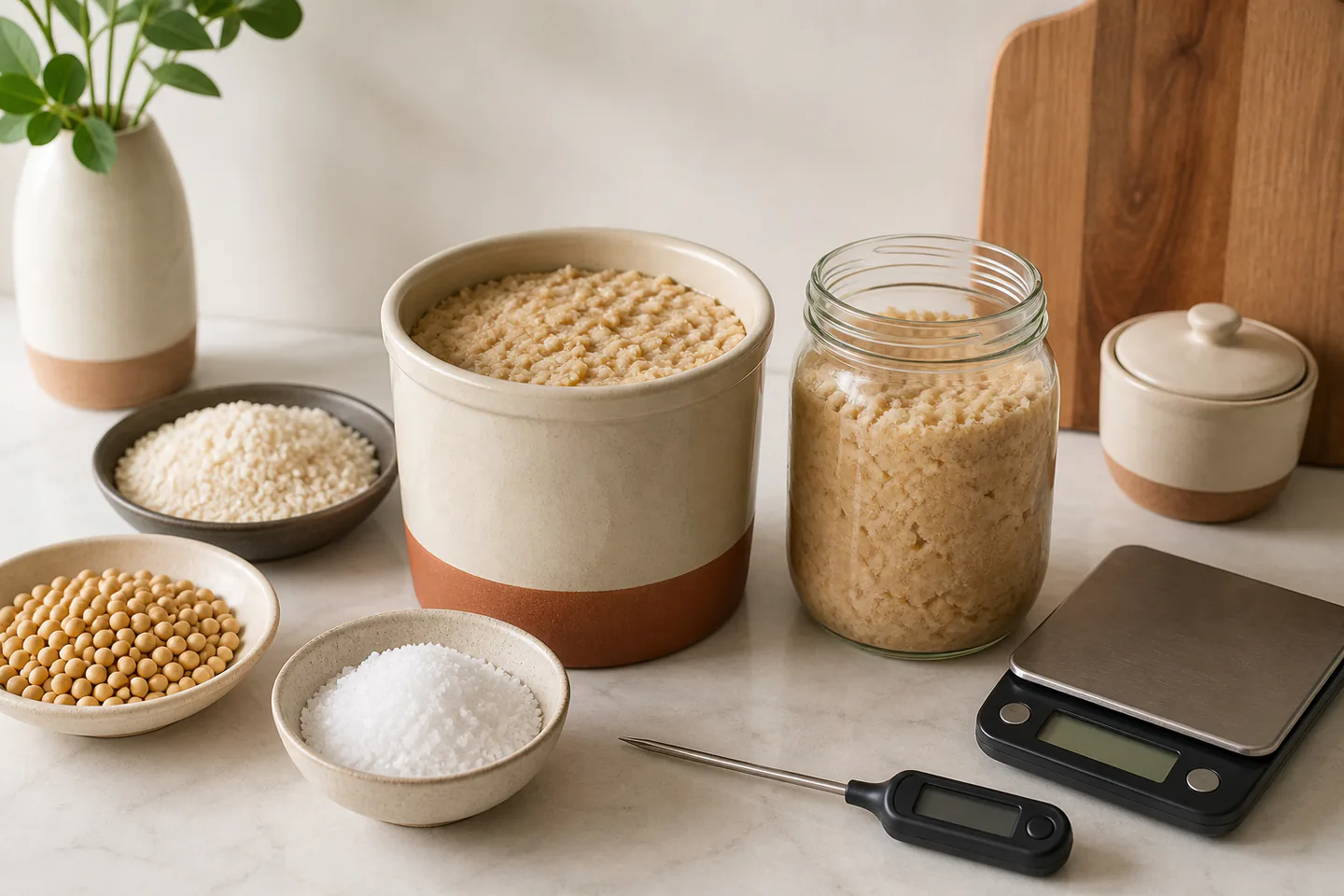
Quick answer
Use prepared koji and a tested formula
Buy fresh or dried rice koji from a traceable specialist, cook soybeans until easily mashed, weigh beans, koji and salt to a tested recipe, mix completely, pack firmly into a clean vessel without air pockets, weight and cover it as directed, then label and ferment at the recipe’s temperature and duration.
- 01
Koji is grain cultured with Aspergillus oryzae; buying it prepared avoids a second controlled incubation process. Keep the first attempt narrow enough that preparation, the main action and the result can all be reviewed together.
- 02
Salt is a process control as well as seasoning, so the first batch should not be reduced casually. Keep the first attempt narrow enough that preparation, the main action and the result can all be reviewed together.
- 03
Soft beans and thorough mixing prevent dry pockets and uneven fermentation. Keep the first attempt narrow enough that preparation, the main action and the result can all be reviewed together.
- 04
Miso takes months rather than days, and colour or surface change must be judged with reliable guidance. Keep the first attempt narrow enough that preparation, the main action and the result can all be reviewed together.
What to expect
The active work is short; the feedback loop is long
A batch can take two to eight months or longer, so accurate notes and a small vessel make the first experiment manageable.
Koji
Freshness, grain type and storage influence enzyme activity. For miso making, note what actually happened rather than relying on memory; that turns the next attempt into a controlled change instead of another guess.
Beans
They must be tender enough to mash smoothly without leaving dry centres. For miso making, note what actually happened rather than relying on memory; that turns the next attempt into a controlled change instead of another guess.
Salt
Uneven mixing creates zones with different protection and flavour. For miso making, note what actually happened rather than relying on memory; that turns the next attempt into a controlled change instead of another guess.
Surface
Exposure to air encourages surface growth; weights and close packing reduce it but do not remove monitoring. For miso making, note what actually happened rather than relying on memory; that turns the next attempt into a controlled change instead of another guess.
Core method
Weigh, mix, exclude air and label
Choose one complete recipe
Use the exact bean, koji, salt and yield stated rather than combining ratios from several sources. For miso making, note what actually happened rather than relying on memory; that turns the next attempt into a controlled change instead of another guess.
Cook and cool safely
Cook beans very soft, cool to the recipe’s safe mixing range and keep utensils clean. For miso making, note what actually happened rather than relying on memory; that turns the next attempt into a controlled change instead of another guess.
Mix and pack
Distribute salt and koji thoroughly, form balls if the method uses them and press out trapped air. For miso making, note what actually happened rather than relying on memory; that turns the next attempt into a controlled change instead of another guess.
Ferment and assess
Label formula and date, keep conditions stable and use the recipe’s guidance for surface checks and maturity. For miso making, note what actually happened rather than relying on memory; that turns the next attempt into a controlled change instead of another guess.
Useful products
Products with a clear job in the setup
The Kilner jar, Salter scale and ThermoPro thermometer support measurement and containment. Koji and soybeans should come from a traceable food supplier with storage instructions.
Kilner One-Litre Clip-Top Glass Jar
A small batch is easier to pack, label and monitor.
Etekcity Digital Kitchen Scale, 0.1 g to 5 kg
Weight is more reliable than volume for the salt ratio.
ThermoPro TP19 Instant-Read Food Thermometer
It prevents adding koji to excessively hot beans and documents the process.
First project
Pack one small rice-koji soybean miso
Use a tested beginner formula and enough headspace for weight and cover.
- 01
Record the dry formula
Write exact weights and expected yield. For miso making, note what actually happened rather than relying on memory; that turns the next attempt into a controlled change instead of another guess.
- 02
Cook beans until crushable
No chalky centre should remain. For miso making, note what actually happened rather than relying on memory; that turns the next attempt into a controlled change instead of another guess.
- 03
Cool and combine
Use the recipe’s temperature and mix salt throughout. For miso making, note what actually happened rather than relying on memory; that turns the next attempt into a controlled change instead of another guess.
- 04
Pack without voids
Press each addition firmly and clean the vessel walls. For miso making, note what actually happened rather than relying on memory; that turns the next attempt into a controlled change instead of another guess.
- 05
Label and monitor
Record date, weight, temperature range and every surface check. For miso making, note what actually happened rather than relying on memory; that turns the next attempt into a controlled change instead of another guess.
What can wait
What can wait until the first result
Extra equipment becomes useful only when the basic method has exposed a specific, repeated limitation.
- 01
Growing koji from spores
It requires controlled warm incubation and contamination judgement. For miso making, note what actually happened rather than relying on memory; that turns the next attempt into a controlled change instead of another guess.
- 02
Low-salt experiments
They narrow the safety and stability margin. For miso making, note what actually happened rather than relying on memory; that turns the next attempt into a controlled change instead of another guess.
- 03
Huge crocks
A failed large batch wastes time and ingredients. For miso making, note what actually happened rather than relying on memory; that turns the next attempt into a controlled change instead of another guess.
- 04
Frequent opening
Every inspection changes the surface environment. For miso making, note what actually happened rather than relying on memory; that turns the next attempt into a controlled change instead of another guess.
Upgrade path
Upgrade the repeated limitation
Change one recipe variable per batch and keep records over the full ageing period.
Prepared-koji jar
£25–£60Small vessel, scale and tested recipe
Learn packing and ageing.Parallel two-jar test
£20–£50 extraSame formula with one controlled variation
Compare koji or ageing time.Larger crock
£50–£180Weights and several-kilogram batch
Gain capacity after a successful cycle.Koji cultivation
£80–£300Incubation chamber and specialist training
Control the culture stage itself.Safety & care
Do not improvise away the process controls
Long room-temperature fermentation depends on the tested formula, clean handling, correct salt and informed spoilage judgement.
- Use a tested miso recipe and do not reduce salt casually. Follow current manufacturer, food-safety, access, wildlife or local guidance wherever it applies.
- Buy food-grade koji from a traceable supplier and follow its storage dates. Follow current manufacturer, food-safety, access, wildlife or local guidance wherever it applies.
- Clean hands, utensils and vessel and prevent cross-contamination from raw foods. Follow current manufacturer, food-safety, access, wildlife or local guidance wherever it applies.
- Discard a batch when reliable guidance indicates dangerous or unexplained spoilage; tasting is not a safety test. Follow current manufacturer, food-safety, access, wildlife or local guidance wherever it applies.
- People with soy allergy, salt restrictions or compromised immunity should seek appropriate medical advice before consuming home ferments. Follow current manufacturer, food-safety, access, wildlife or local guidance wherever it applies.
Outside help
When outside help earns its place
A fermentation teacher is valuable for surface diagnosis and koji handling; the first batch can still use bought koji and a complete tested recipe.
Follow one source from ingredient weights through storage.
Ask whether food safety, salt calculation, surface growth and take-home ageing are covered.
Representative UK learning options checked 31 August 2026; local prices, access, materials and tutor support vary.
Sources
Where the guidance came from
Food-safety guidance frames the hygiene limits; specialist fermentation sources support prepared koji, complete salt mixing and patient ageing.
-
01
Cultures for Health · Chickpea miso
Prepared koji, bean softness, thorough mixing and salt caution.
Open source -
02
Cultures for Health · Koji, miso and shoyu
Practitioner context for ageing and koji work.
Open source -
03
Food Standards Agency · Food safety at home
UK hygiene and storage baseline.
Open source -
04
National Center for Home Food Preservation
Evidence-led home food-preservation principles.
Open source -
05
Reddit · r/Koji
Recurring practitioner discussion of koji, ratios and surface growth.
Open source -
06
Amazon UK · One-Litre Clip-Top Glass Jar
Exact Amazon UK product page or ISBN used for the recommendation; current price, seller, specification and availability should be confirmed.
Open source -
07
Amazon UK · 1036 Digital Kitchen Scale
Exact Amazon UK product page or ISBN used for the recommendation; current price, seller, specification and availability should be confirmed.
Open source -
08
Amazon UK · TP19 Instant-Read Food Thermometer
Exact Amazon UK product page or ISBN used for the recommendation; current price, seller, specification and availability should be confirmed.
Open source
Guide information and links checked 31 August 2026.