Beginner’s guide · Explore earth science
Test properties in order,
then name the uncertainty.
Lustre, crystal form, cleavage, hardness, streak and density work together. A six-specimen reference set teaches the decision process without damaging valued finds.
Quick answer
Complete one property table before expanding the setup
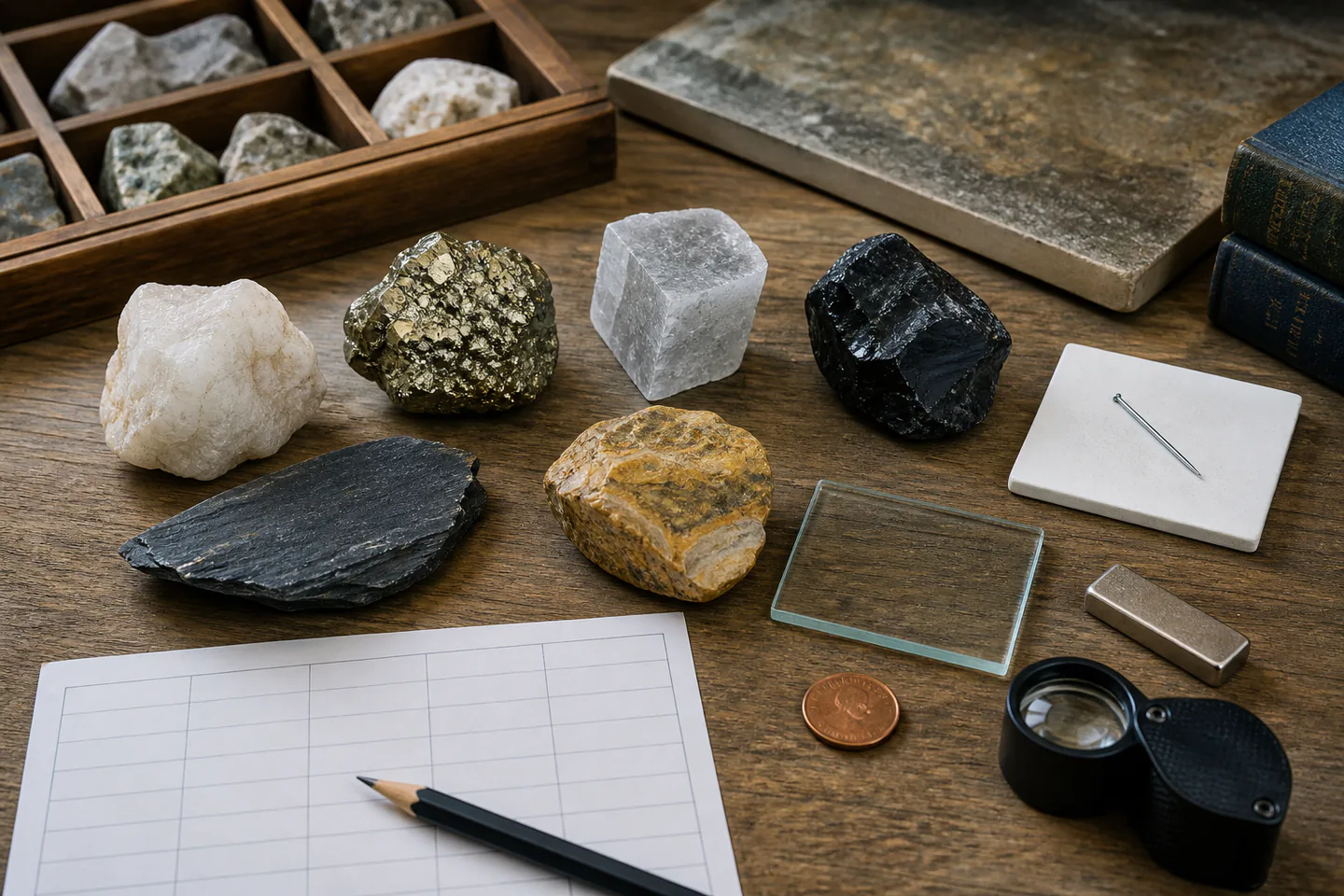
Use a labelled educational set of common minerals and keep one unknown aside. Observe colour, lustre, transparency, habit, cleavage and fracture under good light, test magnetism, perform hardness comparisons from soft to hard on inconspicuous areas, use a streak plate only when appropriate and record each observation before comparing a decision key. Do not use taste, acid or destructive tests on unknown or valued specimens.
- 01
Colour varies with impurities and weathering, so it is rarely enough by itself. Record what happened during mineral identification so the next attempt changes one known variable instead of several guesses.
- 02
Hardness is resistance to scratching, not breaking, and requires confirming which surface scratched which. Record what happened during mineral identification so the next attempt changes one known variable instead of several guesses.
- 03
Streak is useful mainly below the plate’s hardness and can be altered by weathered coatings. Record what happened during mineral identification so the next attempt changes one known variable instead of several guesses.
- 04
A mineral species is defined by chemistry and crystal structure; some home observations narrow rather than prove identity. Record what happened during mineral identification so the next attempt changes one known variable instead of several guesses.
What to expect
What mineral identification is really like at the start
The useful beginner controls are preparation, one bounded task and a record of the result; specialist equipment matters only when it solves a repeated limitation.
Surface
Weathering, dirt, polish and coatings hide fresh lustre and colour. Record what happened during mineral identification so the next attempt changes one known variable instead of several guesses.
Hardness
Powder trails and crumbling edges can be mistaken for a true scratch. Record what happened during mineral identification so the next attempt changes one known variable instead of several guesses.
Cleavage
Repeated planar breakage differs from one accidental flat fracture. Record what happened during mineral identification so the next attempt changes one known variable instead of several guesses.
Name
Fine-grained mixtures and look-alike species may need microscopy or laboratory analysis. Record what happened during mineral identification so the next attempt changes one known variable instead of several guesses.
Core method
The core mineral identification method
Observe before testing
Describe habit, lustre, transparency, colour, cleavage, fracture and grain on a clean surface. Record what happened during mineral identification so the next attempt changes one known variable instead of several guesses.
Use safe physical clues
Check magnetism, heft and simple geometry without damaging the sample. Record what happened during mineral identification so the next attempt changes one known variable instead of several guesses.
Test hardness in sequence
Begin with the least damaging comparison and verify the mark under magnification. Record what happened during mineral identification so the next attempt changes one known variable instead of several guesses.
Use a decision key
Combine properties, state alternatives and stop where evidence no longer distinguishes them. Record what happened during mineral identification so the next attempt changes one known variable instead of several guesses.
Useful products
Products with a clear job in the route
The magnifier provides a stable close view, the caliper records crystal dimensions and the safety glasses protect against incidental chips; a labelled Mohs and streak set is best used through a geological supplier or club where identities are verified.
Carson LL-10 10× LumiLoupe Stand Magnifier
A stand leaves delicate paper, specimens or small finds undisturbed.
Kynup Digital Caliper, 150 mm
It makes small fit differences visible instead of relying on feel.
3M SecureFit 200 Safety Glasses
They are easy to keep at the bench for routine impact risks.
First project
Identify six labelled reference minerals and one unknown
Build the property table from observations first, then use the labels to check the method before tackling the unknown.
- 01
Create the property table
Include habit, lustre, transparency, cleavage, hardness range, streak and magnetism. Record what happened during mineral identification so the next attempt changes one known variable instead of several guesses.
- 02
Observe all seven samples
Use neutral light and magnification without opening the answer labels. Record what happened during mineral identification so the next attempt changes one known variable instead of several guesses.
- 03
Run least-damaging tests
Check magnetism and hardness on inconspicuous areas in increasing order. Record what happened during mineral identification so the next attempt changes one known variable instead of several guesses.
- 04
Compare the reference set
Use the known six to calibrate vocabulary and test technique. Record what happened during mineral identification so the next attempt changes one known variable instead of several guesses.
- 05
Name or bound the unknown
State the best match, alternatives and the next expert or laboratory test. Record what happened during mineral identification so the next attempt changes one known variable instead of several guesses.
What can wait
What can wait until the first result
Delay anything that adds cost, risk or another variable before the basic workflow has produced something you can review.
- 01
Acid tests
Unknown carbonates, fumes, splashes and waste need controlled procedure. Record what happened during mineral identification so the next attempt changes one known variable instead of several guesses.
- 02
Taste and smell
Unknown minerals can be toxic or contaminated. Record what happened during mineral identification so the next attempt changes one known variable instead of several guesses.
- 03
Breaking a specimen
Fresh surfaces may help but destroy provenance and value. Record what happened during mineral identification so the next attempt changes one known variable instead of several guesses.
- 04
Phone-app certainty
Photographs rarely capture hardness, streak, cleavage and density. Record what happened during mineral identification so the next attempt changes one known variable instead of several guesses.
Upgrade path
Add the capability you can now name
Each stage should remove a demonstrated constraint rather than make the setup look more advanced.
Use what you own
£0–£20Existing equipment and one written plan
Use a labelled common-mineral set.Repeat the first route
About £20–£70A complete repeatable starter setup
Repeat property tables on lawful low-value samples.Add one capability
Often £50–£250One selected tool, service or learning resource
Add specific gravity, microscope or controlled chemistry with training.Build specialist depth
Club, course or specialist dependentA documented specialist workflow
Use X-ray, Raman or other laboratory analysis when species-level certainty matters.Safety & care
Unknown minerals are not safe household chemicals
Some species contain arsenic, mercury, lead, uranium, asbestos-like fibres or soluble salts and should not be tested casually.
- Do not taste, lick, burn, heat or acid-test unknown minerals.
- Avoid creating dust or fresh fractures and wet-clean the bench; do not dry sweep mineral powder.
- Wear eye protection for controlled hardness or streak tests and keep fragments contained.
- Treat fibrous, radioactive, soluble, metallic or strongly coloured unknowns as expert-only until identified.
- Wash hands, keep specimens away from food and store labelled material out of reach of children and pets.
Outside help
When outside help earns its place
A geological society or museum identification day is useful because known reference sets and expert comparison reveal test errors quickly.
Bring provenance and photographs and ask before performing any test on another person’s specimen.
Use outside help after the first mineral identification attempt can reveal the exact technique, access or safety problem that needs live correction.
Representative UK learning and access routes checked 1 September 2026; local prices, permissions, equipment and tutor support vary.
Sources
Where the guidance came from
Authoritative and specialist guidance supports the method and safety boundaries; community discussion contributes recurring beginner problems rather than unsupported claims.
-
01
Natural History Museum · Identify UK rock types
UK rock textures, groups and beginner identification cues.
Open source -
02
Mindat
Mineral properties, localities, photographs and nomenclature reference.
Open source -
03
Mineralogical Society of Great Britain and Ireland
Mineralogy, publications and UK specialist community.
Open source -
04
GIA · Gem and mineral properties
Physical and optical property context from a gemmological authority.
Open source -
05
Geology.com · Mineral identification
Property sequence, hardness, streak, cleavage and habit overview.
Open source -
06
Reddit · r/whatsthisrock
Community evidence on required photographs, tests and identification uncertainty.
Open source -
07
Amazon UK · LL-10 10× LumiLoupe Stand Magnifier
Exact Amazon UK product page or ISBN used for this recommendation; current price, seller, specification and availability should be confirmed.
Open source -
08
Amazon UK · Digital Caliper, 150 mm
Exact Amazon UK product page or ISBN used for this recommendation; current price, seller, specification and availability should be confirmed.
Open source -
09
Amazon UK · SecureFit 200 Safety Glasses
Exact Amazon UK product page or ISBN used for this recommendation; current price, seller, specification and availability should be confirmed.
Open source
Guide information and links checked 1 September 2026.