Beginner’s guide · Observe nature
Watch from the path,
then learn what the detector can and cannot tell you.
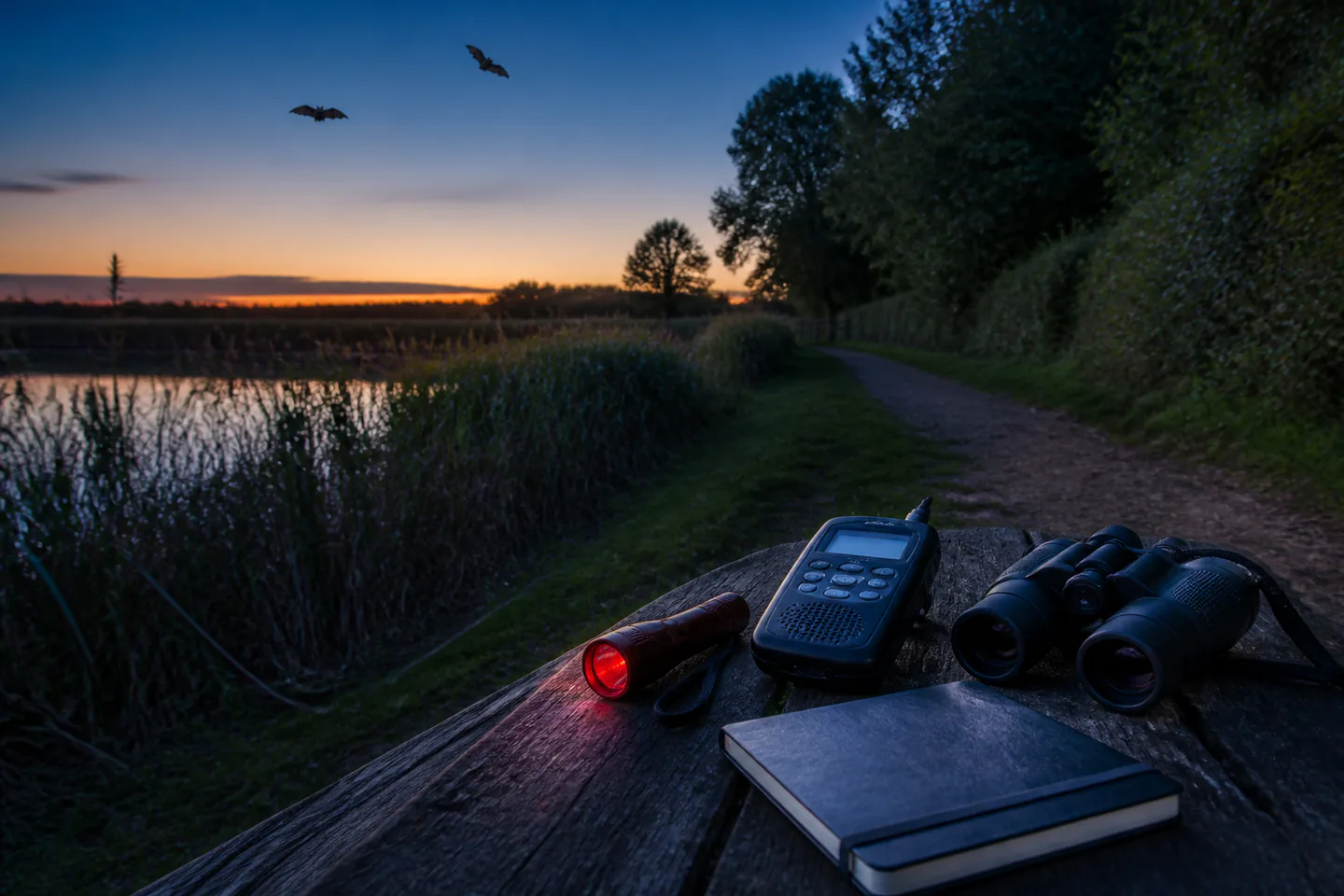
A dusk walk can reveal bat activity through silhouettes, flight behaviour and a heterodyne detector without approaching roosts or treating one frequency as certain identification.
Quick answer
Complete one dusk watch before expanding the setup
Join a Bat Conservation Trust or local bat-group walk first. Arrive before sunset on a familiar lawful route, watch open sky and habitat edges from the path, record time, weather, habitat and flight behaviour, use a borrowed heterodyne detector at the leader’s suggested frequency and log uncertain activity rather than searching for roost entrances or following bats off route.
- 01
All UK bats and their roosts are legally protected; ordinary watching must avoid capture, obstruction and disturbance. Record what happened during bat watching so the next attempt changes one known variable instead of several guesses.
- 02
A heterodyne frequency is one clue and several species overlap, so visual behaviour and habitat matter. Record what happened during bat watching so the next attempt changes one known variable instead of several guesses.
- 03
Bats may use a roost even when they are not visible, and approaching or lighting an entrance can alter behaviour. Record what happened during bat watching so the next attempt changes one known variable instead of several guesses.
- 04
A safe return route and awareness of water, traffic and darkness are part of every dusk record. Record what happened during bat watching so the next attempt changes one known variable instead of several guesses.
What to expect
What bat watching is really like at the start
The useful beginner controls are preparation, one bounded task and a record of the result; specialist equipment matters only when it solves a repeated limitation.
Dusk
Low contrast makes size and colour unreliable while silhouettes and flight pattern remain useful. Record what happened during bat watching so the next attempt changes one known variable instead of several guesses.
Detector
Tuning changes what becomes audible and can miss calls outside the selected band. Record what happened during bat watching so the next attempt changes one known variable instead of several guesses.
Species
Confident identification often needs full-spectrum recording and expert analysis beyond a casual walk. Record what happened during bat watching so the next attempt changes one known variable instead of several guesses.
Weather
Temperature, wind, rain and insect activity strongly affect what is detected. Record what happened during bat watching so the next attempt changes one known variable instead of several guesses.
Core method
The core bat watching method
Choose a non-invasive site
Use a public path with safe footing and do not target a known roost entrance without appropriate expertise. Record what happened during bat watching so the next attempt changes one known variable instead of several guesses.
Record context first
Note sunset, time, temperature, wind, cloud, habitat and observer position. Record what happened during bat watching so the next attempt changes one known variable instead of several guesses.
Combine clues
Listen across suitable frequencies while observing height, rhythm, direction and feeding behaviour. Record what happened during bat watching so the next attempt changes one known variable instead of several guesses.
Submit cautious records
Use activity or species group where evidence is incomplete and follow local recorder guidance for locations. Record what happened during bat watching so the next attempt changes one known variable instead of several guesses.
Useful products
Products with a clear job in the route
The notebook records context, the red torch supports low-level task light and headphones can monitor a compatible recorder later; borrow a detector before choosing heterodyne or full-spectrum equipment.
Silvine A5 Executive Dotted Hardback Notebook
A durable small notebook is quicker to annotate than rebuilding events from memory.
Celestron Night Vision Red LED Flashlight 93588
Low red light helps preserve visual adaptation while sketching or checking equipment.
Audio-Technica ATH-M40x Monitor Headphones
Closed backs are practical while recording and checking a first mix.
First project
Join one guided dusk bat walk
Compare visual passes and detector sounds with an experienced leader while staying on the route.
- 01
Check the event and route
Confirm meeting point, finish time, accessibility, weather policy and required kit. Record what happened during bat watching so the next attempt changes one known variable instead of several guesses.
- 02
Arrive in daylight
Learn the path, hazards and habitat before visibility falls. Record what happened during bat watching so the next attempt changes one known variable instead of several guesses.
- 03
Record conditions
Note sunset, temperature, wind, cloud and start time. Record what happened during bat watching so the next attempt changes one known variable instead of several guesses.
- 04
Watch and listen
Keep light low, remain quiet and compare detector cues with flight. Record what happened during bat watching so the next attempt changes one known variable instead of several guesses.
- 05
Close the record
Log end time, route, activity and uncertainty and leave without approaching roosts. Record what happened during bat watching so the next attempt changes one known variable instead of several guesses.
What can wait
What can wait until the first result
Delay anything that adds cost, risk or another variable before the basic workflow has produced something you can review.
- 01
Searching roof spaces or trees
Roost inspection and disturbance can require licensed expertise. Record what happened during bat watching so the next attempt changes one known variable instead of several guesses.
- 02
Buying a detector immediately
Guided comparison reveals whether real-time or recorded analysis suits the goal. Record what happened during bat watching so the next attempt changes one known variable instead of several guesses.
- 03
Automatic species claims
Software suggestions require call quality, context and expert review. Record what happened during bat watching so the next attempt changes one known variable instead of several guesses.
- 04
Playback or acoustic lures
They can alter behaviour and may require licensing or specialist justification. Record what happened during bat watching so the next attempt changes one known variable instead of several guesses.
Upgrade path
Add the capability you can now name
Each stage should remove a demonstrated constraint rather than make the setup look more advanced.
Use what you own
£0–£20Existing equipment and one written plan
Attend a guided walk without equipment.Repeat the first route
Free guided walk to about £120 detectorA complete repeatable starter setup
Borrow a detector and repeat one public route with context notes.Add one capability
Often £50–£250One selected tool, service or learning resource
Choose heterodyne or full-spectrum equipment for a defined recording goal.Build specialist depth
Club, course or specialist dependentA documented specialist workflow
Join a monitoring scheme and undertake appropriate training and licensing for advanced survey work.Safety & care
Observation must not become disturbance
Bats, roosts and access points are protected whether or not a casual observer can see animals present.
- Stay on lawful paths and do not enter buildings, caves, roofs, trees or fenced land to find bats.
- Do not touch, handle, illuminate, obstruct or crowd a bat or suspected roost entrance.
- Do not use playback, lures, traps or close roost survey methods without current expert guidance and any required licence.
- Plan darkness, water edges, traffic, weather, footwear, communication and a safe return.
- Share sensitive roost locations only with the appropriate bat group or recording scheme.
Outside help
When outside help earns its place
A local bat-group walk is the correct first session because detection, legal protection, route safety and uncertainty are taught in context.
Ask whether detectors are loaned and whether the walk is general observation rather than a roost survey.
Use outside help after the first bat watching attempt can reveal the exact technique, access or safety problem that needs live correction.
Representative UK learning and access routes checked 1 September 2026; local prices, permissions, equipment and tutor support vary.
Sources
Where the guidance came from
Authoritative and specialist guidance supports the method and safety boundaries; community discussion contributes recurring beginner problems rather than unsupported claims.
-
01
GOV.UK · Bats protection and licences
England legal protection, prohibited activities and licensing context.
Open source -
02
GOV.UK · Protected-species survey and filming
Disturbance boundaries, lures, torches and licence requirements.
Open source -
03
Bat Conservation Trust · Buying a bat detector
Heterodyne, full-spectrum and beginner detector trade-offs.
Open source -
04
Bat Conservation Trust · National Bat Monitoring Programme
UK monitoring methods, schemes and data context.
Open source -
05
Bat Conservation Trust · Bat detectors and surveys
Beginner visual surveys and detector-supported routes.
Open source -
06
Reddit · r/batty
Community evidence on detector choice, uncertain identification and bat-walk access.
Open source -
07
Amazon UK · A5 Executive Dotted Hardback Notebook
Exact Amazon UK product page or ISBN used for this recommendation; current price, seller, specification and availability should be confirmed.
Open source -
08
Amazon UK · Night Vision Red LED Flashlight 93588
Exact Amazon UK product page or ISBN used for this recommendation; current price, seller, specification and availability should be confirmed.
Open source -
09
Amazon UK · ATH-M40x Monitor Headphones
Exact Amazon UK product page or ISBN used for this recommendation; current price, seller, specification and availability should be confirmed.
Open source
Guide information and links checked 1 September 2026.