Beginner’s guide · Make & create
Start with one hook.
Learn the fabric.
Pair one metric hook with smooth, light-coloured yarn and make a small flat square. Once the stitches and edges make sense, move to granny squares, shaped pieces, toys or garments with a clear reason for each extra tool.
Quick answer
Use one yarn and one matching hook
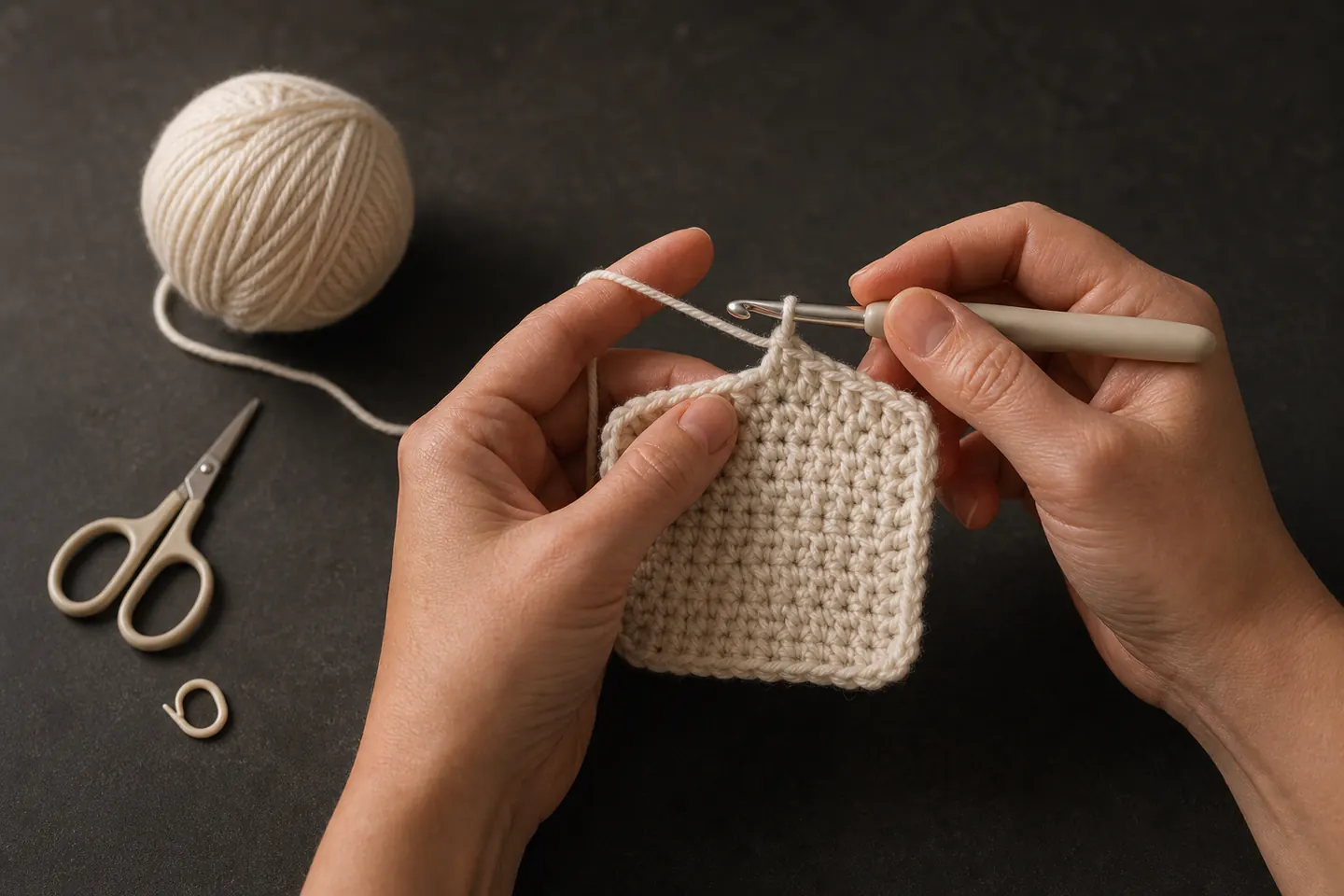
Start with one smooth, light-coloured ball of DK yarn and the metric hook size printed on its label. The checked Amazon route pairs Stylecraft Special DK in Cream with one 4 mm Clover Amour hook. Household scissors and a safety pin or short scrap of contrasting yarn cover the other early jobs.
- 01
Use yarn and hook as a pair. DK is not a promise that every brand behaves identically, so follow the label or pattern rather than buying by yarn name alone.
- 02
Check whether a tutorial uses UK or US crochet terms before the first stitch. UK double crochet is US single crochet; UK treble is US double crochet.
- 03
Learn a slip knot, chain and rows of UK double crochet before choosing a blanket, toy or garment.
- 04
Count every row and mark the first or last stitch. Most early sloping edges come from a missed or added stitch.
What to expect
The first rows feel stranger than they look
Crochet is compact and low-mess, but it is still a repeated hand movement that asks you to control a hook, a working loop and yarn tension at the same time. The first session is usually about making recognisable stitches rather than making them fast.
Grip
Knife and pencil-style grips are both common. Use the one that lets the hook turn without squeezing hard.
Tension
Early chains are often too tight and later stitches too loose. Aim for loops that slide on the shaft of the hook without collapsing.
Counting
The turning edge is easy to miss. Mark it and count the same number of stitches before starting another row.
Undoing
Pulling out a few stitches, often called frogging, is normal and usually faster than hiding a mistake that changes the shape.
Cost
One ball is cheap; blankets, garments and colour-heavy projects can require many balls, plus extra yarn for swatches and joins.
Storage
A hook and one ball fit in a small bag. A growing yarn collection takes more room and needs protection from pets, damp and tangles.
Yarn & hook
Choose a combination you can actually see
Use what you already own
Look for a smooth yarn in a pale or mid-tone solid colour. Read the ball band for its weight, fibre, recommended hook range and care instructions. If you already have the stated metric hook, try a short chain before buying anything. Very dark, fluffy, eyelash, loosely plied or velvet-style yarn can hide the loops you need to identify, so save it for a later project.
The checked one-hook route
Stylecraft Special DK in Cream is a smooth 100% acrylic yarn sold as a 100 g, 295 m ball. Pair it with one 4 mm hook. The exact Amazon pages showed £4.88 for the yarn and £8.02 for the Clover Amour hook when checked, before any delivery charge. That is enough material for repeated practice, several small squares and a first granny-square experiment.
Why the metric size matters
Hook letters and numbers are not fully consistent between systems and manufacturers. A metric size states the hook diameter directly, so “4 mm” is the useful part to match. The size printed on a yarn label is a starting point, not a guarantee of identical fabric in every hand. A larger hook usually opens and loosens the fabric; a smaller hook makes it denser and can make insertion harder. A sized pattern may ask you to change hook after checking tension.
Fibre changes the job
Acrylic is inexpensive, widely available and forgiving for practice. Cotton gives clearer stitch definition and less stretch but can feel firmer in the hands. Wool and blends add warmth, elasticity and different care needs. Choose for the finished object after you can form and count the stitch, rather than buying an expensive fibre to solve a technique problem.
Starter pair
One hook and one ball are enough
Buy these only if you do not already own a smooth light-coloured DK yarn and a matching 4 mm hook. They are a pair, not two competing routes.
Clover Amour Crochet Hook, 4.0 mm
The 4 mm size matches the selected DK yarn and the grip gives a beginner a comfortable, widely recommended starting profile.
Stylecraft Special DK Cream 1005, 100 g
The smooth light solid colour makes the top loops and turning chain easier to identify than dark or novelty yarn.
First square
Make a counted practice square
This small flat piece teaches the parts that later projects reuse: a starting chain, UK double crochet, turning, recognising the first and last stitch, counting, fastening off and deciding whether the fabric feels too tight or loose.
- 01
Set out the basics
Use smooth light-coloured DK yarn, a matching 4 mm hook, household scissors and a safety pin or short piece of contrasting yarn as a marker.
- 02
Make a loose foundation
Tie a slip knot and chain 21. Keep each chain large enough for the hook tip to enter without forcing it.
- 03
Work the first row
Using UK terms, insert the hook into the second chain from the hook. Yarn over, pull up a loop, yarn over again and pull through both loops. Repeat across for 20 UK double crochet stitches.
- 04
Mark and turn
Mark the edge stitch, chain 1 and turn the work. Crochet once into each stitch across. Count 20 before starting the next row.
- 05
Repeat without rushing
Continue until the piece is roughly square. If the count changes, undo to the last correct row and look at the edge before reworking it.
- 06
Finish and keep the evidence
Cut the yarn leaving a tail, pull it fully through the final loop and weave the tail through several stitches with the hook or a blunt yarn needle. Keep the square as a stitch sample, or make a second and join three sides later to practise a simple pouch.
UK & US terms
Check the language before the pattern
Two names can describe the same stitch
Crochet patterns written in English commonly use either UK or US terminology. The names are offset even though the hand movement is the same. A UK double crochet is a US single crochet. A UK half treble is a US half double crochet. A UK treble is a US double crochet. A UK double treble is a US treble.
Do not guess from the website’s country. Check the pattern introduction, abbreviations or video description. If it says “sc”, it is using US terminology because standard UK crochet does not use single crochet as a stitch name.
Read the material line as a system
A useful pattern names the yarn weight or exact yarn, hook size, finished measurements, tension information and the terminology used. For garments and fitted accessories, make the stated tension swatch before committing to several balls. For a decorative square, exact tension may matter less, but consistency still determines whether pieces will join neatly.
Mark repeats on paper or screen
Brackets, asterisks and phrases such as “repeat from *” control which instructions recur. Work one repeat slowly, count its stitches, then continue. A row total is a check, not decoration.
Skip for now
What can wait
Extra tools are useful when a project creates a specific problem. They do not replace seeing the stitch and keeping the count.
- 01
A large hook set
One matching size is enough for the first fabric. Buy another size when a chosen yarn or pattern asks for it, then you will also learn which handle shape you prefer.
- 02
Dark or novelty yarn
Black, fluffy, chenille and highly variegated yarn can hide stitch tops and splits. Use it after you can identify the stitch by touch as well as sight.
- 03
A big blanket quantity
A blanket repeats simple skills but creates a long commitment and a large yarn bill. Make one or two test squares before buying matching dye lots for the full project.
- 04
An amigurumi kit
Toys add tight stitches, working in rounds, increases, decreases, stuffing, assembly and small-part decisions. They are a good second route, not the easiest way to learn a flat edge.
- 05
Blocking mats and a yarn winder
Pins, mats, swifts, bowls and winders solve later shaping and storage jobs. A towel, clean surface and hand-wound ball are enough for early samples.
Next projects
Choose the next skill, not the biggest object
Each route changes the technique as well as the shopping list. Finish a small example of the new construction before buying a project-sized quantity of yarn.
Flat fabric
£0–£5One hook + one ball
Practise chains, rows, straight edges, counting and simple seaming with squares, rectangles, scarves or pouches.Granny squares
£5–£20Two or more colours + yarn needle
Learn chains as spaces, taller stitches, working in rounds, colour changes, joining and weaving multiple ends.Shaped toys
£10–£30+Dense fabric + markers + stuffing
Add a magic ring or chain start, continuous rounds, increases, decreases, assembly and proportion. Child-use and selling safety need separate attention.Garments
£20–£100+Sized pattern + tension swatch + enough matching yarn
Tension, drape, fibre, body measurements and ease become more important than making each stitch in isolation.Useful extra
A small organiser, once it solves a problem
A locking marker becomes useful when you keep losing the first stitch, pause work mid-row or begin pieces worked in the round. A safety pin or contrasting scrap of yarn still performs the same first job for free.
Clover Quick Locking Stitch Markers, Medium
It opens and closes around a stitch, so it can mark an edge or secure the live loop without piercing the yarn.
Safety
Small tools and long strands need a place
Crochet is generally low-risk, but repetitive movement, sharp scissors, loose yarn and the intended user of the finished object all matter.
- Work in shorter sessions while your grip is new. Relax the shoulders and fingers, support the project, and change position rather than crocheting through increasing pain, tingling or numbness. Seek NHS advice if symptoms do not settle or get worse.
- Close or cover scissors and store hooks where children and pets cannot reach them.
- Keep yarn, thread and offcuts away from cats and other pets. PDSA warns that swallowed wool or string can cause a serious gut blockage; contact a vet promptly if ingestion is suspected.
- Follow the fibre’s care label and the pattern’s intended use. A practice acrylic square is not an oven cloth, pan holder or substitute for a heat-rated item.
- For items intended for babies or young children, assess seams, cords, stuffing and every attached part. A component sold as a safety eye does not remove the need to assess the complete object.
- Selling crocheted objects as children’s toys in Great Britain brings manufacturer duties under toy-safety law, including safety assessment, conformity documentation and appropriate marking. Check current official guidance before offering them for sale.
Groups & classes
When another pair of eyes helps
The first square can be learned at home. A group, yarn shop or short workshop becomes useful when you cannot see where the hook should enter, your edges keep changing despite counting, or you want feedback before starting a fitted project.
UK Hand Knitting and specialist tutorial libraries provide demonstrations of the basic movements. Confirm the terminology and pause at each completed stitch.
Useful for seeing several ways to hold yarn and getting quick help with a dropped edge, pattern repeat or join. UK Hand Knitting maintains a searchable group directory.
A short in-person class can correct grip, tension and stitch placement early. Check whether the fee includes hook, yarn and a printed pattern before booking.
UK Hand Knitting learning, group and workshop listings checked 27 July 2026; dates, venues, materials and prices change.
Sources
See what shaped the advice.
Follow the evidence.
Crochet standards, UK terminology guides, manufacturer specifications, health and product-safety guidance, current UK product pages and recurring beginner experience were checked for this guide.
-
01
Craft Yarn Council · Standard Yarn Weight System
Standard yarn-weight categories, common yarn names and suggested metric crochet-hook ranges
Open source -
02
Craft Yarn Council · Hooks & Needles
Metric crochet-hook sizes and the variation between letter and number systems
Open source -
03
Craft Yarn Council · FAQs
Why metric sizing is used and why yarns in the same weight category are not automatically interchangeable
Open source -
04
LoveCrafts · Crochet terms: UK vs US
UK and US stitch-name equivalents, including UK double crochet versus US single crochet
Open source -
05
LoveCrafts · How to crochet for beginners
Beginner sequence covering hook and yarn, slip knot, chain, UK double crochet, treble and fastening off
Open source -
06
LoveCrafts · How to double crochet
Step sequence and terminology for UK double crochet, called single crochet in US terms
Open source -
07
UK Hand Knitting · Learn to knit and crochet
UK learning routes including videos and workshops
Open source -
08
UK Hand Knitting · Knitting and crochet groups
Searchable directory and practical role of local knitting and crochet groups
Open source -
09
UK Hand Knitting · Workshops
Current UK workshop directory used to qualify availability, dates and variable course details
Open source -
10
Stylecraft · Special DK
Manufacturer specifications for Special DK, including 100 g ball, 295 m length and 4 mm sizing information
Open source -
11
Clover · Amour Crochet Hook 4.0 mm
Official Art No. 1045 specifications and claims for smooth stitch handling, soft non-slip material and shaped grip
Open source -
12
NHS · Repetitive strain injury
Symptoms linked with repeated movement, initial activity reduction and advice to seek help when symptoms persist or worsen
Open source -
13
PDSA · Exercising your cat
Veterinary warning that swallowed wool, string, thread or twine can cause serious gut blockage
Open source -
14
GOV.UK · Toys (Safety) Regulations 2011: Great Britain
Current official guidance on safety, assessment, documentation and marking duties for businesses placing toys on the GB market
Open source -
15
r/crochet · Best yarn for absolute beginners
One of several community discussions repeatedly favouring smooth, visible yarn over fuzzy or slippery yarn for first stitches
Open source -
16
r/crochet · Yarn and colour tips for beginners
Recurring advice to use a light or bright solid colour so stitch structure is easier to see
Open source -
17
r/crochet · Common hook sizes
Community experience showing that 4 mm is common with some DK yarns but hook choice follows yarn, pattern and personal tension
Open source -
18
r/crochet · Are Clover Amour hooks worth it?
Mixed experienced-user reports on grip comfort and glide, supporting a one-hook trial rather than assuming one profile suits everyone
Open source -
19
Amazon UK · Clover Amour 4 mm hook
Exact 4.0 mm Clover hook, current seller, £8.02 observed price and in-stock status.
Open source -
20
Amazon UK · Stylecraft Special DK Cream 1005
Exact 100 g Cream 1005 yarn ball, £4.88 observed price and current availability.
Open source -
21
Amazon UK · Clover medium locking stitch markers
Exact medium marker pack, £7.11 observed price and current availability.
Open source
Guide information and links checked 27 July 2026.