Beginner’s guide · Grow & care
Grow leaves before fruit.
Control one small reservoir.
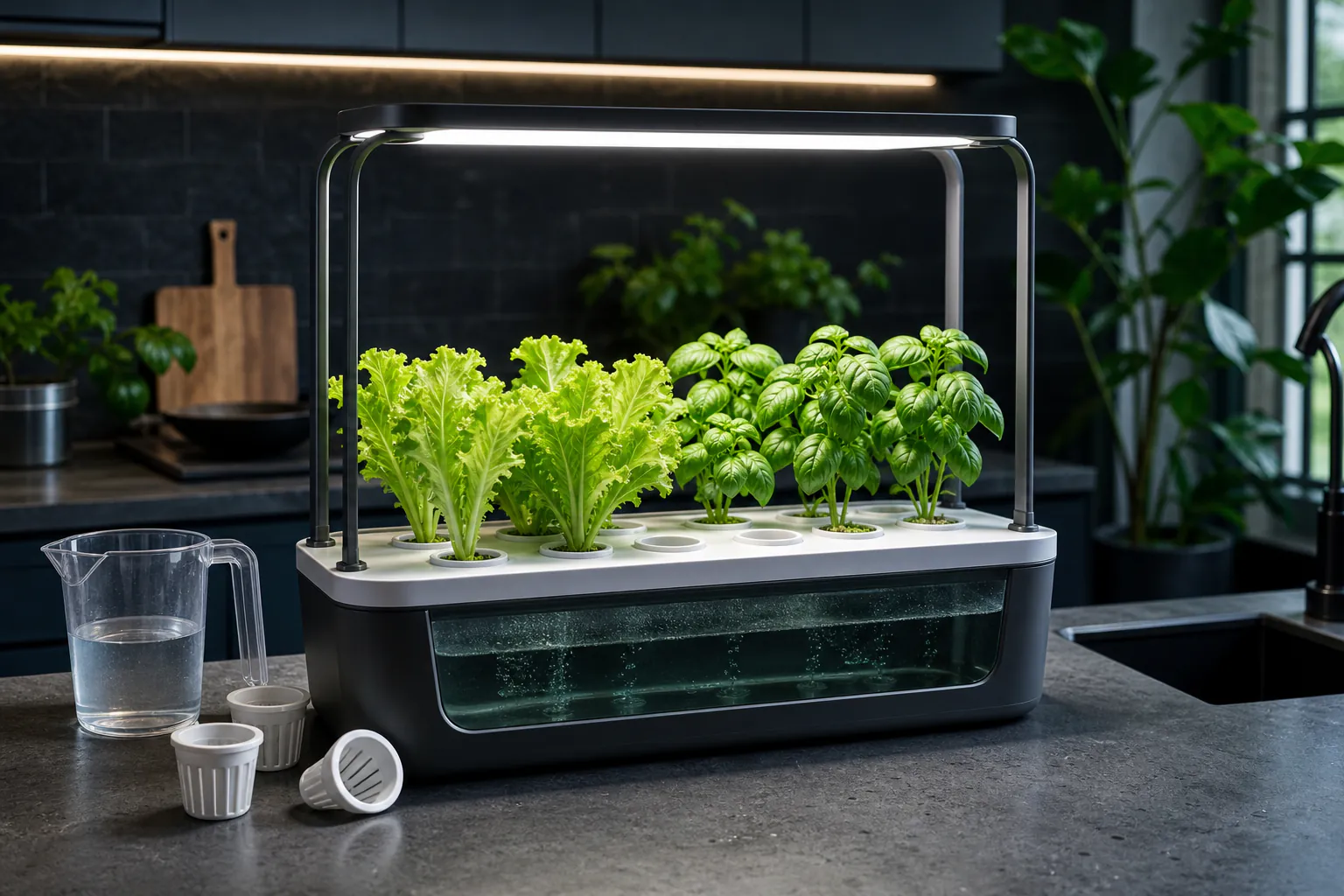
Use a countertop system to grow lettuce or basil under its built-in light. Learn water level, nutrient mixing, root oxygen, cleaning and pH before building buckets or attempting heavy fruiting crops.
Quick answer
Use one integrated system exactly as documented
Start two or three lettuce or basil pods in the iDOO system using untreated edible-crop seed and the supplied or specified nutrients. Keep unused pod holes covered, follow the manufacturer’s fill, mixing and light schedule, top up with clean water and inspect roots and reservoir rather than adding nutrient every time the level drops.
- 01
Leafy crops and herbs stay within the light height and root volume of a countertop system more easily than tomatoes or chillies.
- 02
Mix nutrients into water in the stated order and concentration. Stronger solution can burn roots; it is not faster food.
- 03
Opaque covers and clean equipment reduce algae. Light reaching nutrient water creates the problem even when the plants look healthy.
- 04
Home hydroponic guidance commonly uses mildly acidic nutrient solution, but the exact target and correction method depend on crop and system.
What to expect
Hydroponics removes soil, not plant care
The roots depend directly on the reservoir for water, dissolved minerals and oxygen. Small systems are convenient because they integrate those parts, but they also change quickly.
Germination
A sponge should stay moist and airy, not submerged above the seed. Domes come off after emergence as the system directs.
Light
The fixture must remain close enough for seedlings and high enough not to scorch leaves; competing crops create shade.
Nutrients
Water use and nutrient use are not equal. Repeatedly topping with full-strength solution can concentrate salts.
pH
Incorrect pH can make present nutrients unavailable. Cheap uncalibrated meters can create as much confusion as no test.
Roots
Healthy roots need oxygen and moderate temperature. Brown smell, slime or pump failure require prompt cleaning and diagnosis.
Harvest
Leaf crops can be cut from the outside while the centre grows. Bolting and bitterness still arrive with heat, age and variety.
System basics
Keep the first reservoir simple and inspectable
Choose crops that fit the machine
Use compact lettuce or basil and leave empty spaces so leaves and roots have room. Do not fill all twelve sites merely because the lid has holes. Fruiting crops outgrow the light height, need more root volume and often require pollination and support.
Follow the nutrient system, not a forum recipe
Use the included A and B nutrient exactly as directed, dissolving and adding components in the specified order. Measure water accurately. Never combine concentrated parts together before dilution unless the manufacturer explicitly instructs it. Keep the solution away from children and pets.
Manage water and light separately
Top up the reservoir to the marked level with suitable water as plants drink, following the maker’s nutrient-refresh schedule. Cover unused holes so light cannot enter. Raise the lamp as plants grow and use its programmed cycle rather than leaving it on continuously.
Clean between crops
Disconnect power, remove roots from the pump and channels, discard spent sponges and clean every wet surface using the system instructions. Rinse thoroughly. A new crop should not inherit algae, decomposing roots or an unknown nutrient concentration from the old one.
Useful products
One complete counter system, its matching refill and a pH meter for a later technical step
The 12-pod iDOO is the first system, though the guide deliberately uses only a few pods. The matching accessory set keeps sponges, baskets and nutrients compatible for a later crop. The Apera PH20 is a more credible future pH tool than disposable wide-range paper, but it requires calibration, storage solution and care.
iDOO ID-IG301 12-Pod Hydroponics Growing System
The combined pump, light, timer and pod deck reduce construction while leaving water and roots visible for learning.
iDOO 12-Pod Replacement Accessory and Nutrient Kit
The matching sponges, baskets and nutrient remove uncertainty when a successful first crop is repeated.
Apera Instruments PH20 Waterproof Pocket pH Tester Kit
A calibratable recognised meter is more defensible than treating broad-range paper as a precise nutrient tool.
First crop
Grow two lettuce plants and one basil
Use seed from a reputable edible-crop supplier and the current iDOO manual for assembly, nutrient quantity, mode and cleaning.
- 01
Wash and assemble
Rinse permitted parts, fit pump and light and place the unit on a stable dry surface near a safe socket.
- 02
Fill with measured water
Use the marked volume and prepare the supplied nutrients in the exact order and dose.
- 03
Sow only three pods
Use two lettuce sites and one basil site with one or two seeds each; cover every unused hole.
- 04
Set germination conditions
Fit domes and use the correct mode until seedlings emerge, then remove covers as directed.
- 05
Thin seedlings
Keep the strongest seedling in each pod before roots and leaves become entangled.
- 06
Maintain water and lamp height
Top up appropriately, inspect roots and keep the light at the documented distance.
- 07
Harvest outside leaves
Use clean scissors and leave the centre of lettuce and basil growth intact for repeat harvests.
- 08
Reset the reservoir
At the system interval or end of crop, disconnect, remove roots and clean rather than endlessly topping up old solution.
What can wait
What can wait until one reservoir remains stable
A countertop unit is useful because it hides some plumbing without hiding the plant signals.
- 01
All twelve growing sites
Crowded leaves shade one another and roots tangle. Use a few pods until mature plant size is understood.
- 02
The replacement accessory pack
Buy it when the included consumables have been used and the system is worth repeating, not as duplicate stock on day one.
- 03
The Apera pH meter
Integrated systems can first be run to their manual. Add a maintained meter when recurring deficiency or source water makes pH a real question.
- 04
Tomatoes and chillies
They need greater height, light, support, root volume and pollination. A countertop herb machine can germinate them without being a good finishing system.
- 05
DIY deep-water buckets
They add air pumps, leaks, nutrient calculation, temperature and electrical routing. Learn one small reservoir first.
Upgrade path
Increase control before increasing water volume
The next equipment should measure or stabilise a variable that has already caused a repeat problem.
Countertop leaves
About £80–£110Integrated light, pump, reservoir and supplied nutrients
Learn seed, root and reservoir care with limited plumbing.Repeat crops
About £20–£45 per refill cycleCompatible sponges, baskets, nutrients and chosen seed
Record yield and cost while keeping the hardware.Measured solution
About £60–£150Calibrated pH meter, storage solution and EC meter if needed
Diagnose nutrient availability and concentration instead of guessing.DIY larger system
£150–£600+Opaque reservoir, aeration or circulation, lights, meters and leak control
Grow more or larger crops while taking on water, electrical and nutrient engineering.Food & electrical safety
Keep nutrient water away from people, pets and electricity
A clean small system is manageable; contamination, spills and concentrated chemicals are not cosmetic issues.
- Use untreated seed intended for edible growing, clean hands and equipment, and wash produce before eating.
- Keep concentrated nutrients labelled, closed and out of reach; follow the safety and dilution instructions exactly.
- Place the system on a stable waterproof surface with dry cable loops and a suitable protected socket; unplug before wet maintenance.
- Discard crops and clean the system if water becomes foul, roots become extensively slimy or contamination is suspected.
- Do not release nutrient solution, plants or root material into natural water bodies; dispose according to product and local guidance.
Outside help
When technical advice helps
A countertop garden should not require a class. Specialist help becomes useful when moving to mixed nutrients, EC targets, larger reservoirs or fruiting crops.
Use crop and pH guidance to understand the system rather than replacing its manual.
Choose a session that measures pH and EC and covers cleaning, crop choice and electrical safety.
Free extension guidance and representative UK workshop pricing checked 31 July 2026; course equipment and crop focus vary.
Sources
Where the guidance came from
University extension guidance establishes crop, pH and nutrient principles; manufacturer-compatible products keep the first reservoir bounded.
-
01
University of New Hampshire Extension · Hydroponics at home
Home hydroponic crops, light, nutrients, water quality and representative pH guidance.
Open source -
02
Oklahoma State University Extension · Hydroponics
System types, nutrient solution, aeration and crop-management fundamentals.
Open source -
03
Royal Horticultural Society · Hydroponics
Home-growing overview and practical limits of soil-free systems.
Open source -
04
Amazon UK · iDOO ID-IG301 12-pod hydroponic system
Exact product page, model or ISBN, observed price and availability checked for this guide.
Open source -
05
Amazon UK · iDOO 12-pod replacement accessories and nutrient
Exact product page, model or ISBN, observed price and availability checked for this guide.
Open source -
06
Amazon UK · Apera Instruments PH20 pH tester
Exact product page, model or ISBN, observed price and availability checked for this guide.
Open source
Guide information and links checked 31 July 2026.